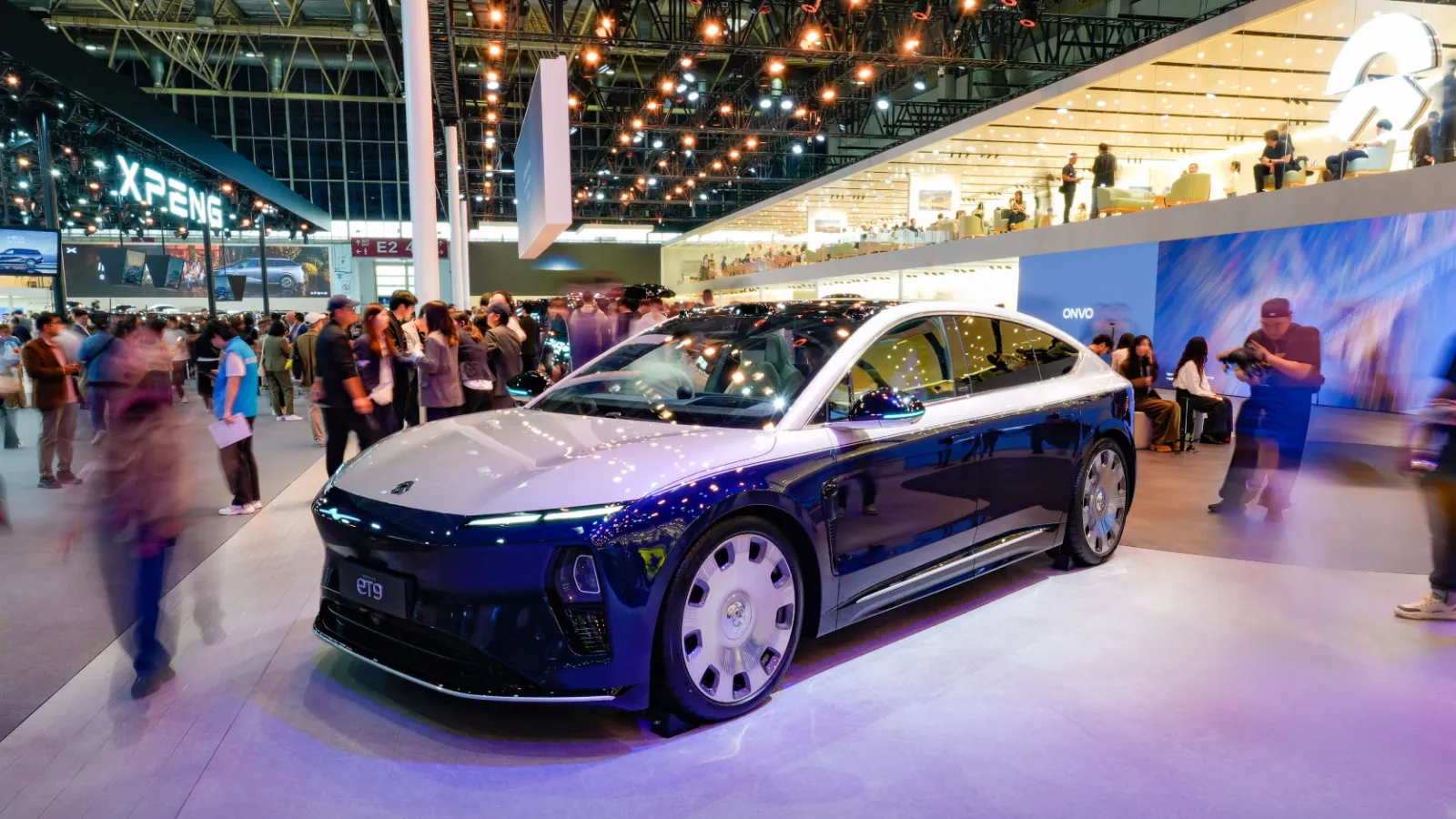
Nio‘s U.S.-listed shares fell to their lowest since April 2020 on Friday, extending a slide of more than 42% this year as the Chinese EV maker heads into the year-end with deliveries falling, its 2026 growth target out of reach and no date yet for its third-quarter results.
Friday’s drop came as Chinese carmakers sold off in Hong Kong. XPeng fell 5.1%, Li Auto 4.8% and BYD 3.8% there, while the benchmark Hang Seng Index lost 1.5%.
The American depositary shares (ADS) fell as much as 4.6% to $2.91 in New York trading, matching their intraday low of April 24, 2020. They had last traded lower on April 15, 2020.
Nio’s Hong Kong-listed shares closed 5.4% lower at HK$23.32 ($2.97) on Friday, their lowest close since the company began trading in Hong Kong in March 2022.
The ADS are down 42.5% this year from their 2025 closing price of $5.10, 57.4% below their 52-week closing high of $6.87 on April 16, and 95.3% below their record close of $62.84 in February 2021.
At $2.93, the 2,505,667,022 shares Nio reported outstanding by the end of March are worth about $7.3 billion.
A Growth Target Out of Reach
Founder and CEO William Li said on the fourth-quarter 2025 earnings call in March that the company was “very confident” of achieving 40% to 50% delivery growth for the full year, from 326,028 vehicles in 2025.
By the September 1 call, he framed the range differently. “We expect our annual volume growth to be around 40% to 50%, and we will maintain that for the mid and long term,” Li said.
Nio Inc. has delivered 334,547 vehicles in the first 10 months of 2026, up 38.5% from a year earlier. Reaching 40% growth would require 456,439 deliveries for the year, or about 121,900 in November and December, an average of about 60,900 a month.
The company’s monthly record is 48,135, set in December 2025. Its best month this year was June, at 40,597, and it has never delivered more than 40,000 vehicles in two consecutive months. The 50% upper end would require about 77,200 a month.
October Falls Short
Nio Inc. delivered 34,246 vehicles in October, down 15.2% from a year earlier and its first year-on-year decline since February 2024. It was also down 8.5% from September and the group’s lowest monthly total since April.
The October total fell about 5,750 short of the 40,000 monthly average Li set for the quarter. To reach that average, the company would need about 85,750 deliveries in November and December combined, or about 42,900 a month.
The premium Nio brand delivered 18,125 vehicles, its lowest since February. Onvo’s deliveries fell for a fifth straight month, down 51.7% from a year earlier to 8,383, while the small-car brand Firefly set a record of 7,738.
Onvo accounted for all of the decline. Group deliveries were 6,151 lower than a year earlier, while Onvo alone delivered 8,959 fewer, falling to 8,383 from 17,342.
The Nio brand rose by 982 to 18,125 and the small-car brand Firefly by 1,826 to 7,738, so without Onvo the group would have grown.
The ES9 flagship SUV reached its 40,000th delivery this week, but the latest 10,000 units took 49 days, the longest stretch since its launch in May. CPCA data show the ES9 sold 6,690 units at retail in October and the ES8 8,735, its lowest of the year. Together they made up 85.5% of the Nio brand’s retail sales.
The wider market gave little support. Retail passenger car sales in China fell 27.1% from a year earlier to 1.64 million in October, according to the China Passenger Car Association (CPCA).
Analysts Question the Outlook
Analysts turned more cautious after the second-quarter results on September 1. Within four days, six firms cut their targets or ratings on the stock, according to Price Target.
Price Target, a sister publication of EV, archives Wall Street analysts’ research on the electric vehicle, artificial intelligence and semiconductor sectors.
JPMorgan’s Nick Lai downgraded the ADS to ‘Neutral’ from ‘Overweight’ with a $4.50 target. Freedom Broker’s Dmitriy Pozdnyakov cut the stock to ‘Hold’ from ‘Buy’, lowering his target to $4 from $7, saying third-quarter guidance below expectations “may point to slower growth” in the second half.
Goldman Sachs’ Tina Hou cut her target to $6.10 from $7, keeping a ‘Buy’ rating. She said the third-quarter outlook fell short “mainly due to ongoing weak domestic market demand as well as relatively lower recognition of its Onvo brand.”
Citi’s Jeff Chung lowered his target to $7.10 from $8.20, keeping a ‘Buy’ rating. Bernstein’s Eunice Lee cut hers to $5 from $6 with a ‘Market Perform’ rating, titling her note “The launch treadmill” and writing that growth “awaits earnings leverage.”
Macquarie’s Eugene Hsiao lowered his Hong Kong target to HK$45 ($5.74) from HK$55, keeping an ‘Outperform’ rating.
Some remained positive. UBS’ Paul Gong started coverage of the Hong Kong shares at ‘Buy’ with a HK$43 ($5.48) target on September 11, saying Nio had beaten expectations on profitability “despite a muted share price performance” and pointing to refreshed ES6 and ET5 models in 2027.
Morgan Stanley’s Tim Hsiao raised his target to HK$68.50 ($8.73) on September 15, keeping an ‘Overweight’ rating.
Lai cut his target again on October 26, to $3.70 from $4.50, keeping the ‘Neutral’ rating. The shares now trade about 21% below that target.
CLSA’s Ding Luo cut his target on the Hong Kong shares to HK$29 ($3.70) from HK$55 on October 23, keeping an ‘Outperform’ rating. Friday’s close is about 20% below it.
Price Target lists five current targets on the ADS, from $3.70 to $7.10, with a median of $5.
The cuts extend a five-year retreat that has tracked the share price. Lai raised his target to a Street-high $75 from $50 on January 11, 2021, the day the ADS hit their intraday record of $66.99. His current $3.70 is 95.1% lower.
Citi’s Chung set a Street-high $87 on November 11, 2021, and his $7.10 is 91.8% below that. Morgan Stanley’s Tim Hsiao, who raised his target to $80 from $33 on January 28, 2021, had cut it to $7 by January this year. He raised his Hong Kong target to HK$68.50 ($8.70) from HK$58 on September 15, keeping an ‘Overweight’ rating.
BofA Securities’ Ming Hsun Lee had a $63 target in April 2021. He now rates the stock ‘Neutral’ with a $6.80 target, 89.2% lower.
Large holders were split in the third quarter. JPMorgan Chase nearly exited its Nio stake, cutting it by 97.7% to 62,998 ADS, and Renaissance Technologies cut its holding by 60.9% to 6,313,800, while UBS nearly doubled its stake to 36,586,129 ADS, their filings show.
Onvo’s Rapid Fade
The sharpest drop has come at Onvo, Nio’s mass-market family brand. Its October deliveries of 8,383 were its fifth straight monthly decline and left its three-SUV lineup only 645 units ahead of Firefly, which sells a single small hatchback, according to company figures.
Onvo peaked this year at 12,029 in May, when its L80 and refreshed L90 reached customers, and has fallen every month since. It made up 24.5% of group deliveries in October, against 42.9% a year earlier, when it outsold the Nio brand itself.
The slide has come despite changes at the top. Shen Fei, a longtime Nio executive and former Vice President of its battery-swap unit, replaced Alan Ai as Onvo’s head in April 2025, after Ai missed sales targets.
Onvo’s Vice President of Global Design, Raul Pires, left for Ford in February. Juliano Vilas Boas now leads day-to-day design, and Senior Vice President of Design Kris Tomasson took over brand-level oversight of Onvo in April.
Onvo relaunched its L60 SUV in June at a lower starting price of 192,800 yuan ($28,900). “Supply-chain prices really have risen too much now. The Onvo L60 still has gross margin, but it’s pretty dire,” Li told the Economic Observer.
“To be honest, Onvo still hasn’t done well enough,” President Qin Lihong said in September, a day after Morgan Stanley’s Tim Hsiao told Li on the earnings call that Onvo’s momentum had been “routinely moderated” since launch.
Nio has said Onvo will get a new strategic model in 2027, and its European launch has slipped to 2028 or 2029, from the 2027 date Li gave in November 2025.
No New Model for the Rest of the Year
Nio has not announced an all-new model for the rest of 2026 after launching the ES9 and the Onvo L80 in May. It has relied instead on special editions and design packages for existing models, including a second ES8 special edition planned for the Guangzhou auto show on November 27.
“For the NIO brand, for next year, we will be introducing new products coming from the 5 and 6 series product lines,” Li said on the September 1 call, referring to the ES6, EC6, ET5 and ET5 Touring.
Nio will hold a technology event in Guangzhou on November 25 focused on AI cockpit and assisted-driving products, followed by its annual Nio Day in Wuhan in December.
Little Help From Abroad
Nio has not been able to lean on exports as many Chinese rivals have. BYD sold 169,564 vehicles abroad in October, up 103%, it said. Exports made up 35% of Chinese carmakers’ passenger vehicle sales in October, according to the China Passenger Car Association, against 19% a year earlier.
Nio Inc. exported 1,141 vehicles in the first 10 months, equal to 0.34% of its deliveries, according to data from Chinese auto portal Yiche compiled by EV. Co-Founder and President Qin Lihong said in March the company expected to deliver “several thousand units” outside China this year.
Zeekr, the Geely-owned premium brand that competes with Nio, delivered 32,483 vehicles in October, up 51.6%, and passed its 300,000-unit annual target with two months to spare, the company said. It said its European deliveries had risen 200% this year in 22 countries.
Retreat in Europe
Nio registered no new cars in Germany in October, its first month without a registration there since at least January 2023, according to the Federal Motor Transport Authority (KBA). It has registered 20 in Germany this year, down 91.2%, against 47,961 for BYD and 8,403 for XPeng.
Across eight European markets, Nio Inc. registered 171 vehicles in October, down 28.2% from September, with Denmark its largest market.
The company moved European sales to distributors in a restructuring EV reported exclusively in March, and told European staff there would be no model updates until late 2027.
It has since closed its Hamburg flagship showroom on July 20 and shut two of its three German sales and service hubs, in Cologne and Weiterstadt, at the end of September. Nio also held talks with Xiaomi over its remaining hub in Munich, a source told EV.
It did open a battery swap station near Kassel on October 26, its first new European station in more than 13 months.
In Portugal, where registrations fell to eight in October from 58 in September, its distributor is offering the ET5 to business buyers at about a quarter below its launch price.
Nio released a European software update on Thursday, 199 days after the previous one. Its China-built cars face a combined 30.7% tariff in the European Union.
Executive Vice President Mark Zhou, Chairman of Nio’s Product Committee, said in February that the company’s early success in Norway had not carried over to the rest of the European Union.
“A lot of our vehicles are big because they’re more tailored to the Chinese environment. But some of those vehicles do not fit well in the European environment,” he said on IMD business school’s Leaders Unplugged podcast.
“We didn’t anticipate the speed and we didn’t anticipate the total cost of setting it up,” Zhou said of the charging and swapping infrastructure.
Profits Did Not Lift the Stock
The slide has come despite a run of quarterly profits. Nio reported a third straight quarter of adjusted operating profit in the second quarter, at 206.9 million yuan ($31.0 million), on revenue of 32.14 billion yuan ($4.82 billion), up 69.1%.
Its net loss was 528.0 million yuan ($79.1 million), and adjusted net profit 26.1 million yuan ($3.9 million). Cash and investments stood at 56.7 billion yuan ($8.50 billion) at the end of June, the company said.
Li told staff in February that Nio would strive for full-year profit on a non-GAAP basis in 2026.
In an interview with China Entrepreneur magazine republished by 36Kr, Li said rising prices for memory chips and other components driven by AI data centers had added about 14,000 yuan ($2,100) to the cost of each vehicle in the second quarter compared with the end of 2025. “Now when the volume goes up, the cost may also go up,” he said.
Li has said the market undervalues the company. “Capital-market pricing is just a market price. It reflects how investors view you at a given point in time,” he said at a briefing after the second-quarter results, according to Phoenix Tech, cited by 10jqka. “Our chips, operating system and AI capabilities are definitely undervalued.”
“The only way is to let better operating results speak over time. You can’t win on concepts,” he said.
“Around 2021, Nio’s market value was very high, but Nio today is actually much healthier than it was in 2021,” he told Securities Times in September.
“Don’t focus on the ups and downs of the capital market. In the end, profitability is what matters,” Li said. He added that when hiring this year he had told new employees, who receive shares, that they had chosen well because “the share price is low, so they can get more shares with the same money.”
He also said Nio would not actively cut prices in the second half. “We can’t afford big price changes, and the cost structure doesn’t support them,” he said. EV found no public comments from Li on the share price since September.
CATL Closes In on Swapping
Nio’s lead in battery swapping, the service at the heart of its strategy since 2018, is narrowing. The company had 4,236 swap stations in China on November 3, according to its own count, up 560 from 3,676 at the end of 2025. Nio said on its September 1 call that it still planned to build 1,000 stations this year.
CATL, the world’s largest battery maker, had built more than 2,520 Choco-Swap stations across 200 cities by September 29, CATL said. It began building them only at the start of 2025 and had about 1,020 by the end of that year. It has said it aims to have more than 3,000 by the end of 2026.
At their 2026 pace, CATL has been adding about 167 stations a month against Nio’s roughly 56. If both kept those rates, CATL’s network would overtake Nio’s around the end of 2027, by EV‘s calculation.
The two companies are closely tied. CATL has supplied Nio’s cells since the ES8 entered production in 2018 and provides 93% of the cells Nio sources, according to CATL. It co-founded Nio’s battery-asset company, Wuhan Weineng, in August 2020 and holds about 8.9% of it.
CATL agreed in March 2025 to invest up to 2.5 billion yuan ($374.8 million) in NIO Power, Nio’s battery-swapping unit, and to bring its Choco-Swap standard to Firefly. Nio has not announced that the investment was completed. In September, Geely Holding Group agreed to take a 30% stake in NIO Power.
Swap Partners Without Swap Cars
Nio began signing up other carmakers for its swap network in November 2023, when Changan Automobile became the first partner. Geely, Chery, JAC, Lotus, GAC, FAW Group and Jidu followed, according to Nio.
Three years on, none of them has launched a mass-produced model that can use Nio’s stations. Exeed, Chery’s premium brand, said in January 2025 that its first compatible models would arrive in the third quarter of that year.
“In the short term, we will not treat whether third-party companies use our battery swap network as a priority. It is not our strategic focus,” Li told a media roundtable on April 29.
Geely Holding has gone furthest, with its Nio Power stake. Even so, the September 28 filing said only that the two companies “have made preliminary plans” to adopt battery swapping for consumer models and commercial mobility.
Several of Nio’s partners have also signed with CATL. GAC joined Nio’s network in May 2024 and agreed a similar deal with CATL about a week later. FAW, Changan, GAC, Chery and BAIC unveiled models for CATL’s Choco-Swap network in April 2025, and Chery signed a new strategic agreement with CATL on April 25 this year.
On April 21, CATL named Changan, Chery, GAC, Seres, SAIC-GM-Wuling and BAIC as the first partners in a shared charging and swapping network. Nio was not on the list.
The next day, CATL’s General Manager of Battery Swap Business, Yang Jun, called Nio “an irreplaceable and important strategic partner” in answer to a question from EV. “Our strategic cooperation in battery swap is to seek parallel dual-network development,” he said.
No Date for Results
Nio has not announced when it will report third-quarter results, according to its investor relations website. It reported the same quarter of 2025 on November 25 last year, after announcing the date on November 12.
In four of the past five years, Nio announced its third-quarter date by November 12. It gave notice on November 7, 2024 and reported on November 20, and it reported on November 10 in 2022 and November 9 in 2021. The exception was 2023, when it announced the date on November 21 and reported on December 5.
Nio gives a delivery forecast for the current quarter each time it reports quarterly results. With its second-quarter figures on September 1, it guided third-quarter deliveries of 108,000 to 111,000, and it delivered 109,178.
Its third-quarter report will therefore carry the first official fourth-quarter outlook. Nio delivered 300,301 vehicles in the first nine months, so reaching 40% growth for the year would take 156,138 deliveries in the fourth quarter, and 50% would take 188,741. The guidance will show whether the company still expects to come close.
Li told analysts on the second-quarter call that Nio’s target for the fourth quarter was “achieving an average volume of over 40,000 units per month.” That implies more than 120,000 deliveries in the quarter, of which October contributed 34,246.