
CATL called Nio “an irreplaceable and important strategic partner” on Wednesday morning while reaffirming that the world’s largest battery maker and the pioneer of large scale battery swapping are working together to create a national battery swap standard in China.
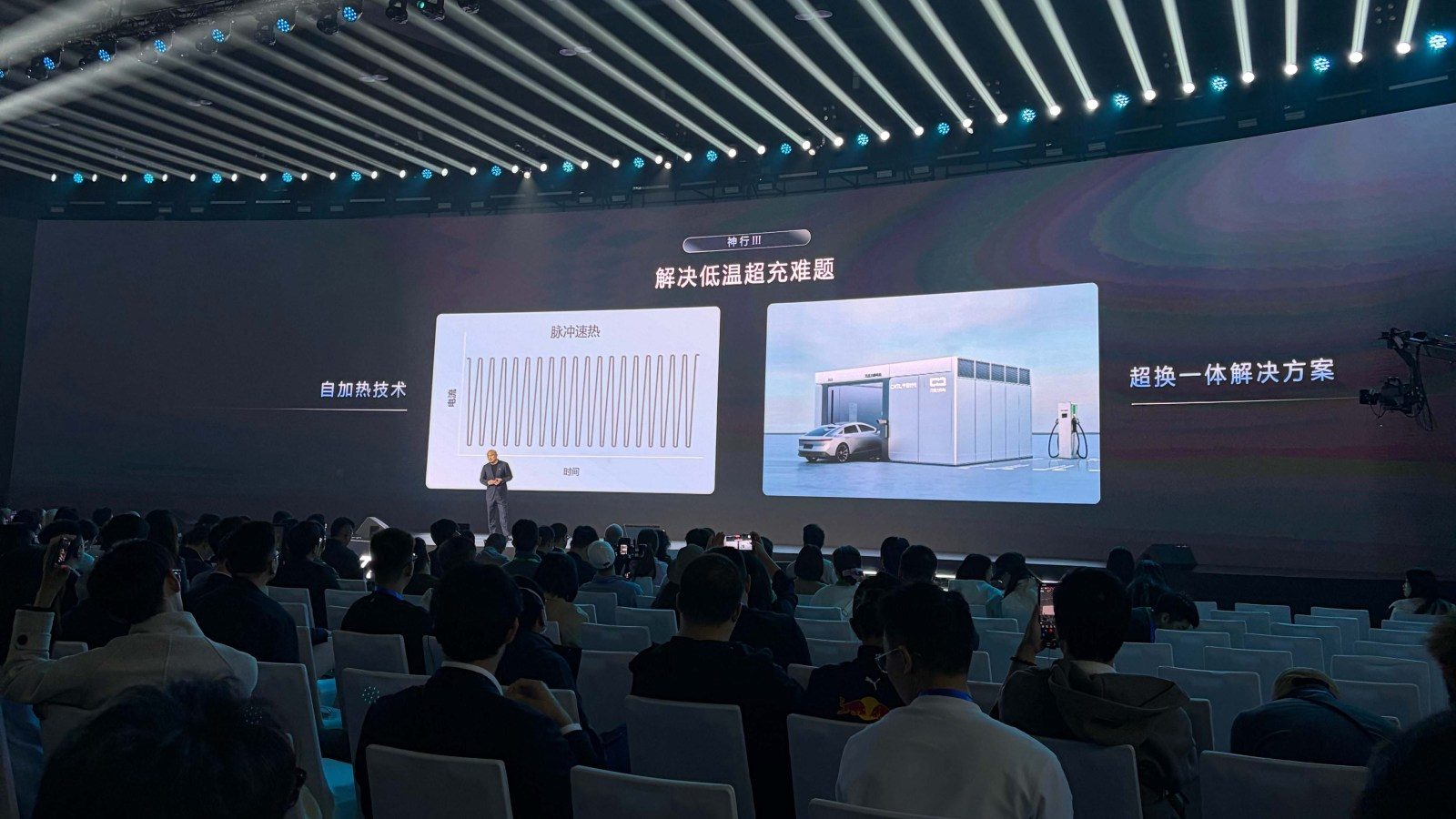
The comments were made at a media roundtable in Beijing, the day after CATL unveiled an integrated charge-and-swap network targeting more than 100,000 shared stations by the end of 2028.
CATL‘s General Manager of Battery Swap Business, Yang Jun, was questioned by EV on the increasingly layered relationship between the two companies.
The Web of Connections
The question laid out the full web of ties between the two companies, which Yang acknowledged had grown increasingly complex.
CATL has been Nio‘s primary battery cell supplier since the first mass produced model of the premium brand — the Nio ES8 — entered production in 2018.
Currently, and according to CATL, 93% of the battery cells sourced by Nio come from the Ningde-headquartered battery giant.
CATL holds approximately 8.9% of Wuhan Weineng Battery Asset Co. — Nio‘s battery asset operator, known internationally as Mirattery — which it co-founded in August 2020 alongside Nio, Guotai Junan International and Hubei Science and Technology Investment.
In March 2025, CATL agreed to invest up to 2.5 billion yuan ($346 million) directly into Nio Power — Nio‘s energy and battery-swap business — with the goal of building “the world’s most advanced battery swap network for passenger vehicles” based on unified standards.
The two companies have also set up two joint ventures for battery technology — Weineng (Shanghai) Battery Technology, jointly held by Nio and CATL, whose registered capital was increased from 500 million to 1.5 billion yuan in May 2025, and Weineng (Wuhan) Battery Technology, established in late 2025 with 100 million yuan in registered capital focused on battery leasing, recycling and cascade utilisation.
Last January, Nio founder and CEO William Li and CATL Chairman Robin Zeng met in Hefei and signed a five-year strategic cooperation agreement covering technology, ecosystem and market.
The partnership most recently extended into Onvo, with CATL in late 2025 taking over supply of 100 kWh packs for the sub-brand after Nio halted cooperation with BYD‘s FinDreams Battery unit for the L60, according to 36Kr.
‘Irreplaceable Strategic Partner’
“Nio is an irreplaceable and important strategic partner for us,” Yang said in response to an EV question focused on the highly complex relationship between the two companies.
“Our strategic cooperation in battery swap is to seek parallel dual-network development, ultimately to provide resources for consumers,” CATL‘s executive said before affirming that “the most important issue we need to solve between us is standardisation.”
“As you all know, charging has a national standard, but battery swap and charging still don’t. So we have reached this consensus: we will jointly promote a national standard for battery swap in China,” Yang stated. “Ultimately, this is so that consumers don’t have to make difficult choices.”
The division chief added that on the battery swap track, “there aren’t that many players, but the underlying understanding among players is easier to reach consensus on” — a signal that CATL views Nio as a technical ally rather than a rival as new Chinese automakers weigh swap adoption.
The comments came after Nio was absent from the six-automaker partner list CATL announced on Tuesday for its Choco-Swap sharing network, which includes Changan, Chery, GAC, Seres, SAIC-GM-Wuling, and BAIC.
GAC announced in May 2024 that it would become a battery swap partner of Nio‘s network.
A week later, it signed a similar agreement with CATL.
Parallel Dual-Network
Yang’s use of the phrase “parallel dual-network development” marks the clearest public description CATL has given of how its own swap network will coexist with Nio‘s.
The two networks currently operate on different architectures: Nio‘s Power Swap stations serve the Nio, Onvo and Firefly brands, while CATL‘s Choco-Swap stations are designed for multi-automaker deployment with the Choco-Swap #26 battery launched at Super Tech Day using 800-volt architecture.
Nio‘s network had reached 3,172 Power Swap stations at the time of the March 2025 CATL investment and has since expanded to more than 3,700, making it the world’s largest passenger-vehicle swap network.
CATL‘s Choco-Swap network currently comprises 1,470 stations across 99 cities, with the company targeting 4,000 integrated charge-swap stations by the year end and more than 100,000 shared stations by the end of 2028 alongside the six announced partner automakers.
Yang’s commitment to “parallel dual-network development” implies the two systems will continue to coexist rather than merge, with cross-compatibility to be achieved through the joint national standard rather than shared hardware.
The Standardisation Question
China has national standards for EV charging connectors and communication protocols, but no equivalent national standard for battery swap — meaning swap-compatible batteries are tied to specific vehicle manufacturers and cannot be exchanged across brands.
A unified national swap standard would address this by defining common pack dimensions, electrical interfaces, and communication protocols, potentially allowing vehicles from different brands to swap batteries at any compatible station.
Yang’s comment that the two companies “have reached this consensus” suggests that progress on the joint standard has moved beyond the preliminary discussions flagged at the March 2025 signing.
The original March 2025 cooperation agreement had already committed the two companies to “jointly advance the establishment of national battery swap standards to achieve cross-brand and cross-model battery compatibility.”
A second CATL executive at the same Wednesday roundtable — speaking after Yang — added that charging and swap should not be “pitted against each other.”
“Different consumers have different needs,” the executive said, drawing an analogy with LFP and NCM battery chemistries that CATL Chief Scientist Wu Kai had presented as complementary at Tuesday’s Super Tech Day keynote.
“The world’s diversity is exactly why every individual has their own choice. As long as this kind of utilisation exists, our era will progress.”
The national standard, if implemented, would eventually allow batteries to flow between the two networks — meaning a Nio vehicle could theoretically use a Choco-Swap station, and vice versa.
Yang’s “long-life battery” framing — his observation that swap requires batteries engineered for high cycle counts because a single pack serves multiple vehicles — is also a technical endorsement of Nio‘s choice of CATL cells for its swap fleet.
“Nio‘s choice of CATL batteries as long-life batteries better supports swap product operations,” Yang said.