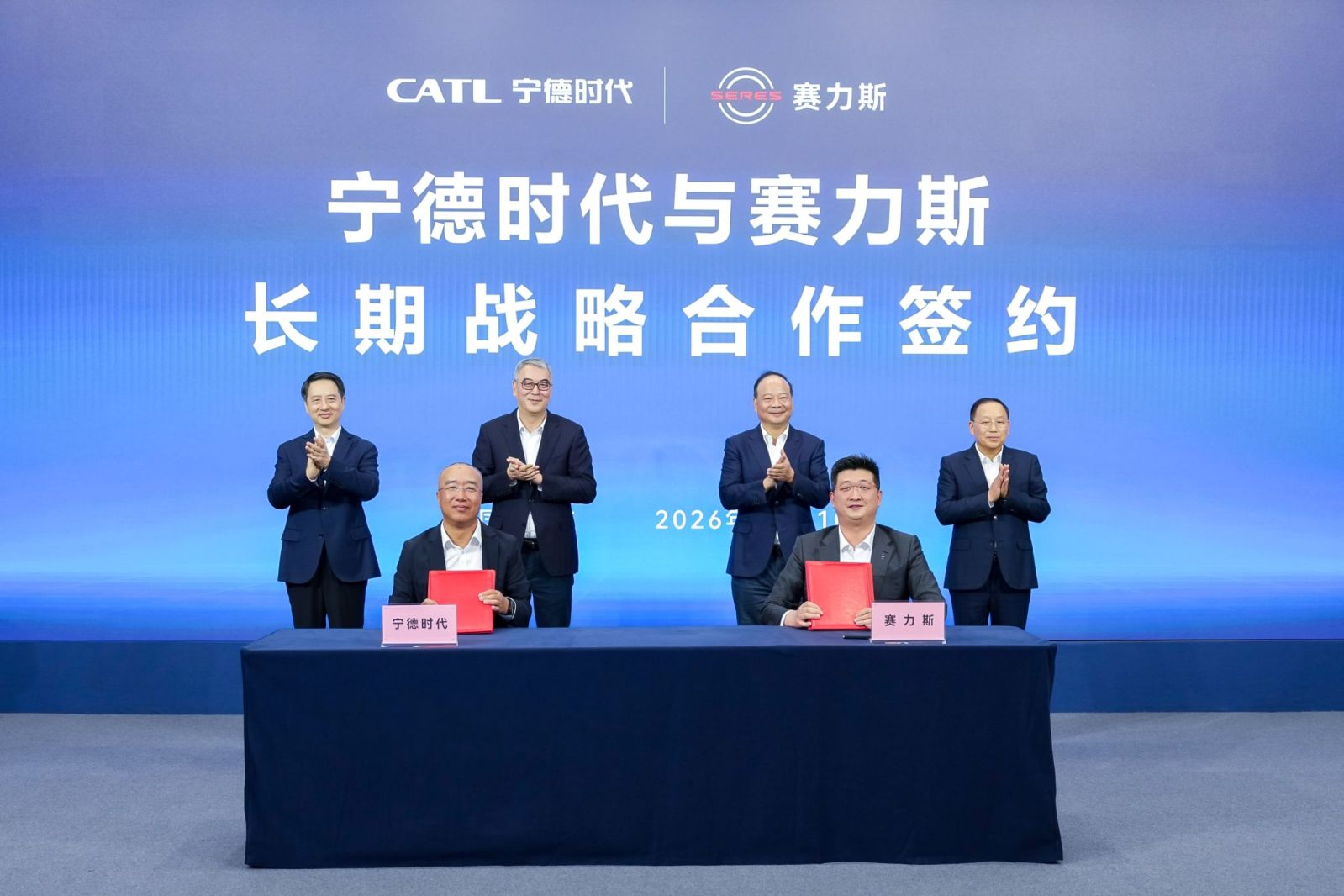
BAIC Group and CATL signed an agreement to deepen their battery-swap partnership, with BAIC committing to connect several of its brands’ models to CATL’s Choco-Swap network and to open its dealerships to the battery giant’s stations.
The Chinese carmaker said that the deal covers vehicle and battery design and development, construction of swap-station networks, battery energy-service products, and new business models.
Across its brands, BAIC targets one million swap-enabled vehicles.
BAIC said the two companies would push for the “specialized integration” of swap assets and faster unification of swap standards. It called the signing “a key step” for China’s swap sector in “standard unification, asset interoperability and resource sharing.”
What BAIC Brings
BAIC will bring compatible models from several of its brands onto CATL’s Choco-Swap system.
It will also open its dealer network. CATL will site swap stations around BAIC dealerships and explore a jointly operated model with BAIC’s dealer teams, according to the statements.
The agreement builds on a three-way deal signed on April 25 by BAIC, CATL and CATL’s swap unit, CAES, during the Beijing auto show.
That agreement said BAIC would add swap versions of the Arcfox T5, S5, T6 and S6, alongside the Arcfox S3 that already offers swapping, and other models from its Beijing brand.
The first product of the partnership is the Arcfox Beta S3, launched on May 22. Its swap version starts at 59,800 yuan ($9,000) with the battery rented at 599 yuan ($90) a month.
The swap version had more than 23,000 pre-orders at launch. The car drew more than 30,000 orders within a month, about 76% of them for the swap version.
BAIC launched a swap version of the Beijing EU8 sedan, aimed at both private and ride-hailing buyers, four days later. It uses CATL’s No. 25 Choco-Swap block and has a range of 535 kilometers, according to Choco-Swap.
BAIC and CATL agreed in June 2024 to cooperate on skateboard chassis and swap-enabled models. CATL’s swap unit, CAES, signed a separate swap framework agreement with both at the time.
BAIC has spent years in China’s swap taxi and ride-hailing market. An Arcfox sedan was among 10 Choco-Swap models that five carmakers unveiled at the Shanghai auto show in April 2025.
CATL’s Swap Bet
CATL launched Choco-Swap at the end of 2024 and has expanded it rapidly since.
The network had more than 2,520 stations in 200 cities across all 31 of China’s provinces at the end of September, up from 1,020 stations in 45 cities at the end of 2025, according to Choco-Swap.
CATL is targeting more than 3,000 stations by the end of this year and 30,000 in the long run.
At its Tech Day in April, CATL set a separate goal of 4,000 combined supercharging and swap stations by the end of 2026.
It also launched a shared charging and swap network with Changan, Chery, GAC, Seres, SAIC-GM-Wuling and BAIC as first partners, targeting more than 100,000 shared facilities by the end of 2028.
The economics remain unproven. Yang Jun, General Manager of CATL’s swap business, said in April that the recharging industry faced major challenges and was loss-making almost across the board, The Paper reported.
The company sells the system on standardization. “Gasoline has No. 92 and No. 95, and Choco-Swap will also use two standard swap blocks, named No. 20 and No. 25,” Zeng has said, comparing the packs to fuel grades.
BAIC joins FAW, Changan, Chery, GAC and Huawei’s Yinwang, which Chinese tech outlet Kuai Keji listed as earlier members of CATL’s swap alliance.
Huawei‘s autonomous-driving unit Yinwang signed with CATL and CAES on Monday. The aim is cars running Huawei’s Qiankun driver-assistance system that can find a swap station, drive in, swap and leave on their own.
Several have shown or launched compatible models. FAW, Changan, GAC, Chery and BAIC unveiled Choco-Swap models in April 2025, and GAC showed a new swap-compatible N60 at this year’s Beijing show.
CATL is also taking the system abroad. It plans to open its first European swap station in Paris as a demonstration site in 2027, as exclusively reported by EV.
Nio’s Swap Alliance
The contrast with Nio, which has been building its swap network since 2018, lies in what has reached the road.
Nio operates the larger network, with 4,189 swap stations in China as of Thursday, according to its website. But its stations still serve only its own three brands, Nio, Onvo and Firefly.
Nio has signed swap framework agreements with eight carmakers since November 2023: Changan, Geely, Lotus, Chery, JAC, GAC, FAW and Jidu, the Geely-Baidu venture.
No vehicle from any of them has been connected to Nio’s network or reached the market.
Four of those signatories, Changan, Chery, GAC and FAW, have since launched or shown models for CATL’s system.
Founder and CEO William Li said in April that third-party use of the network was no longer a priority. “In the short term, we will not treat whether third-party companies use our battery swap network as a priority — it is not our strategic focus,” he said.
Nio’s biggest partner move came last month.
Geely Holding agreed to take a 30% stake in NIO Power on September 28, paying with its commercial-vehicle swap operator Yiyi and 640 million yuan ($95.9 million) in cash, a deal that values the unit at about 16 billion yuan ($2.4 billion).
Nio said Geely would develop consumer battery-swappable models, but named no brand, model or launch year. The deal still requires regulatory approval, and Nio’s filing described the consumer-car element only as preliminary plans subject to further discussion.
Partners and Rivals
Nio and CATL are tied together even as their networks compete. CATL supplies most of Nio’s cells and calls the company an “irreplaceable” strategic partner.
In March 2025, CATL agreed to invest up to 2.5 billion yuan ($374.6 million) in NIO Power, with Firefly models to be adapted to Choco-Swap.
Neither has happened. No completed CATL investment has been announced, CATL did not appear among NIO Power’s shareholders in the Geely filing, and Firefly launched on Nio’s own fifth-generation stations rather than Choco-Swap.
The two networks cannot serve each other’s cars. Nio’s stations take Nio, Onvo and Firefly packs, while CATL’s take the No. 20 and No. 25 Choco-Swap blocks.
Zeng has predicted that by 2030 battery swapping, home charging and public charging will each hold about a third of the market for recharging electric cars.