BYD sold 490,168 new energy vehicles in October, its highest monthly total since December 2024, as sales of fully electric models topped 300,000 for the first time and offset a further slide in plug-in hybrids.
Sales rose 10.97% from 441,706 a year earlier and 5.7% from September’s 463,561, the Shenzhen-based carmaker said in a filing with the Hong Kong stock exchange on Sunday.
It was BYD’s sixth straight month of year-over-year growth and its eighth straight monthly increase, though growth slowed from 17.0% in September. October’s total was the fourth-highest in the company’s history, behind only the three months of the fourth quarter of 2024, when sales peaked at 514,809 in December.
Sales of fully electric vehicles jumped 37.4% year over year to 305,743, while plug-in hybrid sales fell 17.2% to 177,382, according to the filing.
Among rivals, Leapmotor delivered a record 106,127 vehicles in October, XPeng a record 50,237 and Xiaomi more than 50,000.
Battery-Electric Record
The battery-electric total was the company’s highest on record, its third straight monthly record, and its fourth straight monthly increase, up from 233,105 in July, 256,230 in August and 273,143 in September, according to BYD’s monthly filings.
Fully electric models accounted for 63.3% of BYD’s passenger car sales in October, compared with 59.8% in September and about 51% a year earlier. Plug-in hybrid sales also fell 3.4% from September.
Plug-in hybrid sales, which outsold battery-electric models as recently as December, fell year over year in both September and October. They are down 11% in the first ten months, while battery-electric sales are up 5.9%.
BYD said on October 9 that “order demand for flash-charging models is currently strong” and that its “top priority is to accelerate the capacity ramp-up of the second-generation Blade Battery” and “fully raise delivery capacity.”
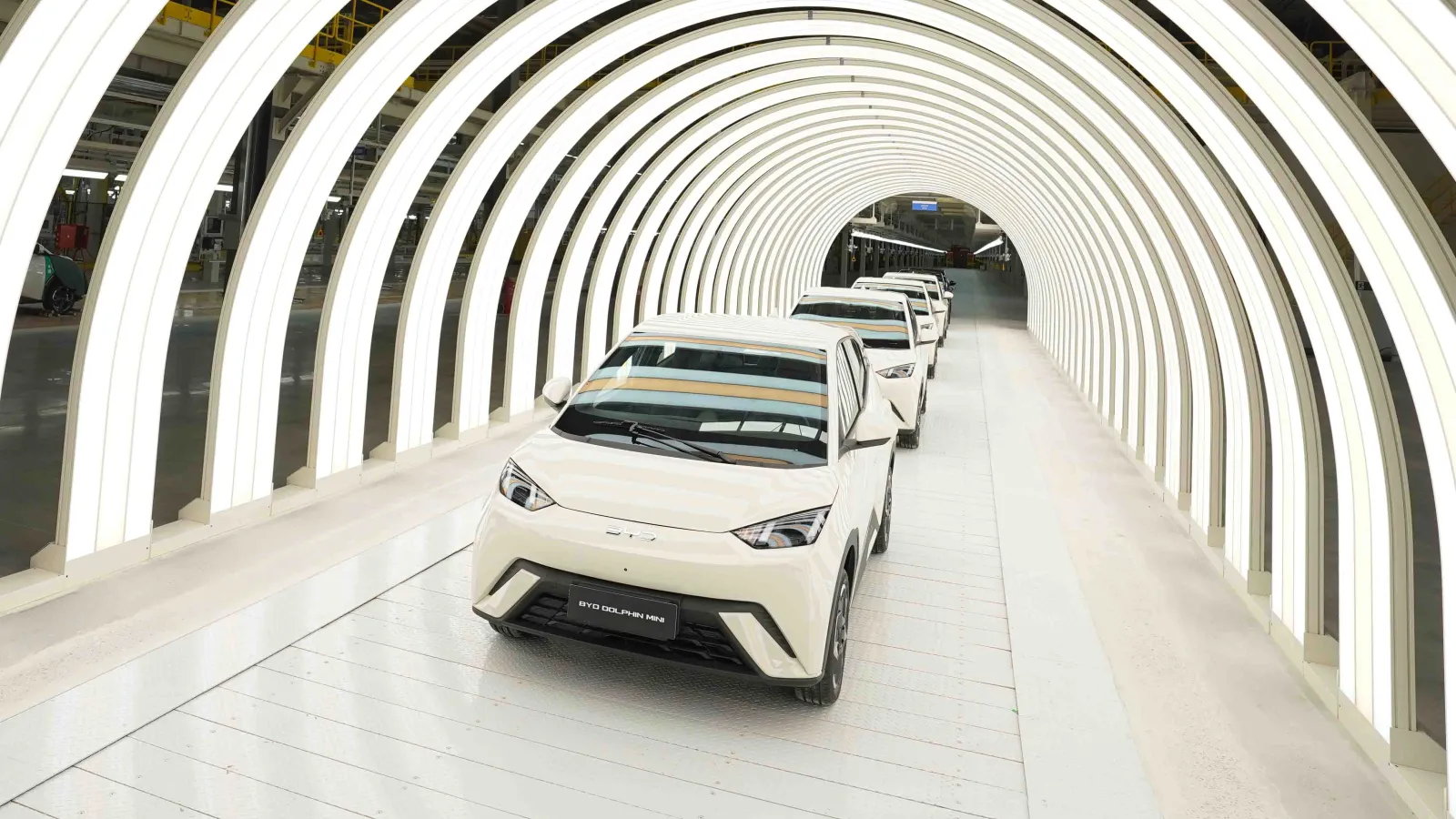
BYD launched a bigger second-generation Seagull hatchback in China in October, priced from about $9,900, and unveiled a new Seal 07 in late September.
Exports Ease
BYD exported 170,194 new energy vehicles in October, about double the 83,904 it shipped a year earlier, according to the filing.
Exports fell for a second straight month, from a record 189,466 in August and 180,700 in September, and accounted for 34.7% of October sales, down from 39.0% in September but up from 19.0% a year earlier.
Using its own measure of overseas passenger car and pickup sales, BYD said it sold 169,564 vehicles abroad in October, up 103% from a year earlier, and 1,507,395 in the first ten months, according to figures it released with the filing.
Excluding exports, BYD sold 319,974 vehicles in October, down 10.6% from 357,802 a year earlier. The domestic figure was nonetheless up 13.1% from September and the highest of the year.
The figures suggest the company’s growth is coming almost entirely from abroad, while its home market remains under pressure. Domestic sales in the first ten months fell 27.8% to 2,108,590.
Overseas Targets
BYD has repeatedly raised its overseas goal this year. It set a target of 1.3 million vehicles in January and raised it to 1.5 million in March, which management reiterated in May.
Chairman and President Wang Chuanfu told shareholders on June 9 that overseas sales now looked likely to exceed earlier expectations.
In September, Deutsche Bank and Citi analysts said BYD management had raised the goal to 1.9 million to 2.0 million overseas sales this year and more than 2.5 million in 2027, after a post-earnings meeting with the company.
At 1,507,395 overseas passenger car and pickup sales through October, BYD is already above the March target.
Reaching 1.9 million to 2.0 million would require about 196,300 to 246,300 a month in November and December, above August’s record.
BYD entered North Macedonia, its 38th European market, in early October, and said in late October it would not let higher EU tariffs sway European buyers’ choice of its cars. It has also been hiring several thousand workers in Xi’an as export orders rise, while production in Thailand slowed by a third.
Still Behind Last Year
BYD’s sales in the first ten months totaled 3,621,744, down 2.16% from 3,701,852 a year earlier. The decline has narrowed from 3.94% after nine months.
To match its 2025 total of 4,602,436, the company would need about 980,700 sales in November and December, or roughly 490,300 a month, almost exactly its October pace.
Management guided investors in May to 5.0 million to 5.5 million sales in 2026, including 3.5 million to 4.0 million in China, JPMorgan analysts said at the time. Reaching 5 million would now require about 689,100 sales a month in November and December, well above BYD’s all-time record of 514,809. The domestic range is out of reach, with 2,108,590 sold in China so far.
Production rose 13.6% year over year and 5.2% from September to 488,104 vehicles in October, 2,064 fewer than it sold. Production in the first ten months was 3,627,050, down 0.45%.
Commercial vehicle sales rose 45.2% to 7,043, including 600 buses.
Unlike a year earlier, the October filing did not report battery installations. The October 2025 filing put BYD’s power and energy storage battery installations at about 27.362 gigawatt-hours.
Brand Breakdown
BYD’s Dynasty and Ocean series sold 423,843 vehicles in October, according to brand figures the company released alongside the filing.
The Fang Cheng Bao off-road brand sold 43,872, premium brand Denza 15,152 and luxury brand Yangwang 258.
Fang Cheng Bao passed 600,000 cumulative sales on October 18, about three years after its launch. “As the youngest member of BYD’s brand matrix, just three years old, Fang Cheng Bao’s monthly sales have held at 40,000 for three consecutive months,” BYD Executive VP He Zhiqi said at the time.
October’s figure made it four months above 40,000. He said the Tai 9 SUV, the third model in the brand’s Tai series, would be unveiled soon.
Xiong Tianbo, General Manager of the Fang Cheng Bao division, wrote on Weibo on October 22 that this year’s traditional September-October peak season was under “more pressure than in the past,” but that the brand’s “overall performance is still on track and the team is confident.”
Profit and Inventory
The October figures followed BYD’s third-quarter results, which showed net profit attributable to shareholders rising 28.1% from a year earlier to 10.02 billion yuan ($1.5 billion) on revenue of 221.49 billion yuan ($33.3 billion), up 13.6%, according to its quarterly report.
Net profit for the first nine months fell 4.2% to 22.34 billion yuan ($3.4 billion).
Inventories rose 60.1% from the end of 2025 to 221.58 billion yuan ($33.4 billion) at the end of September. BYD attributed the increase mainly to the growth of its overseas business.
The company’s workforce topped 1.02 million, up about 150,000 since the end of 2025.
Analysts Trim Targets
Macquarie cut its price target on BYD’s Hong Kong shares to HK$97 ($12.40) and kept an ‘Outperform’ rating on Friday, according to Price Target, EV‘s sister publication that archives Wall Street analyst research on the EV, AI and semiconductor industries.
The Macquarie note followed a CLSA cut to HK$104 ($13.30) from HK$120 ($15.30) on October 23, when the broker kept a ‘High-Conviction Outperform’ rating, and a JPMorgan downgrade to ‘Neutral’ from ‘Overweight’ on September 30, with the target lowered to HK$88 ($11.20) from HK$124 ($15.80). CLSA’s cut came alongside deeper reductions for Nio and XPeng.
BYD’s Hong Kong shares closed down 0.6% at HK$68.25 on Friday, about 42% below Macquarie’s new target, while its Shenzhen shares fell 1.0% to 81.65 yuan.
Market Context
China’s new energy vehicle retail sales fell 13% year over year to 753,000 units from October 1 to 25, while wholesale volumes, which include exports, rose 3% to 1.008 million, according to the China Passenger Car Association.
BYD kept the top spot in the association’s September NEV retail ranking, with 246,816 sales and a 22.8% share. The association has not yet published its October brand and model data.