
Nio announced on Tuesday that it has opened ten new highway battery swap stations in Yunnan province, adding to a wave of state-owned enterprise partnerships that now account for more than 800 stations across China.
The Shanghai EV maker’s energy arm has now partnered with more than 40 local state-owned capital platforms and financial institutions across 25 provinces, municipalities and regions.
Under the arrangements, partners supply the capital and own the stations while Nio provides technology and handles operations — a structure the company has described as “state-capital partner holds the asset, Nio operates.”
For a company that has staked its credibility on turning its first annual profit in 2026 after a decade of losses, the model keeps construction costs off its own balance sheet while expanding network coverage across urban areas and highway systems.
As EV reported in June, the template scales from a regional pilot with Zhongan Energy — which traces back to January 2024, when Nio joined Anhui’s provincial energy group Wenergy and battery maker Gotion to build an open charging and swap network across the province — to a national rollout.
Nio Power and Zhongan signed a strategic agreement on June 25 to jointly build 500 swap stations across China within a year, after an initial batch of 50 was handed over in December 2025. Chief financial officer Stanley Qu, who also leads the power business, attended the signing alongside founder and CEO William Li.
A Summer of Handovers
All 10 Yunnan sites sit at major highway service areas operated by ‘Yunnan Communications Investment Group,’ a provincial state-owned enterprise primarily responsible for investment, construction and operation of road, rail and waterway transportation infrastructure in the province.
The new swap stations cover the G5621 Kunming–Chuxiong–Dali highway, G85 Yinchuan–Kunming highway, G78 Shantou–Kunming highway, G5 Beijing–Kunming highway and G8511 Kunming–Mohan highway, with stations serving both directions.
Coverage now spans central, eastern, western and southern Yunnan, filling gaps across several of the province’s main highway corridors.
Yunnan Communications Investment Group’s highway service-area network provides an existing infrastructure base for deploying energy-replenishment facilities — parking, dining and rest stops are already in place, allowing battery swapping to slot into a break drivers would make regardless.
The Yunnan deployment caps a rapid sequence of partner deliveries.
On August 5, ‘Zhongan Energy’ and Nio Power completed the delivery of 90 additional stations, spanning the Yangtze River Delta, Beijing-Tianjin-Hebei corridor, Greater Bay Area and northwest China.
A week later, Nio Power and ‘Wuhan Optics Valley Transportation Group’ handed over 36 jointly developed charging and battery swap stations in Wuhan — a transfer that left every existing swap station asset in the city held by state-owned partners.
Wuhan is where Nio Power is headquartered.
Late last month, Nio Power and S’cience City (Guangzhou) Investment Group’ completed the handover of 23 battery swap stations in Huangpu, Guangzhou.
Named Partners Across China
The partner list extends well beyond the headline deals.
Other confirmed agreements include ‘Beijing Future Science City Development Group,’ which signed a 100-station plan starting in Beijing’s Changping district, ‘Wuhan Shouyi Sci-Tech Innovation Investment Group’ (~100 stations in Hubei), ‘Changsha Economic & Technological Development Group’ (100 in Hunan), ‘Xi’an Chengtou New Energy,’ ‘ZDK Group’ (100 across Northeast China and Inner Mongolia), and ‘Jining Hi-Tech Holding Group’ (50 in Shandong).
Beyond local platforms, Nio has built cooperation with national energy companies and grid operators.
Partners include Sinopec, PetroChina, CNOOC, Shell, State Grid and China Southern Power Grid.
Founder and CEO William Li noted in 2025 that Nio has had cooperative agreements with PetroChina, Sinopec and CNOOC for swap stations at fuel stations.
CATL, the world’s largest EV battery maker, invested up to 2.5 billion yuan in Nio Power in March 2025, targeting a unified national swap network and shared industry standards.
Stations Near 4,100
As of Tuesday, Nio had built over 9,300 charging and battery swap stations nationwide, of which 4,075 were battery swap stations.
Cumulative battery swap services have exceeded 120 million, a milestone the company crossed in early August when it opened its 4,000th station and first fifth-generation units across seven cities.
Total charging and battery swap services have surpassed 200 million.
Nio has invested more than 20 billion yuan (nearly $3 billion) cumulatively in battery swapping technology, charging technology and related infrastructure.
Road to 4,600
Nio has shifted its site-selection strategy toward highway exits, a positioning it says can serve both highway transit and nearby county-level markets.
Li set a 2026 target of more than 1,000 new swap stations, with the total exceeding 4,600 by year-end.
Nio added 679 stations in 2024 and 681 in 2025, and has slowed its own direct construction over the past two years to control capital spending.
As EV reported in August, the partner channel is now the only route to the number.
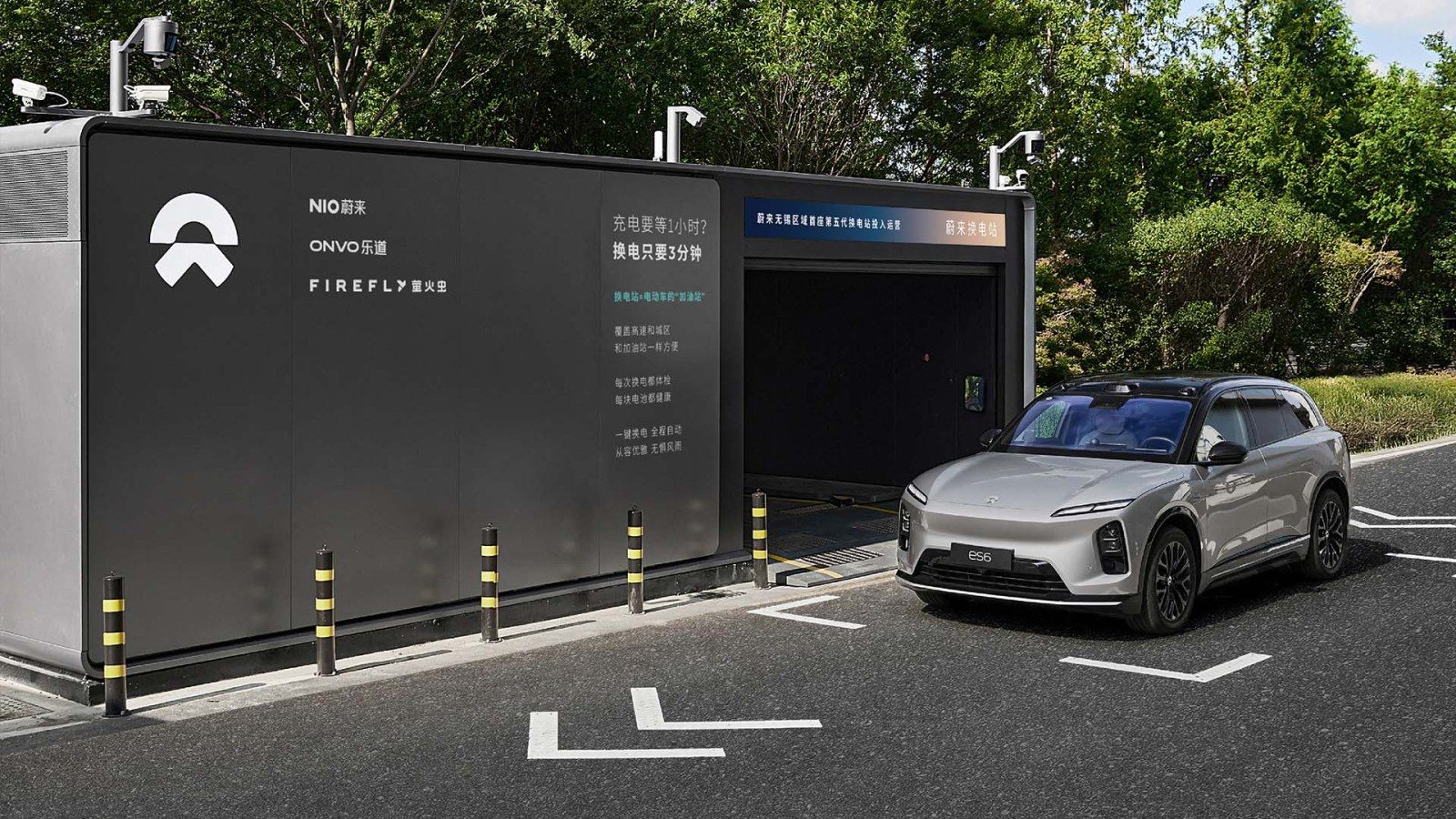
Nio began large-scale deployment of its fifth-generation swap stations in late July.
The new stations are the first to support all three of the group’s brands — Nio, Onvo and Firefly — and expand battery storage capacity to between 21 and 28 packs per station, up from 13 to 20 in the previous generation.
Daily service capacity has risen to 500 swaps from approximately 417.
Nio is targeting more than 100 new openings per month from September, with about 450 stations planned for the fourth quarter alone.
The expansion comes as CATL’s competing Choco Swap network continues to scale rapidly.
CATL deployed 1,020 stations across 45 cities by the end of 2025 and raised its 2026 target to more than 3,000 stations across 140 cities.