
Nio is leaning harder on outside partners to grow its battery-swap network, a strategy that keeps construction costs off its own books as the company chases its first full year of profit.
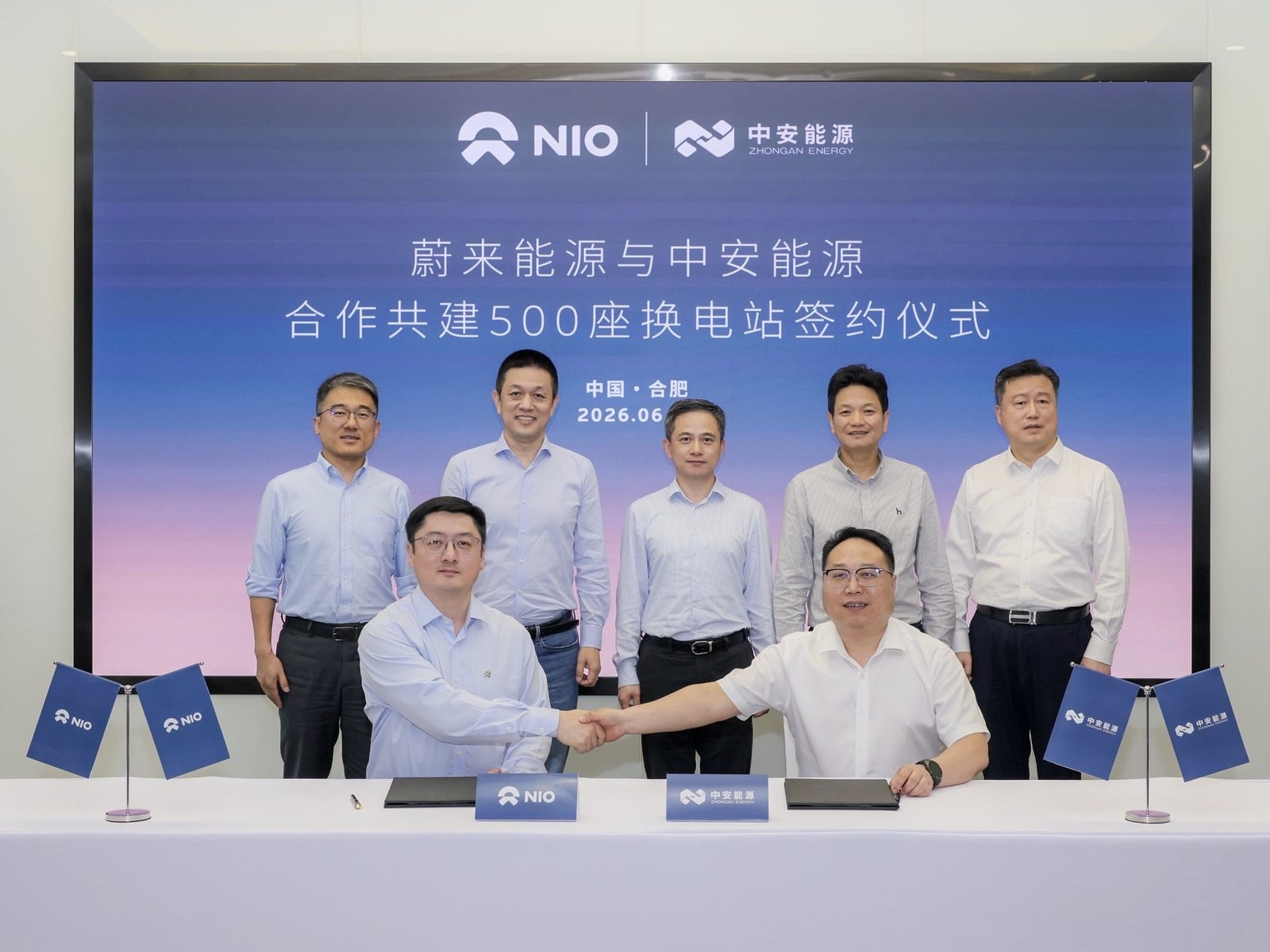
The latest step came on June 25, when Nio Power, the carmaker’s energy arm, signed a strategic agreement with Zhong’an Energy to jointly build 500 swap stations across China within a year.
Under the deal, Zhong’an supplies the capital and owns the stations while the energy unit provides the technology and runs them, a “technology operation plus asset holding” model the company is now replicating nationwide.
On its Weibo account, Nio framed the tie-up as a milestone in scaling that approach from a regional pilot to a national template.
Founder and CEO William Li attended the signing, alongside chief financial officer Stanley Qu, who also leads the power business.
A Model That Shifts the Cost
The arrangement follows a template Li laid out in early 2025, when Nio overhauled how it builds swap stations to spend less of its own money.
“This year, the vast majority of the swap station construction funding won’t come from us,” Li said at the time, describing a program in which partners build stations and the company leases them back to preserve cash.
Partners able to tap cheaper financing make the model more efficient, Li added: “If they build a swap station and we rent it, that’s very cost-effective.”
Such deals now span provincial highway operators, investment firms and state-owned energy groups, with stations also built at filling stations run by PetroChina, Sinopec and CNOOC.
Regional teams can now fund stations themselves when they expect the coverage to lift nearby car sales, a flexibility written into the same cost-accounting overhaul.
By restructuring the rollout around return on investment, Nio has mapped 10,000 candidate sites and ranked them by payback, building first where swaps and car sales justify the outlay.
Spending Discipline Behind the Profit Goal
Holding down that capital outlay matters because Nio has staked its credibility on turning an annual profit in 2026, after a decade of losses.
“For the full year 2026, our financial target is due to achieve positive non-GAAP operating profit,” Qu told analysts on the first-quarter earnings call in May.
That the finance chief also runs the energy business underscores how closely the swap network is now tied to the bottom line.
Qu took over the unit after Shen Fei left to lead the Onvo sub-brand in early 2025.
The company plans to hold research and development spending at about 2 billion to 2.5 billion yuan a quarter, a level Qu said is enough to sustain its investment in chips, operating systems and a yearly cadence of new models.
Li has pushed the same discipline through an internal cost-accounting system, telling staff to spend “decisively where necessary, but not a penny where it’s not needed.”
Profitable Power Business
Nio has poured more than 18 billion yuan ($2.6 billion) into charging and swap infrastructure over 11 years, and now wants that business to pay its own way.
The network passed 100 million cumulative swaps in February, with daily volumes since topping 100,000, and Li has named profitability of the power unit as the next goal.
As of Friday, the count had reached 9,019 charging and swap sites, including 3,934 swap stations, 1,043 of them on highways, with cumulative swaps past 115 million.
On charging, Nio runs 5,085 stations and 29,285 connectors and plugs into more than 1.5 million third-party piles, with outside drivers taking 86.2% of the power its own piles dispense.
Scale is beginning to help, as the company’s stations in Shanghai — its densest market — approach profitability at more than 9,000 swaps a day.
For 2026, the company plans to add 1,000 stations and begin large-scale rollout of its fifth-generation design, while extending swap access to its entry-level Firefly brand.
Those fifth-generation stations entered beta testing in six Chinese cities on the same day as the Zhong’an signing, with Firefly among the first to use them.
Beyond serving cars, the stations feed power back into local grids, a role Li casts as a second source of value for the network.
From an Anhui Pilot to a National Rollout
Zhong’an Energy traces back to January 2024, when Nio joined Anhui’s provincial energy group and battery maker Gotion to build an open charging and swap network across the province.
A first batch of 50 stations signed and handed over in December 2025 began the asset-holding model now being copied elsewhere.
The June 25 agreement widens that remit well beyond Anhui, targeting 500 stations nationwide within the year.
Anchoring the network in state-backed energy groups also gives Nio access to land, grid connections and financing that would be slower and costlier to secure alone.
A Different Kind of Partner
The energy partners bankrolling stations are distinct from the carmakers Nio has courted to share the network, an alliance that has yet to deliver.
Seven automakers including Changan, Geely and Chery have signed on, but none has launched a swap-compatible model, and Li in April played down their near-term importance.
Battery giant CATL, by contrast, has committed up to 2.5 billion yuan to the energy arm.