
Nio Inc.‘s fifth-generation battery swap station will add battery-compartment capacity to accommodate a vehicle and battery lineup that has grown far more complex than the network was first built to serve.
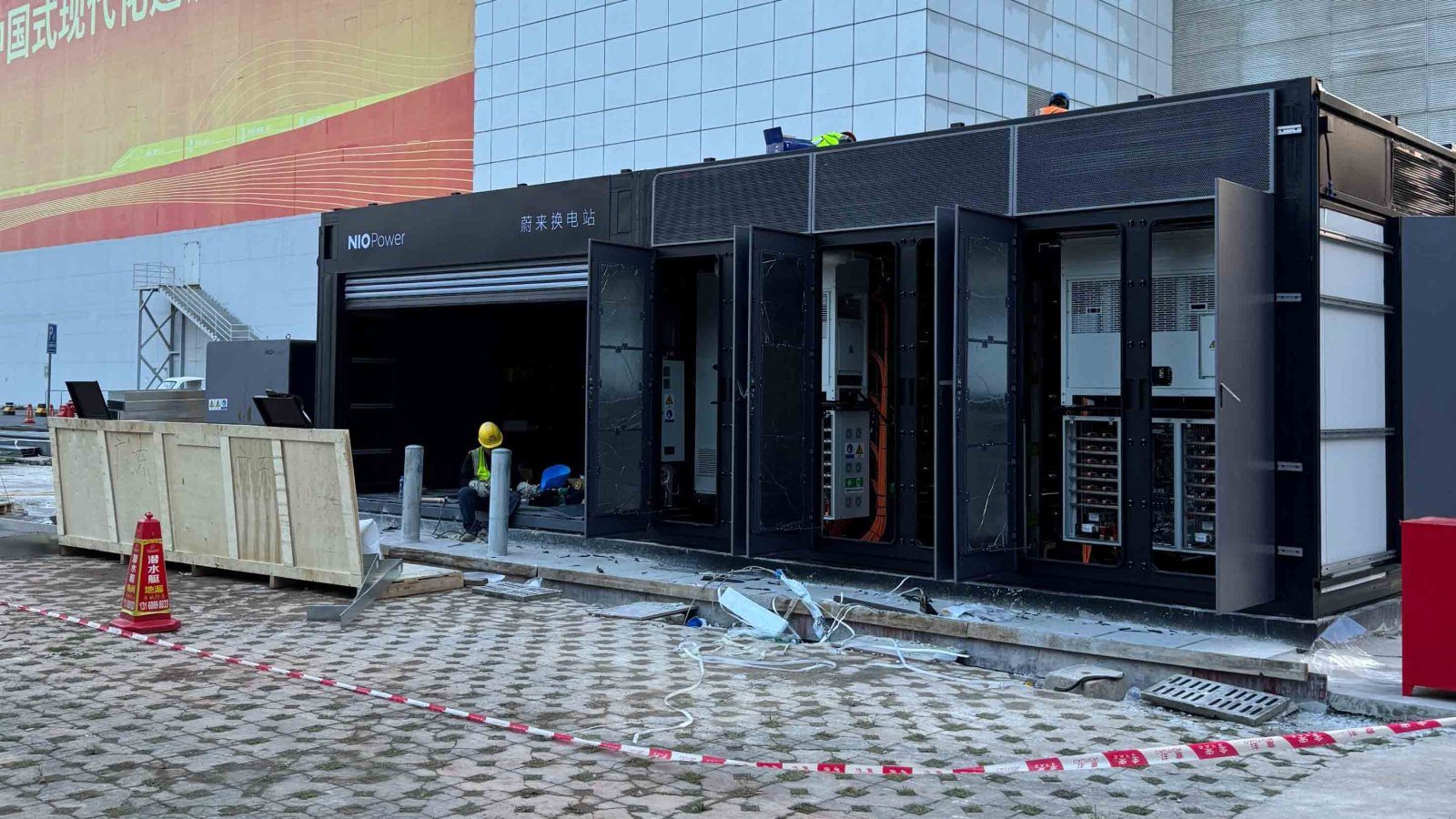
One of the first batches of fifth-generation stations is being installed in Guangzhou this week, with grid connection, system testing, and commissioning to follow.
Mass production and installation of the new stations have been recently delayed and are now planned to start in the third quarter of the year.
Photos of the installation shared by several bloggers close to Nio on social media show a unit with its side panels removed, exposing the internal battery racks and power electronics, with what appears to be an additional compartment compared with the current fourth-generation design.
The EV maker has previously said the new station raises per-station capacity by about 20% over the fourth generation, though it has not published a battery-bay count for the fifth generation.
The defining change is range: a single fifth-generation station is built to handle every battery format in the group, from Firefly‘s 42.1-kilowatt-hour pack to the 150-kilowatt-hour unit at the top of Nio‘s range, even as the largest pack has been wound down.
As of Tuesday, it remains unclear whether Nio continues equipping stations with 150kWh batteries, given the setback announced by the management over the ultra-long range batteries.
It is the first generation able to serve Firefly, the group’s budget brand, whose shorter wheelbase left it unable to use any earlier station.
A Growing Number of Bays
Each generation of Nio‘s swap station has held more batteries than the last, a progression that tracks the company’s expanding fleet.
The first generation, opened to customers in 2018, stored five batteries and could perform about 100 swaps a day.
The second generation, co-developed with Sinopec and rolled out from 2020, held thirteen.
The third generation, unveiled at the end of 2022, increased that to 21 and lifted daily capacity to 408 swaps, a 30% gain over the second generation.
The fourth generation, deployed from June 2024, holds 23 batteries and can complete up to 480 swaps a day, with a single swap taking 144 seconds, 22% faster than the third generation.
The fifth generation continues that trajectory, with Nio guiding to a roughly 20% capacity increase and as many as 500 vehicles served per station per day.
The added compartment visible in the Guangzhou installation is consistent with that capacity gain, though Nio has not yet announced a specific bay count.
From Two Batteries to Seven
The reason the network keeps expanding is not only volume but variety.
When Nio began swapping, its cars used essentially two battery sizes: a standard-range pack and a long-range pack.
The earliest standard pack was a 70-kWh ternary-lithium unit launched in 2018, briefly enhanced to 84 kWh in 2019, paired with a 100-kWh long-range battery.
In September 2021, Nio replaced the 70-kWh pack with a 75-kWh hybrid-cell battery combining ternary-lithium and lithium-iron-phosphate cells, later shifting the 75-kWh pack to an all-LFP design.
A 150-kWh semi-solid-state battery followed, expanding the top of the range, before the arrival of the sub-brands added smaller packs at the bottom.
The 150-kWh pack saw limited uptake, however, and Li has said production was discontinued after a few hundred units because customers rarely upgraded to it.
Demand has instead concentrated at the standard end.
Li has said that with more than 3,500 swap stations in China, about 97% of users now choose the 75-kWh pack over the 100-kWh option, against a roughly even split when the network was smaller.
In August 2025, Nio made the 100-kWh battery standard across its main-brand lineup, keeping the 75-kWh pack available through its battery-leasing plan.
Nio‘s swap network now spans seven battery capacities, compared with just two three years ago: 75, 100, 120 and 150 kWh for the main brand, 65 and 85 kWh for Onvo, and 42.1 kWh for Firefly.
The 150-kWh pack remains the network’s nominal upper bound even though its production has stopped, leaving the active span effectively running from 42.1 to 120 kWh.
The company has acknowledged that this diversity, while giving customers flexibility, increases the complexity of the swap network, which must stock and match the correct pack for each vehicle.
The Sub-Brands Widened the Span
The complexity grew sharply with the launch of Nio‘s two lower-priced marques.
Onvo, the family-oriented brand, and Firefly, the budget brand, brought vehicles of different sizes and battery formats into a network originally designed around Nio‘s larger sedans and SUVs.
The fourth-generation station already supported Nio and Onvo models, along with battery-swap strategic partners.
Firefly, however, was left out: its shorter wheelbase made it incompatible with the fourth-generation network, and it will gain swap access only with the fifth generation.
To accommodate vehicles of such different dimensions, the fifth-generation station’s battery-bay door adjusts its position, extending as each car enters.
Firefly‘s debut model, the smallest vehicle in the group, requires the most adjustment.
A Shift Away From Outside Brands
While the new station is designed to be compatible with outside automakers, Nio has recently played down that ambition.
“In the short term, we will not treat whether third-party companies use our battery swap network as a priority — it is not our strategic focus,” founder and Chief Executive William Li told a media roundtable in May, the clearest public downgrade yet of the company’s battery-swap alliance.
Nio has signed swap-alliance agreements with eight automakers since Changan became the first in November 2023, a group that also includes Geely, Chery, JAC, GAC, FAW Group and Lotus.
No alliance partner has launched a vehicle compatible with Nio‘s stations to date.
Rival battery maker CATL, which is also Nio‘s main battery supplier and an investor, has moved faster with its own swap standard, signing several Chinese brands.
The de-prioritization sharpens the focus of the fifth-generation rollout on Nio‘s own three brands, with Firefly‘s addition completing in-house coverage of the group.
A Trade-Off in Smoothness
That flexibility introduces a trade-off the company is still refining.
Because the door moves to fit each model, the station produces slightly more movement during a swap than the fourth-generation design.
“The car still feels a bit bumpy,” Firefly‘s brand chief Daniel Jin said during a demonstration, adding that reliability was not in question after extensive testing but that the team wanted to reduce the motion further before launch.
A full Firefly swap takes about three and a half minutes, according to Shen, who said the figure could still improve.
That is nearly double the fifth-generation station’s stated minimum of one minute and 48 seconds, which reflects the larger Nio and Onvo vehicles the network was built around.
Nio has not published an official swap time for Firefly vehicles. Jin described the process only as taking “the time it takes to play one song.”
Rolling Out From Mid-June
The first batch of fifth-generation stations will be completed in mid-to-late June, Jin said, with large-scale deployment beginning in the third quarter.
Firefly users will be able to place orders and try swapping once the first stations open, after the brand rolled out version 1.5.0 of its Aster operating system this month, which added battery-swap compatibility.
The timeline has slipped repeatedly: Nio first targeted a pilot run before Christmas 2025, then revised it to the first quarter of 2026, before pushing large-scale deployment to the third quarter.
The preview followed Nio founder and Chief Executive William Li’s announcement of the fifth-generation station at the ES9 launch event.
Nio operates the world’s largest swap network, with 3,846 stations in China as of Thursday and more than 110 million swaps provided since 2018.
Li has guided to between 4,500 and 4,600 stations by the end of the year.
The scale underlines why compartment capacity matters: at peak travel periods, the network has handled more than 145,000 swaps in a single day, and every additional battery format it must support raises the demands on each station’s storage.