
Written by Cláudio Afonso | LinkedIn | X
Shanghai-based Nio Group is moving closer to the rollout of its Firefly brand with the first image of a dedicated battery swap station for the low-cost EV line circulating on Chinese social media this Wednesday.
The picture marks the first public appearance of the new station, which will support Firefly’s compact electric vehicles set to launch in China on April 19.
The leaked image shows Nio employees running swap tests at the station, which is visibly smaller than the company’s standard fourth-generation swap facilities used by its Nio and Onvo brands.
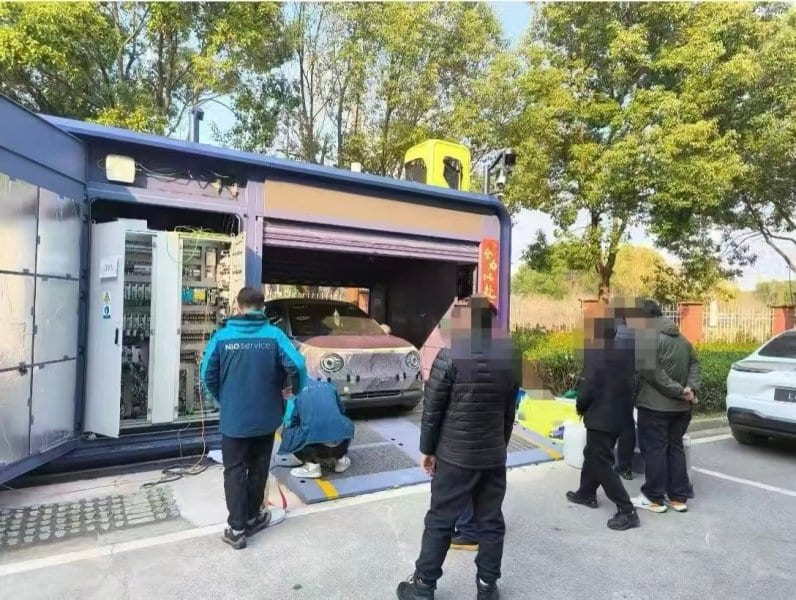
Like Nio’s latest stations, the Firefly unit is equipped with LiDAR sensors, but is expected to be far more affordable to build and deploy. Next to the LiDAR, the station has a pilar with the Firefly logo covered.
“For Firefly’s swap stations, we use much less infrastructure, including transportation and construction costs, which are much lower,” Nio CEO William Li told reporters in December. “Construction costs in Europe are only one-third of the cost of Nio’s current swap stations. Additionally, the speed will be faster.”
The simplified, modular design was created with Europe in mind, Li said, enabling “very simple leveling and very quick assembly,” and allowing for broader deployment via third-party partnerships, much like Nio’s strategy in China.
Firefly Infrastructure
Firefly will be the third EV brand under the Nio Group umbrella, joining the flagship Nio and family-focused Onvo marques. Like its stablemates, Firefly vehicles will support both fast charging and battery swapping.
The company aims to gradually deploy swap stations based on user demand, prioritizing cities with high EV concentration, according to Firefly President Daniel Jin.
Earlier this year, Jin said Firefly’s international expansion will rely on local partners to support station rollouts, particularly in Europe, where Firefly is expected to debut this fall. Unlike the direct-to-consumer model used by Nio, Firefly will operate through national distribution partners.
Specs and Market Response
Regulatory filings from China’s Ministry of Industry and Information Technology (MIIT) revealed earlier this year Firefly’s first model will feature a 42.1-kWh lithium iron phosphate (LFP) battery pack supplied by Sunwoda, and a 105-kW single motor offering a CLTC-rated range of 420 kilometers.
Interior images released recently show a minimalist cabin with a floating central screen and digital instrument cluster.
Pre-orders for the vehicle, which was unveiled in December, have exceeded expectations, Jin said earlier this year, with more than half placed on launch night alone.
The official launch event is set for April 19, when pricing will be announced. First deliveries in China will follow shortly after.
The EV is already arriving at showrooms across the country ahead of its commercial release, though a timeline for European deliveries has not yet been confirmed.
Nio announced earlier this Wednesday it had signed a strategic cooperation agreement with Future Science City Group, a state-owned enterprise backed by Beijing’s Changping district government, to build 100 battery swap stations in China.