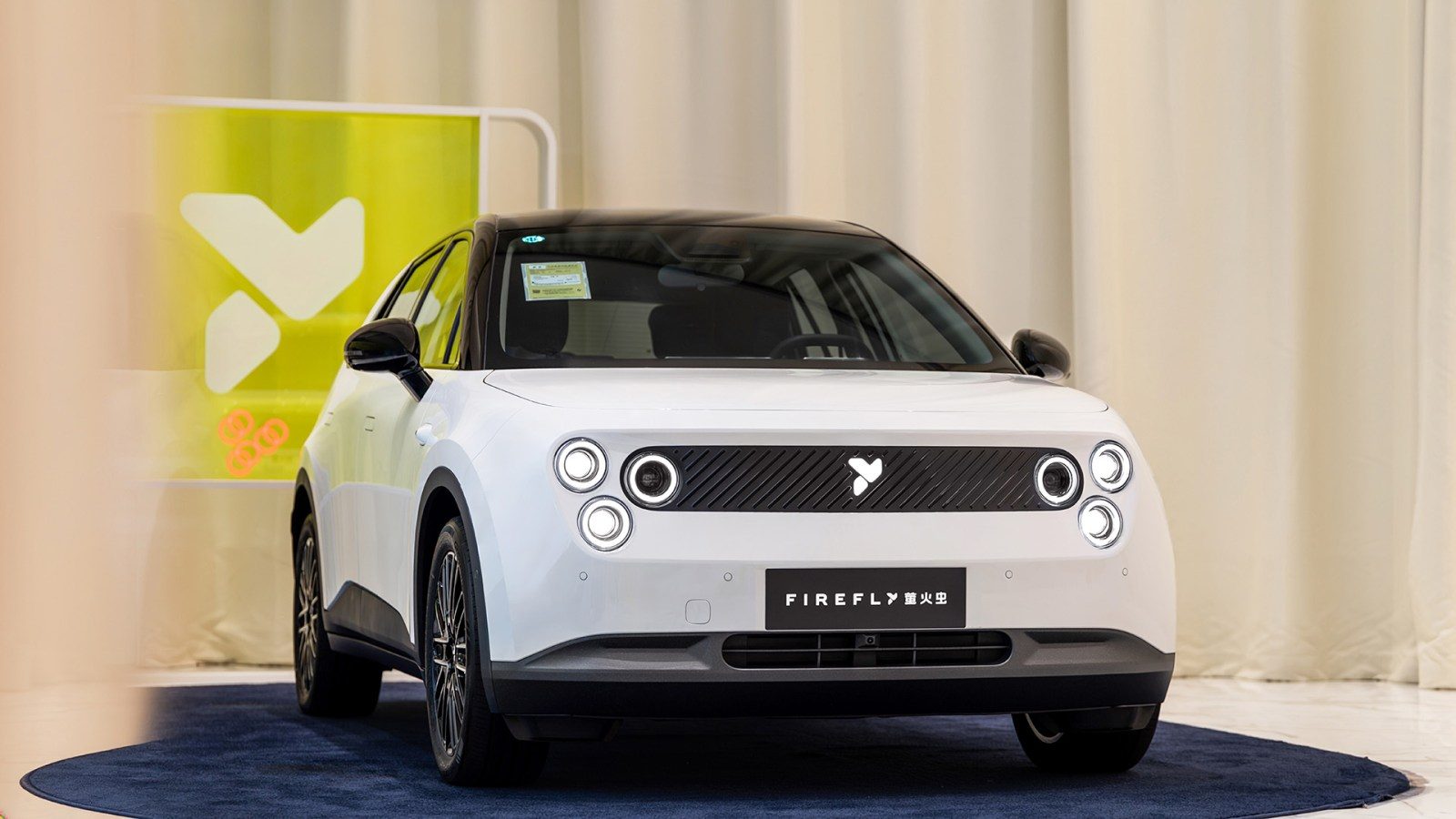

Nio Inc.’s entry-level brand Firefly will launch a 60 kWh battery pack before the end of this year, brand chief Daniel Jin reaffirmed on Tuesday — but declined to say whether future models would be compatible with semi-solid-state or solid-state cells.
Asked whether Firefly vehicles released later would support next-generation battery systems, Jin focused exclusively on the near-term upgrade and cut the exchange short.
“Last time, when I spoke with that user face to face, what I revealed was that Firefly will definitely get a large battery, and it’s coming soon — I gave a timeframe of ‘by Spring Festival at the latest,’ and said we’d do everything we could to make it happen this year,” the brand chief stated.
“We can guarantee that the large battery will launch this year,” he said. “This large battery has a capacity of 60 kWh, and it’s a CATL ternary lithium battery. That’s all I can share for today.”
The “Spring Festival” timeframe refers to remarks Jin made at a meeting with owners in Quanzhou on August 7. The Spring Festival, or Chinese New Year, falls on February 6, 2027.
Jin first gave the year-end guarantee, the 60 kWh capacity and CATL as the supplier on September 5, when the brand marked its 80,000th delivery. Tuesday’s remarks repeated that position without adding a date, a price or a range figure.
From 42 to 60 kWh
Firefly’s current battery is a 42.1 kWh lithium iron phosphate pack with cells from Sunwoda, according to the car’s regulatory filing with China’s Ministry of Industry and Information Technology.
The pack weighs 314 kg and gives a range of 420 km on China’s CLTC test cycle.
The upgrade therefore changes both the chemistry and the cell supplier, from Sunwoda’s lithium iron phosphate to CATL’s ternary lithium.
Ternary cells store more energy per kilogram. The larger pack is a 43% capacity increase, though Firefly has not published a CLTC range figure for it.
Jin said at the Hefei ceremony that the 60 kWh pack matches the physical dimensions and bolt positions of the 42 kWh unit, preserving compatibility with Nio’s swap infrastructure and making retrofits possible across the existing fleet of more than 80,000 cars.
Nio sells its vehicles under both a battery-included purchase model and a battery-as-a-service rental plan — the latter currently priced at 399 yuan ($60) per month.
Firefly has not disclosed pricing for the larger pack under either track, nor said whether it would be offered as a factory option, a retrofit, or both.
Solid-State Question Left Open
Nio has been one of the most vocal proponents of semi-solid-state technology among Chinese automakers.
The company began delivering a 150 kWh semi-solid-state battery pack across its main brand lineup, and has framed the technology as a stepping stone to full solid-state cells.
However, Nio’s founder and CEO said late last year that the company had stopped the 150kWh rollout after several hundred units.
Whether Firefly’s smaller platform can accommodate those chemistries — and whether the form factor Jin described as dimensionally identical to the 42 kWh pack leaves room for future cell upgrades — remains unanswered.
Jin’s closing line, “that’s all I can share for today,” signaled the boundary was deliberate rather than an oversight.
Battery Swap Network
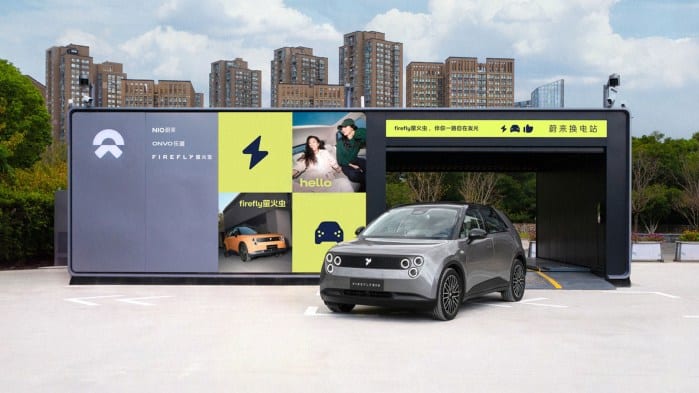
The larger pack arrives as Firefly integrates into Nio’s battery swap network.
The brand could not use any swap stations until August 7, when Nio opened its first fifth-generation stations — the first generation able to accommodate the hatchback’s shorter wheelbase.
The stations averaged 256 Firefly swaps a day in their first weeks. Nio’s full network in China has nearly 4,100 stations.
A 60 kWh pack that fits the same swap cradle as the 42 kWh unit would let owners upgrade through the swap network without structural changes to the stations — a central premise of Nio’s battery-as-a-service model.
Single-Model Strategy Continues
William Li told analysts on a recent earnings call that Firefly would remain a single-model brand in 2027, relying on special editions and technology upgrades rather than new nameplates. Li likened the approach to Apple’s iPhone strategy.
The 60 kWh battery fits that pattern. Rather than launching a second model, Firefly is extending the capability of its single hatchback through hardware retrofits — alongside the electric door handle kit due in October and the Aster 2.1.0 over-the-air software update.
Firefly delivered 80,209 vehicles through August, 494 days after handing over its first car on April 29, 2025.
Brand president Jin has set a target of 100,000 cumulative deliveries by the end of 2026, a figure that requires approximately 19,800 more vehicles across September through December.
The hatchback starts at 119,800 yuan ($17,900) with the battery included in China, or 79,800 yuan ($11,900) under Nio’s battery rental plan.