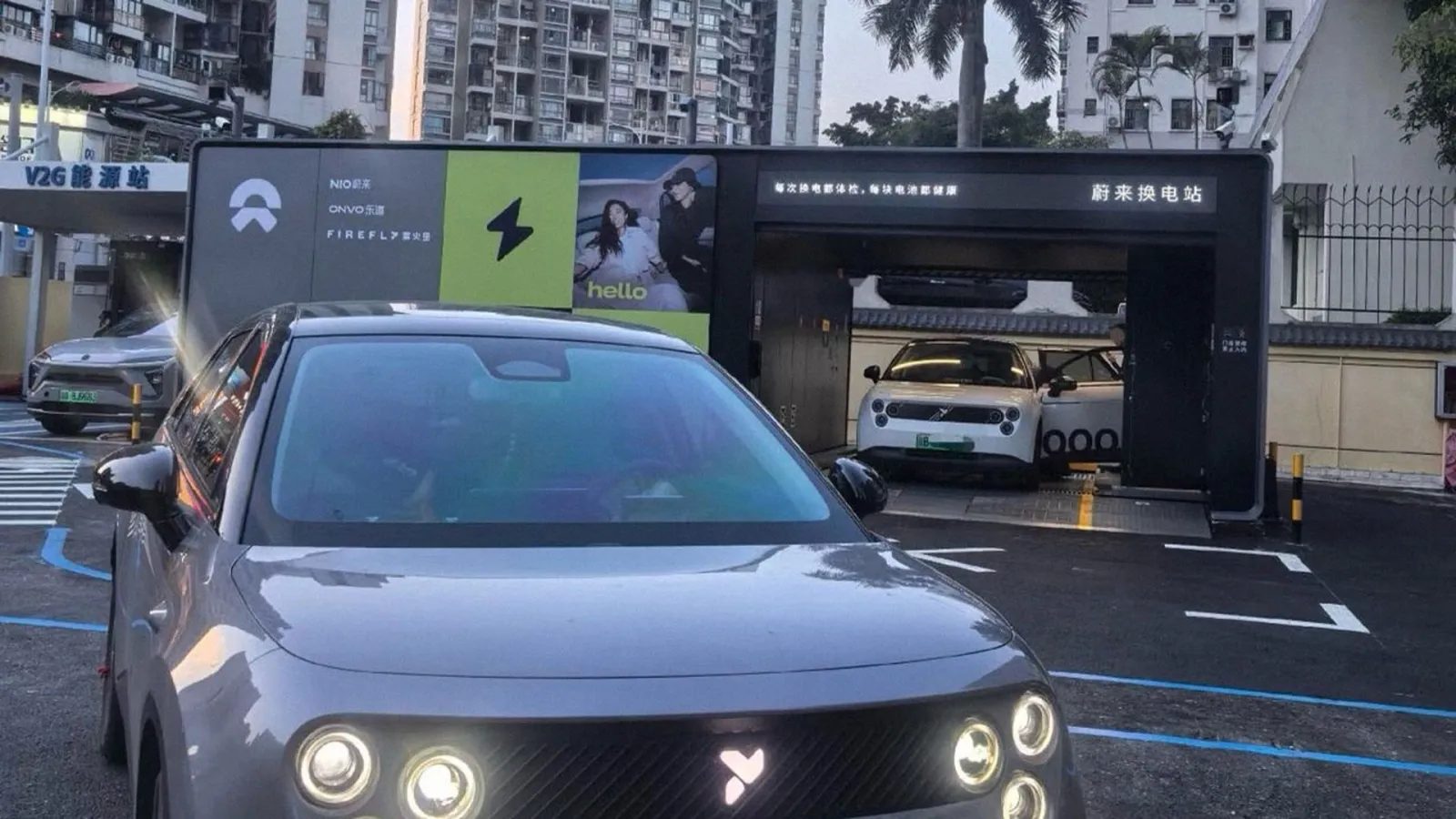

Firefly, the entry-level brand of Chinese EV maker Nio, has passed 10,000 cumulative battery swaps in the 39 days since it gained access to the company’s swap network, the brand said on Monday.
The figure covers 42 fifth-generation swap stations across 33 cities in 15 provinces, Firefly said in a post on its China app.
The milestone indicates a daily average of 256 battery swaps in the first five weeks of operation.
“One station after another, one city after another,” the brand wrote on its app. “Steadily building out the network, bringing effortless swapping to more users.”
The Starting Point
Firefly could not use Nio’s swap network at all until August 7.
On that day Nio put its first batch of fifth-generation stations into service in seven cities: Beijing, Shanghai, Guangzhou, Suzhou, Hefei, Chengdu and Quanzhou.
Nio described the launch by city rather than by station count. The Quanzhou site, at Qiaoxiang Stadium in Fujian province, was also the company’s 4,000th swap station.
Earlier generations could not accommodate the Firefly hatchback, which has a shorter wheelbase than any Nio or Onvo model. The fifth generation is the first compatible with all three brands.
Fifth-generation stations are liquid-cooled. Nio has said Firefly will not join CATL’s air-cooled Choco-Swap network, which is a separate system used mainly for fleet vehicles.
A swap takes about three minutes and the driver does not leave the car.
What 256 a Day Measures
The average is a network total rather than a rate per car or per station, and the base it was earned on grew sixfold during the period.
Nio opened in seven cities on August 7 and had 42 stations across 33 cities by September 14. It has not published a station count for the first day, so the exact rate of expansion is unknown, but daily volume will have risen as sites opened.
The closing rate is higher than 256 and the opening rate lower.
Divided by the 42 stations in operation at the end, the average is about 6.1 swaps per station a day. That is a floor rather than a measurement, because it assumes all 42 were running throughout.
Against the Fleet
Firefly has delivered 80,209 vehicles since April 2025, on the sum of the monthly figures Nio publishes by brand.
At 256 swaps a day, that is about 0.32% of that total on any given day, or one swap per car every 313 days.
Nio’s live dashboard showed 4,088 swap stations in China on Tuesday morning, so the 42 open to Firefly are about 1% of the total.
The company’s 1,056 highway swap stations were built for Nio and Onvo compatibility, so whether a Firefly can use one depends on a fifth-generation unit being there.
The Build-Out
Nio said in February it would add 1,000 swap stations in 2026 and begin large-scale fifth-generation construction that year, promising Firefly owners access.
Its live network dashboard read 4,088 swap stations on Tuesday morning, of which 1,056 are on highways, alongside 5,274 charging stations with 30,382 chargers, for 9,362 charging and swapping sites in total. Cumulative swaps stood at 124,403,754 and cumulative charging sessions at 98,522,883.
Nio also lists 1,726,291 third-party chargers in its app, and says third-party users account for 86.6% of the energy delivered by its own chargers.
The company had reported 4,070 swap stations on September 6, so 18 were added in nine days.
Nio’s ten-year investment in charging and swapping is put at more than 20 billion yuan — equivalent to $2.98 billion yuan.
Firefly is also due a larger battery.
Brand president Daniel Jin said on September 5 that a 60 kWh CATL ternary pack would arrive before the end of this year, and that it is the same size as the current 42 kWh lithium iron phosphate unit with bolt positions in the same places.
Jin said the arrangements for charging, swapping and upgrading to it remain under study, and Firefly has published no pricing.