
Nio Inc.’s entry-level brand Firefly will launch a 60 kWh battery pack before the end of this year and a convertible version of the debut model is in “pre-research phase”, brand president Daniel Jin confirmed at a ceremony in Hefei on Saturday, as the brand marked its 80,000th vehicle delivery.
“We can guarantee the large battery launches this year,” Jin said. “This large battery is 60 kWh — a CATL ternary lithium cell.”
The larger pack represents a 43% increase in capacity over the 42 kWh lithium iron phosphate unit that has been standard since Firefly began deliveries in April 2025.
Jin stressed the upgrade was designed from the outset to be backward-compatible. “The 60 kWh battery pack is exactly the same size as the 42 kWh pack, with bolt positions in exactly the same places,” he said.
Jin framed the compatibility as a delivery on a founding promise. “What does that mean? It means the chargeable, dischargeable, and upgradeable promise we announced holds true for all existing Firefly owners,” he said.
Firefly has not disclosed pricing for the larger pack, whether as a factory option on new vehicles or as a retrofit for the more than 80,000 cars already on the road.
Nio sells its vehicles under both a battery-included model and a battery-as-a-service rental plan — the latter currently priced at 399 yuan ($59) per month. The larger pack could affect both tracks.
From 42 to 60 kWh
Firefly’s current 42 kWh pack uses CATL lithium iron phosphate cells and delivers a CLTC-rated range that sits at the lower end of China’s compact EV segment.
A move to 60 kWh of ternary lithium chemistry — which offers higher energy density per kilogram — would bring a meaningful range uplift, though Firefly has not published an estimated CLTC figure for the larger pack.
CATL supplies both packs and remains the world’s largest battery cell manufacturer by installed capacity.
By keeping dimensions and mounting points identical, Firefly avoids the structural rework that typically accompanies a battery size change and preserves compatibility with Nio’s swap infrastructure.
The group opened its first fifth-generation battery swap station on August 7 — the first generation able to accommodate Firefly’s shorter wheelbase.
Other Updates
Jin used the same ceremony to outline three additional product updates spanning hardware and software.
An official electric door handle retrofit will go on sale in October, timed to coincide with the rollout of Aster 2.1.0, the next over-the-air software update for the brand’s operating system.
Firefly described the exterior handle as a known pain point among owners and positioned the electric alternative as a significant hardware upgrade available to all existing vehicles.
Firefly began rolling out Aster 2.0.0 on August 14, the brand’s first full version change since launch.
The release added or optimized 33 features across the smart cabin, assisted driving, and the Lumo voice companion.
On intelligent driving, Jin drew a clear line between current and future hardware.
Urban Navigate on Autopilot — the city-level autonomous driving feature available across Nio’s main brand lineup — requires a next-generation facelift of the Firefly hatchback to function.
Current models do not carry the sensor or compute hardware needed to support urban NOA, and Jin gave no timeline for when a revised vehicle might arrive.
Convertible in Early Research
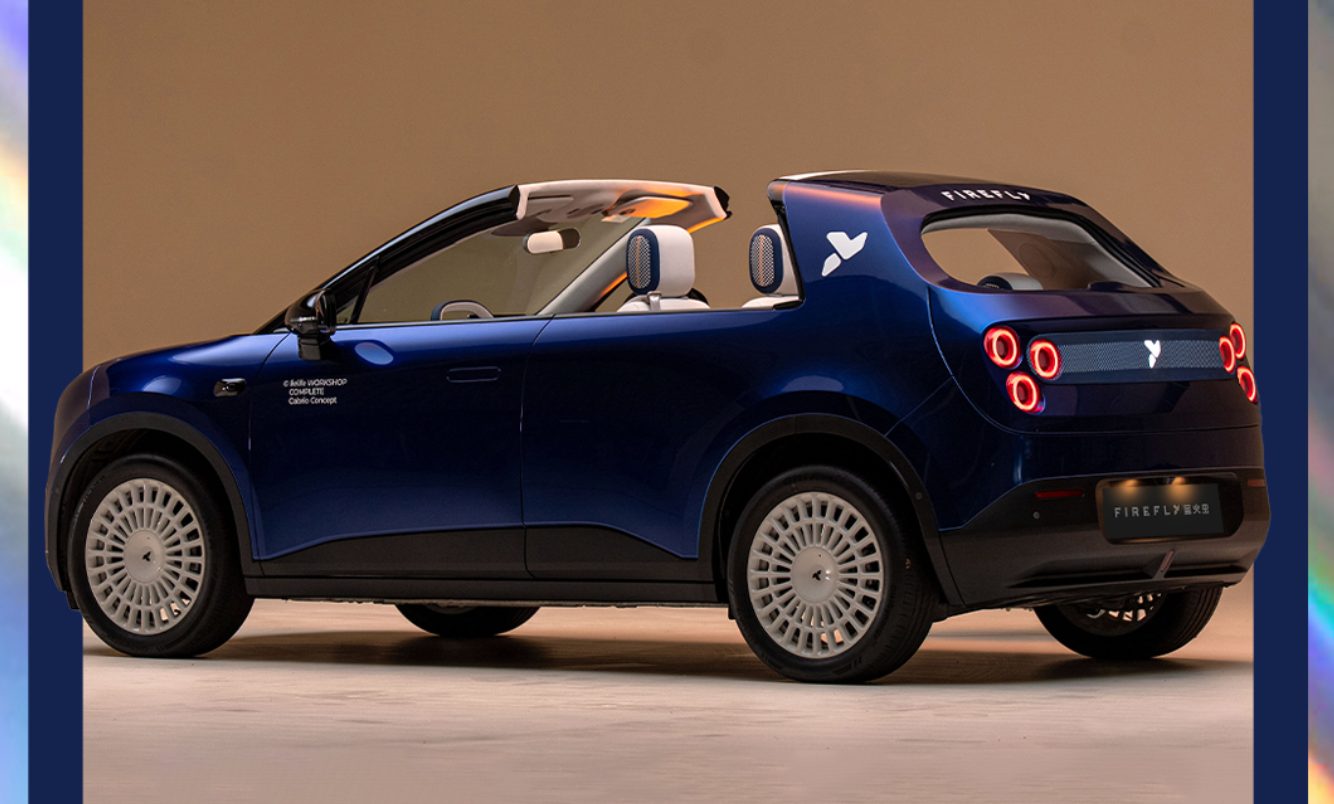
Jin also confirmed a convertible derivative is in what he called a pre-research phase, according to the automotive blogger “莱特宁NEV.”
“The convertible version is currently in a pre-research phase; a convertible would be priced considerably higher than the current model,” the blogger wrote, citing Jin. “Funding will only be advanced once sales reach a certain level, and development will proceed only when the scale of market interest allows.”
Pricing would sit well above the current hatchback, which starts at 119,800 yuan ($17,900) with the battery included in China.
Firefly will move to a crowdfunding model for the convertible only once sales volume reaches a level that justifies the investment.
Jin offered no target number and indicated the project remains conditional on market demand.
80,000 in 494 Days
Saturday’s ceremony came 494 days after the first Firefly was delivered on April 29, 2025.
The brand delivered 5,852 vehicles in August, bringing cumulative deliveries to 80,209 through the end of the month — which indicates that the 80,000th car had already been handed over before the Hefei event.
Monthly volumes have held within a narrow band of 4,980 to 6,946 units since April, making Firefly the most sequentially consistent of Nio Inc.’s three brands this year.
Jin set a target of 100,000 cumulative deliveries by the end of 2026.
Reaching the figure requires approximately 19,800 more vehicles across September through December.
Single Model, Continuous Upgrades
Nio’s founder and CEO William Li told Wall Street analysts on last week’s earnings call that Firefly would remain a single-model brand in 2027, relying on special editions and technology upgrades rather than new nameplates.
Li likened the approach to Apple’s iPhone strategy.
Firefly has launched seven design variants in its first year, including the Halo design series that debuted in July.
Every numbered limited edition has sold out, with sellout windows compressing from about 30 hours for the first 333-unit run to under eight hours for the most recent allocations.
Jin’s remarks on Saturday suggest the brand now views hardware retrofits and battery upgrades — not just special paint and trim — as the next phase of that single-model strategy.
The 60 kWh pack, the electric door handles, and the Aster 2.1.0 update all target the existing fleet.
Firefly has committed to delivering the battery by year-end and the handles by October.