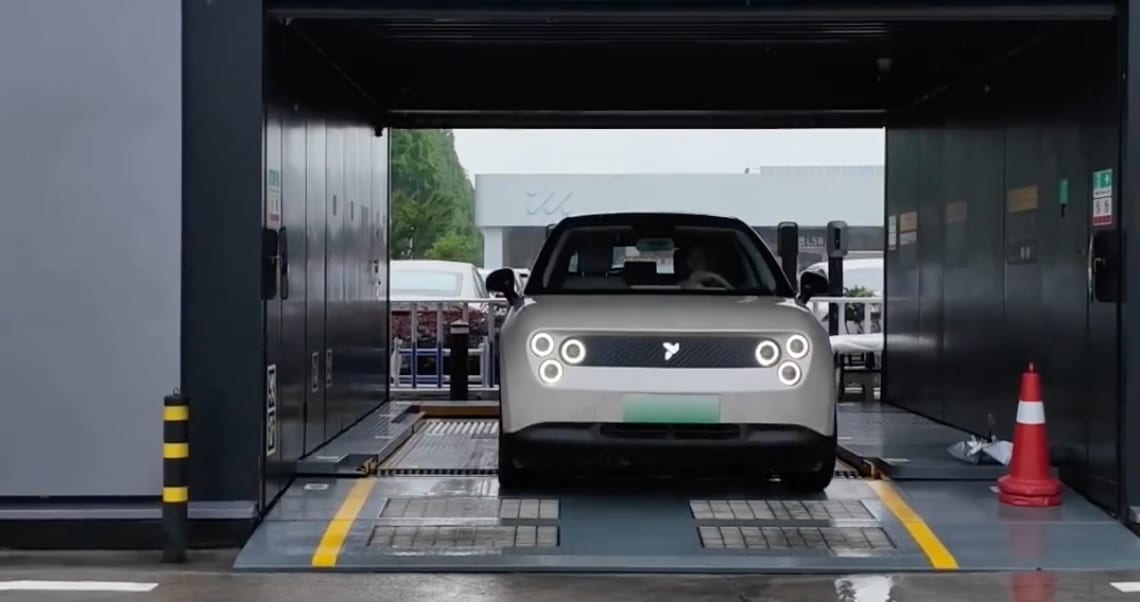

A Firefly battery swap on Nio‘s new fifth-generation station takes about three and a half minutes, the first figure to emerge for the budget brand and nearly double the station’s quoted minimum.
The groundwork was laid earlier this month, when Firefly began rolling out version 1.5.0 of its Aster operating system, which added a battery-swap station compatibility function as the first battery swaps are scheduled for late June.
The figure came from Arthur Shen, an auto blogger close to Nio, who wrote on X on Thursday that a full Firefly swap takes roughly three and a half minutes, a time he said could still be improved.
If confirmed, the number is nearly double the fifth-generation station’s stated minimum swap time of one minute and 48 seconds, and more than a minute longer than the current fourth-generation system.
The current generation completes a swap in about two minutes and 24 seconds for Nio and Onvo models.
The Firefly, whose shorter wheelbase left it incompatible with the fourth-generation stations, will gain swap access only with the fifth generation.
Nio has not published an official swap time for Firefly vehicles.
In a brand video posted the same day, Firefly‘s brand chief Daniel Jin described the process only as taking “the time it takes to play one song” and as being “as fast as refueling,” without giving a figure.
Why the Firefly Is Slower
Nio management has positioned the new station as a speed and capacity upgrade for its main brands, raising per-station capacity by about 20% over the fourth generation and lifting daily throughput to as many as 500 vehicles.
The quoted minimum swap time of one minute and 48 seconds, however, reflects the larger Nio and Onvo vehicles the network was built around.
The fifth-generation station’s defining feature is that it serves Nio‘s entire range from a single piece of infrastructure, accommodating battery packs from Firefly’s 42.1-kilowatt-hour unit up to Nio‘s 150-kilowatt-hour pack.
Earlier stations could not handle that span, which is why Firefly vehicles, with their shorter wheelbase, could not use the fourth-generation network at all.
To fit vehicles of such different sizes, the station’s battery-bay door adjusts its position by extending as each car enters. Firefly‘s debut model, the smallest vehicle in the group, requires the most adjustment.
Jin acknowledged a related trade-off the company is still refining. Because the door moves to fit each model, the station produces slightly more movement during a swap than the fourth-generation design.
“The car still feels a bit bumpy,” he said during the demonstration, adding that reliability was not in question after extensive testing but that the team wanted to reduce the motion further before launch.
Rolling Out From Mid-June
The first batch of fifth-generation stations will be completed in mid-to-late June, Jin said, with large-scale deployment beginning in the third quarter, in line with the July-to-August timeline Nio management gave earlier this year.
At that point, every model across the Nio group will be able to use the stations, with Firefly gaining swap access for the first time. Firefly users will be able to place orders and try swapping once the first stations open.
The preview followed Nio founder and Chief Executive William Li’s announcement of the fifth-generation station at the ES9 launch event on Wednesday.
The timeline has slipped repeatedly.
Nio first targeted a pilot run before Christmas 2025, then revised pioneer deployment to the first quarter of 2026 and mass rollout to the second, before pushing large-scale deployment to July and August.
The Aster 1.5.0 release notes cautioned that the launch timing remained subject to official announcements.
Nio operates the world’s largest swap network, with 3,846 stations in China as of Thursday and more than 110 million swaps provided since 2018.
Li has guided to 4,500 to 4,600 stations by year-end.
How the Swap Works
The vehicle drives itself into the station after the driver parks in a marked area and taps to begin, guided by floor markings and directional arrows.
Jin said the station carries substantial onboard computing power, using sensors to scan the surrounding area for vehicles and pedestrians throughout the process for safety.
Once the battery is removed, sensors and cameras beneath the station inspect its underside for scrapes or hidden faults.
Batteries flagged as problematic are marked and pulled for testing, and any judged a serious risk are retired from the swap network entirely.
Firefly also built in a branded touch with an exclusive swap animation accompanied by original background music composed in a retro 1990s electronic style, according to Jin.
Testing and Reliability
The company has been accumulating test data since the Kunshan test station was completed, Jin said, validating the full process to reach a one-shot swap success rate above 99%.
That testing included unusual scenarios, such as a door being opened mid-swap, which causes the system to exit the swap process. Jin said bugs including interrupted background music and a stuttering animation had been identified and were being fixed ahead of launch.
He said Firefly was “born with battery-swap capability built in,” and that the supporting software became ready after a mid-May update.
The groundwork was laid earlier this month, when Firefly began rolling out version 1.5.0 of its Aster operating system, which added a battery-swap station compatibility function.
The feature guides the car semi-autonomously into the bay after the driver places a swap order and taps to begin, with the option to exit and request manual help from an attendant.