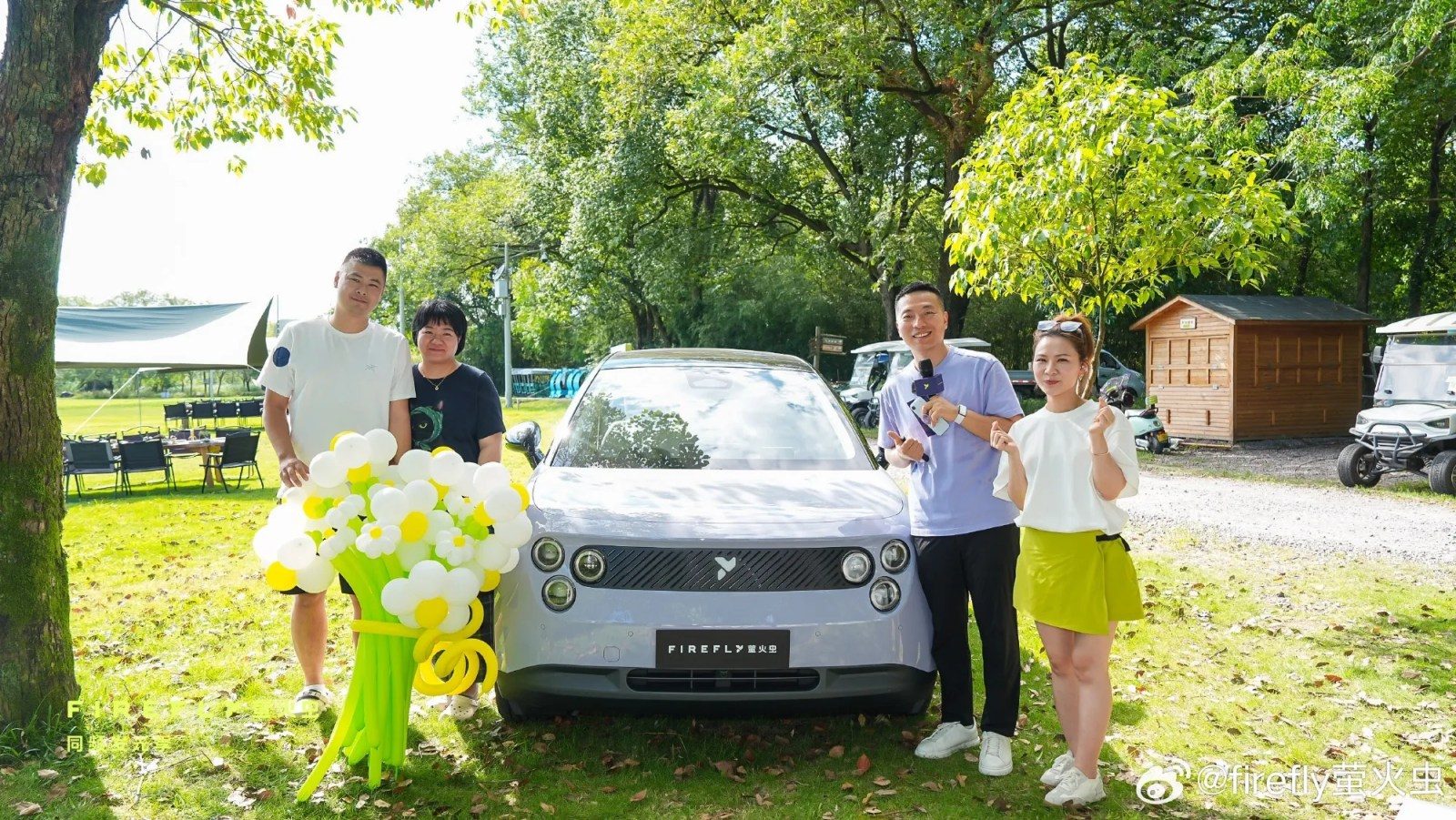

Nio Inc.‘s compact sub-brand Firefly crossed 70,000 cumulative deliveries on Thursday, reaching the milestone about 15 months after its first customer handovers in China.
The last 10,000 units were delivered 54 days after hitting the 60,000 mark on May 23.
Firefly made the announcement on Weibo, where it said the 70,000th vehicle was delivered in Lishui, Zhejiang province.
Cumulative deliveries stood at 68,586 at the end of June, according to company data, which implies that Firefly handed over roughly 1,414 vehicles in the first 16 days of July to cross the threshold.
Additionally, the numbers suggest a slowdown from June’s 6,946-unit total — the brand’s strongest month of 2026 and its second-best on record behind December 2025’s 7,084.
The mid-month pace points to a daily run rate of roughly 88 units, which if sustained would project a full July total well below 3,000 — a figure that would mark the brand’s weakest month since February.
Still, the early July softness comes at a moment when Nio Inc.‘s management attention and production capacity are visibly concentrated on the premium Nio brand’s SUV lineup rather than on Firefly.
Milestone Pace
Firefly began deliveries on April 29, 2025, handing over 231 vehicles in the final two days of the month.
Each subsequent 10,000-unit milestone has been formally announced on Weibo.
The pace of those announcements traces the brand’s delivery curve: the first 10,000 took 88 days, reached on July 26, 2025.
The second arrived 63 days later on September 27.
Firefly crossed 30,000 on November 21 and 40,000 on January 10, 2026 — a 50-day stretch that benefited from a December surge driven by the halving of China’s NEV purchase tax exemption on January 1.
The post-holiday hangover extended the gap between 40,000 and 50,000 to 78 days, the slowest interval in the brand’s history.
January and February deliveries dropped to 2,807 and 2,657 respectively, dragged down by the nine-day Chinese New Year break and a policy-induced demand vacuum.
Momentum returned from March, and Firefly reached 50,000 on March 29 — eleven months after its first handovers.
Since then, the cadence has steadied.
The 50,000-to-60,000 stretch took 55 days, and the 60,000-to-70,000 interval was nearly identical at 54 days.
The consistency suggests Firefly has found a sustainable cruising altitude of roughly 6,000 to 7,000 deliveries per month, broadly in line with the 6,000 to 6,500 monthly target brand chief Daniel Jin set last November.
No New Model
Firefly has operated since launch with a single product — a four-metre electric hatchback developed at Nio‘s Munich design centre and positioned against Mini and Smart in the premium compact segment.
Pricing starts at 119,800 yuan ($17,700) with the battery included, or 79,800 yuan under Nio‘s Battery-as-a-Service rental plan.
An April refresh added new colour options, expanded driver-assistance features and a free over-the-air motor power upgrade to 120 kW, but no structural changes to the vehicle or its pricing.
Beyond the refresh, Firefly‘s recent activity has been limited to special editions — limited-run variants such as the Nomadic Maillard, Night Creature, Newborn Green and a 99-unit collaboration with Dutch artist Jordy van den Nieuwendijk — designed to sustain consumer attention between product cycles without requiring a new model.
Founder and CEO William Li said on the first-quarter earnings call that Firefly would continue to introduce limited additional models to strengthen its brand identity, without providing a timeline.
Jin has maintained a target of 100,000 cumulative deliveries by the end of 2026.
Reaching that figure from the current 70,000 would require roughly 30,000 more vehicles over the remaining five and a half months — an average of about 5,450 per month, a pace below the brand’s recent output and within reach if volumes hold near June levels.
Nio’s Focus on SUV Ramp
The relative quiet around Firefly contrasts with a period of concentrated product activity for the main Nio brand.
The five-seat ES8 launched on July 9 at a starting price of 382,800 yuan, with deliveries beginning the following day across more than ten Chinese cities.
At the same time, the ES9 flagship SUV, which began deliveries on May 28, continues to ramp.
Li has framed 2026 as the start of a third growth cycle, targeting 40% to 50% annual sales growth driven primarily by large SUVs — which include not only Nio‘s models but also Onvo‘s refreshed lineup and the new (also five-seat) L80.
Under the long-term brand mix he has outlined, Firefly would account for 10% of group sales, the smallest of the three marques, behind Onvo‘s targeted 55% and the main Nio brand’s 35%.
Overseas Role
Where Firefly received sustained strategic attention is in its role as the tip of Nio’s international expansion.
Li wrote in an internal letter earlier this year that while the domestic brand hierarchy runs Nio, Onvo, Firefly, the global order is reversed.
The brand now operates in more than a dozen countries across Europe and Southeast Asia, including right-hand-drive markets such as Singapore and Thailand.
European traction has been modest.
Firefly registered 77 vehicles across eight markets in June, and the brand recently announced steep price cuts in Norway and Portugal to stimulate demand.
A batch of 105 vehicles built for the Norwegian market is due to arrive this month.
Daniel Jin acknowledged in March that overseas sales in early 2026 had fallen “considerably” while maintaining the brand’s target of launching in 20 to 30 countries this year.