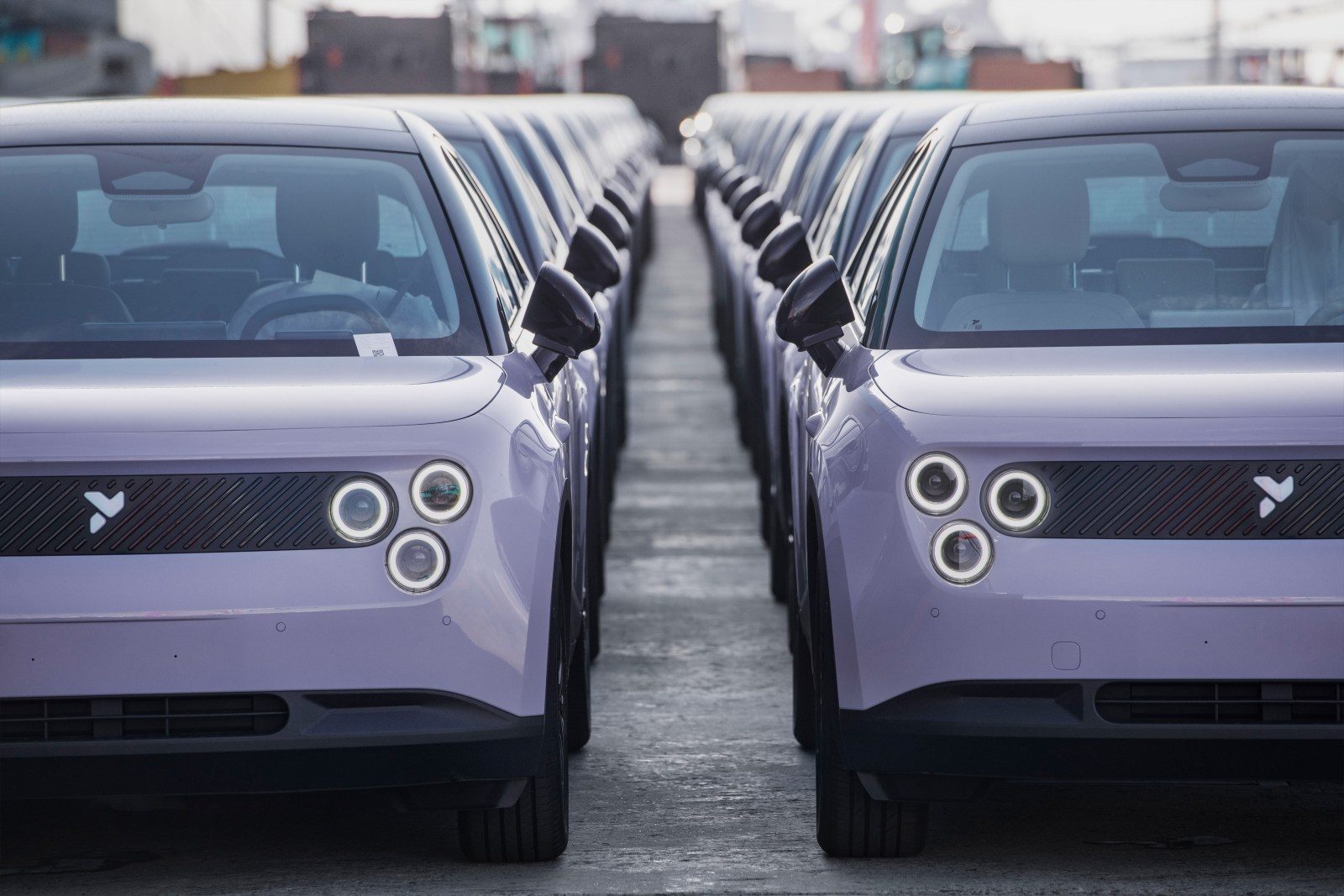

A batch of 105 vehicles that Nio built for the Norwegian market is due to arrive this month, the delivery the Chinese EV maker flagged in June as evidence that it is not retreating from Europe.
Nio had disclosed the delivery in a statement from its Norwegian unit on June 10, saying the 105 cars would arrive in July in line with its plans, alongside a new battery-swap station planned for the Oslo area — the first in over a year.
The vehicles span Nio‘s premium brand and its entry-level Firefly marque, the latter of which has driven most of the group’s recent Norwegian sales.
The total number of vehicles Nio is transporting to Europe is not known. The company has confirmed only the 105-car batch produced for the Norwegian market, and has not said how many vehicles it is sending to the region overall.
The batch is sizeable against the pace of the market. Nio registered 44 vehicles in Norway in June, a fifth straight month of sequential growth, and 161 across the first half.
The recent climb has come off a low base.
Nio registered just nine vehicles in Norway in January, its weakest month there in three years, after Norway cut its EV value-added-tax exemption threshold to 300,000 kroner from 500,000 on January 1, a change the company has said significantly affected its pricing.
Registrations have risen every month since, moving through 15 in February, 24 in March, 26 in April and 43 in May before June’s 44.
A Message Aimed at the Coverage
Nio used the same June statement to argue that recent media coverage had given an unnuanced picture of its European operations, insisting that its push on the continent was being refined rather than slowed and that Norway remained among its highest-priority markets in the region.
An Ho, the country chief of Nio Norway, framed the market as a proof point for the company’s core technology.
“Norway is a market where we see that the model works well,” he said, referring to the battery-swap system that lets drivers exchange a depleted pack for a full one in minutes rather than charging.
The new swap station, planned for the Oslo West and Bærum area, would be Nio‘s first new station in Norway since November 2024, a gap of roughly 19 months and one of only a handful of additions anywhere in Europe since the network’s expansion stalled.
In a recent Nio App post, several customers criticized issues they faced and the slower-than-promised rollout of new battery swap stations.
“How many of these swaps were actually done in Bergen?” a customer questioned replying to the 300,000th milestone post.
“We only have one swap station in the whole city! Many customers have no way to either swap the battery or charge at NIO Power Swap because of the long distance to the swap station,” the user added.
Another user said he/she had visited the workshop four times in the last five months due to an issue during the battery swap process.
“How many of these have had problems with stuck bolts?,” the user questioned. “I’ve already been to the workshop with a bolt problem 4 times in the last 5 months. I got a bolt issue on roughly 1 in 5 swaps I’ve done. You surely must have some statistics on this too.”
Norway hosts 20 of the 60 Nio swap stations across Europe, the most of any country in the region, and the continent’s single most-used station sits in Oslo.
The European network passed its 250,000th swap earlier this year, averaging about 10,000 a month, after the company closed its only Danish facility last year in the network’s first European shutdown.
Battery swapping remains central to Nio‘s pitch, underpinning its battery-as-a-service model, in which customers buy the car without the pack and lease it separately.
Firefly Carries the Volume
Beneath the messaging, the composition of Nio‘s Norwegian sales has shifted toward its cheapest model.
Of the 44 vehicles registered in June, the Firefly sub-brand accounted for 27, with the premium Nio brand contributing 17, split between 15 EL6 SUVs and two EL8 SUVs. No ET5 or ET5 Touring sedans were registered in the month, leaving the small, affordable Firefly, which began its European deliveries in Norway and the Netherlands last year, as the clear driver of demand.
Nio has not broken the incoming 105-car batch down by brand or model. Given the Firefly‘s far lower price and its lead in the group’s recent Norwegian registrations, the sub-brand is the most likely source of the bulk of the delivery, though the company has confirmed no split.
That mix mirrors the group’s wider trajectory, in which Firefly has become the fastest-growing part of the business.
The marque delivered 6,946 vehicles globally in June, its strongest month of the year, though the overwhelming majority of those sales were in China rather than Europe.
Norway sits outside the European Union and levies none of the tariffs the bloc imposed on China-built electric cars in 2024, which has left the Firefly more competitively priced there than in tariff-bound markets, where the same model costs close to double its Chinese starting point.
EU Registration Figures
Across the continent, Nio registered only 74 vehicles in May, with new-market launches masking a stalled core, and its Norwegian tally, while improving month over month, remains modest for a market it describes as a regional stronghold.
June figures are expected to be disclosed later this month when all markets report their registration data.
The company has also shifted its European sales approach toward local distributors outside Norway and thinned its senior ranks, ousting Nio Germany chief David Sultzer earlier this year amid a restructuring of the European operations, followed by the exit of the country’s sales and operations head Sven Conrad — departures that fed the coverage the company is now pushing back against.
The premium brand has gone without an updated model in Europe since the EL8 arrived in 2024, and the third-generation ES8 that launched in China last September has yet to be announced for the region, leaving the range exposed as European rivals refresh theirs.
Norway has become Nio‘s largest European market by volume this year, overtaking Germany, helped by its position outside the EU and the bloc’s 2024 tariffs on China-built cars, though also by its status as the company’s most established market on the continent, which is why the defense of the region has been mounted from Oslo.
Nio is also still selling 2023 and 2024 model-year cars in Europe, stock it has yet to clear across its earliest markets on the continent.