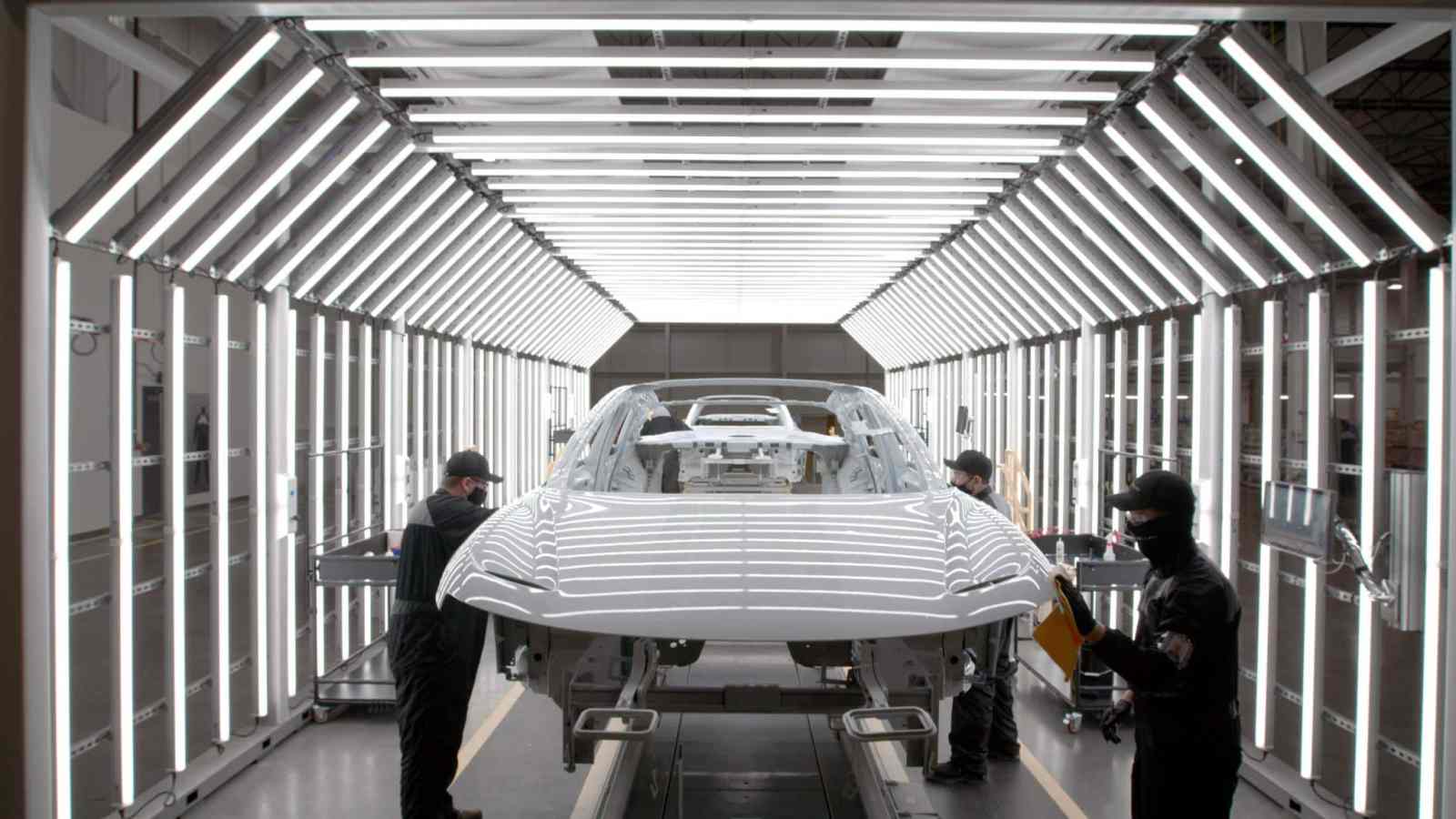

Struggling EV maker Lucid confirmed on Monday that it is cutting about 18% of its US workforce, a reduction that for the first time sweeps in hourly production staff and strips out an entire shift at its Arizona plant.
The disclosure, made in a filing with the Securities and Exchange Commission (SEC), confirmed an earlier EV report that the company had begun shedding US staff, effective Monday.
Lucid said the cut covers full-time employees, contractors and hourly production workers in manufacturing, and that, as part of the move, it had eliminated “the second shift of production at its AMP-1 factory” in Arizona.
The programme is expected to deliver annualised cost savings of about $158 million, the company said, against roughly $32 million in cash chargeemps tied to severance, employee benefits and employee transition.
The Saudi-backed EV maker expects to substantially complete the plan by the end of the third quarter, subject to local law and consultation requirements.
A bigger cut, a smaller saving than February’s
The reduction lands barely four months after Lucid cut about 12% of its US staff in February, a round that — unlike Monday’s — spared hourly workers in manufacturing, logistics and quality.
Monday’s reduction is the fourth formal workforce cut at the company since 2023, following a roughly 18% reduction of about 1,300 roles in March that year and a 6% trim of around 400 positions in May 2024.
That earlier programme was pitched as the larger of the two in dollar terms.
The company valued it at about $500 million in savings over three years, or roughly $167 million a year, against the $158 million in annual savings now attached to a deeper headcount cut.
At about $32 million, the cash cost of the latest round is lower than the $40 million to $42 million Lucid earmarked for the February programme, even though more roles are going this time.
The roughly $158 million in annual savings is less than a sixth of the about $1 billion net loss the company booked in the first quarter alone.
Taken together, the two 2026 rounds would trim a little over $300 million a year from the cost base — meaningful, but a fraction of operating losses that have run into the billions even as revenue climbed 68% in 2025.
As of publication time, Lucid shares were trading 1.6% lower at $5.27 — equivalent to $0.527 on a pre-reverse split basis.
Analysts questioned February’s math
The savings timeline drew scrutiny well before this week’s deeper cut.
In announcing the February reductions, chief financial officer Taoufiq Boussaid said the move would let Lucid “reallocate resources to support the next stage of our growth and margin progression,” with the benefits weighted “towards the near and medium term” and supporting the company’s “path towards gross margin breakeven.”
On the earnings call that accompanied those cuts, BNP Paribas analyst James Picariello pressed management on why $500 million in savings would take three years if the full 12% reduction had already been carried out.
“I’m just curious on the cadence there,” he said, noting that it “sounded like it was more front-end loaded.”
Boussaid replied that this was “not the intent of the message,” explaining that the savings would be “an equivalent proportional amount” each year, with a cumulative impact of “$0.5 billion.”
Investors should “look at it as $500 million divided by 3,” he added. “That’s the yearly impact, and it will be the same for the three years.”
Layoff impact
Boussaid said in February that the cuts touched only the US operation and that “only production workers in manufacturing, logistics and quality are excluded from this action.”
Monday’s deeper round removes that carve-out.
EV reported that the February cuts reached professionals in battery testing and R&D, EV test and validation, continuous improvement and reliability engineering, simulation and thermal engineering, vehicle logistics, and corporate innovation.
Among those let go were former Nikola employees hired less than a year earlier, as the bankrupt rival’s engineers found themselves swept up in the very restructuring that had recruited them.
By extending the latest cut into hourly manufacturing and ending the AMP-1 second shift, Lucid has pushed the retrenchment from back-office roles into production capacity itself — a shift in posture from trimming overhead to scaling back output.
Eliminating the AMP-1 second shift directly reduces how many cars Lucid can build at its only US factory, bringing output closer to demand that has stayed thin.
That change of emphasis matters because the company’s hiring has already collapsed, with open positions down roughly 76% over the past year as it streamlines under new chief executive Silvio Napoli.
The Saudi question
Lucid did not say whether production of its third model — the midsize Cosmos, scheduled to start at its Saudi Arabian plant around the end of the year — remains on track following the latest changes.
That vehicle, a sub-$50,000 crossover built on a new platform, is the company’s central bet to move beyond the low-volume Air and Gravity and toward the mass market.
A delicate stretch
Deliveries fell 42% in the first quarter to 3,093 vehicles, and the company suspended its full-year guidance of 25,000 to 27,000 units pending an update later this year.
The shares have slid to successive record lows in recent weeks, leaving the once-$90 billion business worth a small fraction of its 2021 peak.
Lucid ended 2025 with about $4.6 billion in total liquidity, a cushion that the fresh savings will stretch only at the margins.
Against a cash burn that consumed hundreds of millions of dollars a quarter through last year, the layoffs read less as a turning point than as one lever among several the company is pulling at once.
The same SEC filing that detailed the job cuts also confirmed the departure of chief operating officer Marc Winterhoff, whose role was eliminated only three weeks after he returned to it.