
Li Auto delivered 30,468 vehicles in July, a 0.9% decline from a year earlier and a 1.4% fall from June, the Beijing-based carmaker said on Saturday.
The result leaves Li Auto the only major Chinese auto startup still posting year-over-year declines in the second half, though July’s drop is the shallowest of 2026 by a wide margin after falls of 18.0% in May and 14.8% in June.
Cumulative deliveries reached 1,764,155 as of July 31.
Deliveries for the first seven months total 223,940 vehicles.
A model-level split is not part of the monthly release.
The China Passenger Car Association is expected to publish its model-by-model figures next week, which will separate the i6, the i8, the Mega and the refreshed L-series.
The Supply Problem
The flat July has a specific mechanical cause.
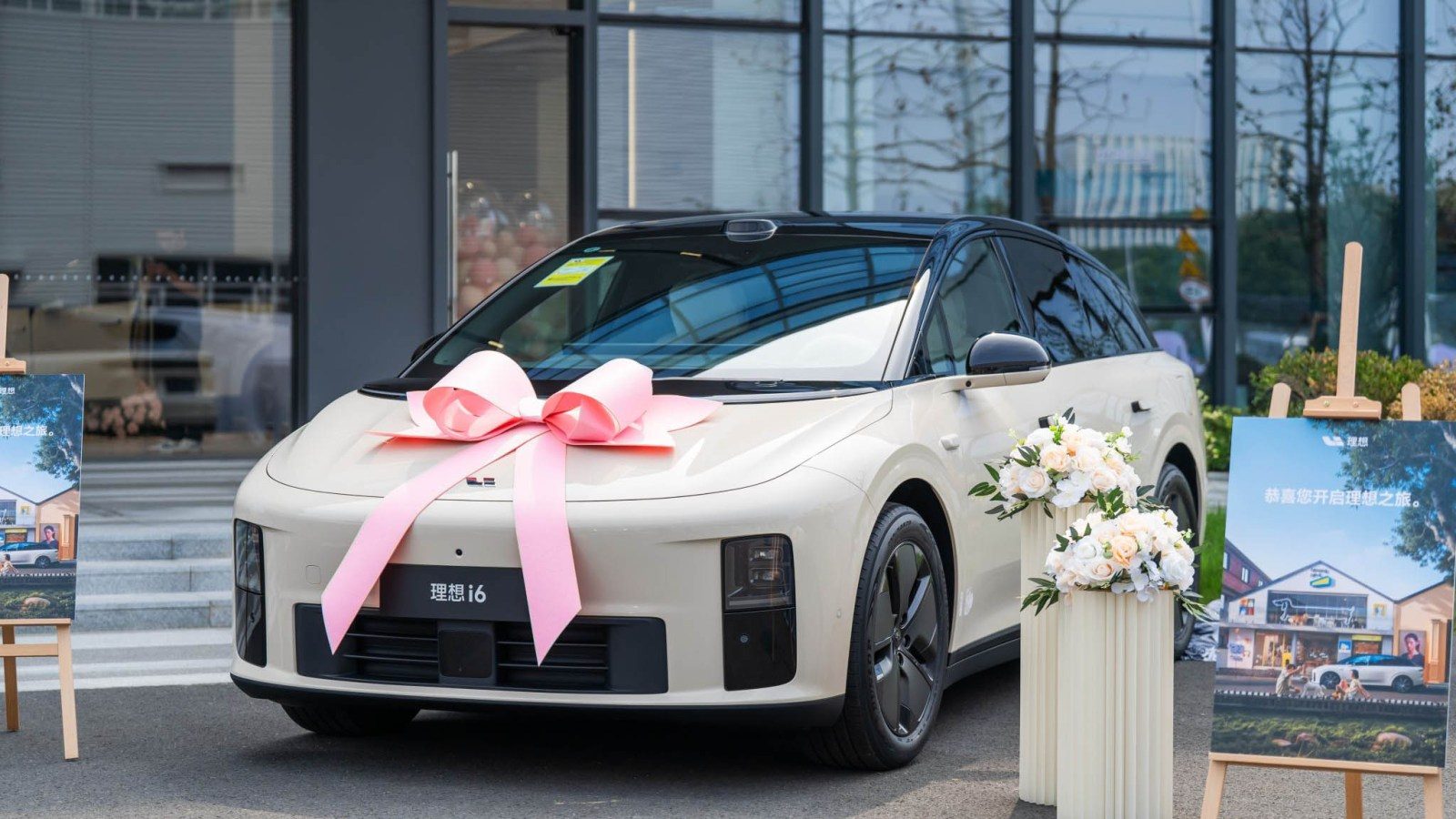
Production of the i6, the fully electric SUV that delivered 21,453 units in June and took 69.4% of that month’s total, was cut by about 4,000 units in mid-to-late July against plan because of temporary fluctuations in headlight supply, product line head Li Xinyang said on Weibo.
He said headlight supply and vehicle production have since returned to normal, and that the company is working with suppliers to recover the lost output so customers who have already ordered are not affected.
Read against a monthly total of 30,468, a 4,000-unit shortfall on the single model carrying most of the volume is the difference between a shallow decline and a return to growth.
That makes August the cleaner read on whether the refreshed lineup is working.
The Refresh Reaches the Volume Model
The next-generation L6 launched on July 16 and reached first customers on July 20, the third of four extended-range SUVs to be renewed this year after the L9 in May and the all-new five-seat L8 on June 23.
The launch date leaves twelve days of L6 deliveries inside the July figure, which is the second reason the month reads flat rather than as a verdict on the refreshed lineup.
Founder and Chief executive Li Xiang said the L6 is due to pass 400,000 cumulative deliveries in August, which would make it the fastest extended-range model priced above 200,000 yuan to reach that mark.
He also said the L9 passed 300,000 cumulative deliveries during July, and the model launched in Kazakhstan on July 15 with local production starting there.
The L6 matters more than the other three combined. Deutsche Bank pegged the refreshed L8 at roughly 5,000 units a month and singled out the entry-level L6 as the larger volume driver among the renewed models.
Cost is the complication. Local outlet Leiphone reported that rising memory chip and lithium carbonate prices had pushed the next-generation L6’s per-vehicle cost up by more than 14,000 yuan, raising the prospect of a price increase at launch.
The L7 remains the only L-series model with no announced refresh, and delivered 754 units in June, down 90.9% year over year.
Target Progress
Li Auto set a 20% growth target for 2026, which chief executive Li Xiang framed on the fourth-quarter earnings call as implying roughly 490,000 deliveries, with international expansion cited as one of the levers.
Against that figure, the 223,940 vehicles delivered through July represent 45.7% completion, requiring an average of 53,212 units a month across the final five.
A 550,000-unit reading of the target, which has also circulated, would put completion at 40.7% and the required pace at 65,212 a month.
Neither figure is close to the current run rate. Li Auto has not delivered above 35,000 units in any month of 2026, and would need to lift volume by at least half to reach the lower target.
The company closed the first half behind its annual goal alongside most of its domestic peers, and was the only major startup to post negative first-half growth.
Where the Pressure Is Coming From
The erosion is specific rather than general.
Xiaomi’s YU7, the Onvo L90 and an expanding XPeng lineup have taken share in the premium segment Li Auto once led, and the company’s fully electric models have faced weaker-than-expected demand against them.
XPeng has also moved into the extended-range segment Li Auto had largely to itself among premium Chinese startups, launching extended-range variants of existing models through 2026.
The response has been to refocus on extended-range vehicles while pushing the fully electric i6 into export markets.
The International Build-Out
Li Auto picked the Benelux region as its first European market for the i6, covering Belgium, the Netherlands and Luxembourg, with a Netherlands entry confirmed through hiring.
The company will make its first appearance at a top-tier European auto show at the Paris Motor Show in October, and has appointed Zach Zhou, previously at Chery and XPeng, as deputy general manager for Europe and managing director for the Benelux.
A right-hand drive Mega is due in Hong Kong, Singapore and other Asia-Pacific markets by year-end, and dealership partnerships have been signed in the United Arab Emirates and Saudi Arabia, with the L-series serving as the main sales driver in the Middle East and Central Asia.
As of July 31 the company operated 490 retail stores across 159 cities, down from 495 stores in 160 cities at the end of June, alongside 536 servicing centres and authorised body and paint shops across 219 cities.
What August Brings
The refresh cycle does not stop with the L6.
Li Auto is preparing revamped versions of both the i8 six-seat SUV and the Mega flagship multi-purpose vehicle for August, according to a Weibo post by an automotive blogger that followed a specification leak, with the i8 expected in showrooms early in the month and the Mega late in it.
Leaked specifications put the refreshed Mega in two trims, a Home variant at 529,800 yuan and an Ultra at 559,800 yuan, while the i8 is said to gain a powered front trunk and semi-hidden door handles with a rear-wheel drive variant serving as the new base trim.
Neither model is confirmed by the company, and both figures should be treated as leaks until it says otherwise.
Separately, Li Auto spun off its in-house automotive AI chip business into a newly registered Shanghai company, putting the silicon effort on the same standalone footing as Nio‘s and freeing the carmaker to concentrate capital on vehicles.