Li Auto‘s global deliveries fell both sequentially and year on year in May to 33,350 units, as the Beijing-based automaker struggles to regain momentum in an increasingly competitive Chinese market.
Compared to April, sales slipped by about 700 units.
A year ago, the company sold 40,856 units in May — placing last month’s figure 18% down year over year.
February had marked the ninth consecutive month of year-over-year sales declines for the company.
In both March and April, Li Auto reversed the trend and posted gains above the year-ago period. May’s result breaks that two-month recovery.
Annual Guidance
The automaker aims to sell approximately 550,000 vehicles this year, up 35.4% compared to 2025 results.
In the first five months of the year, Li Auto reached 162,577 deliveries, representing 29.6% of the full-year target.
To meet the goal, the company must sell 387,423 vehicles across the remaining seven months — an average of roughly 55,350 units per month.
That would place monthly deliveries approximately 20,000 units above the 32,515-unit monthly average it has sustained between January and May.
Last year, Li Auto delivered a total of 406,343 vehicles, failing to meet its revised 640,000-unit goal by 36.5%.
The automaker initially aimed to deliver 700,000 vehicles in 2025.
Li Auto‘s financial position has reflected the delivery shortfall: its gross profit plunged 66% in the first quarter as its vehicle margin collapsed to 6.1%.
i6 Carries the Lineup
Since March, monthly deliveries of the Li i6 pure electric SUV have exceeded 20,000 units for three consecutive months, according to the company.
The battery-electric five-seat model has become the volume driver in the lineup, after Li Auto resolved the early production bottlenecks that limited the i6 to just 404 units in its debut month.
The i6 sits on an 800-volt platform and carries an 87.3 kWh battery from CATL or Sunwoda, supporting 5C charging at up to 500 kW.
The SUV is priced from 249,800 yuan ($36,900), positioning it against the Tesla Model Y, Xiaomi‘s YU7, and XPeng‘s G7.
Li Auto‘s Li i6 is also set to be its first vehicle in Europe, with the company having picked the Benelux region — Belgium, the Netherlands, and Luxembourg — as its initial markets.
L-Series Refresh
To revive sales momentum in its extended-range lineup, Li Auto officially launched the updated flagship Li L9 in May, marking the beginning of the product update cycle for its L-series extended-range SUVs.
Li Auto revealed that the high-end Livis version of the all-new Li L9 garnered over 10,000 firm orders within two weeks of its launch.
The model features the brand’s third-generation extended-range platform with a combined range of 1,650 kilometers.
Following the L9, Li Auto plans to officially launch its five-seat flagship SUV Li L8 in late June.
The updated model will undergo a major product positioning adjustment, abandoning the current six-seat design and pivoting to focus on the premium five-seat market.
The shift is aimed at avoiding internal cannibalization with the larger L9, which also features a six-seat layout. Li Auto also offers the fully electric three row Li i8.
Rising Competition
Li Auto is facing pressure from multiple directions in the Chinese market.
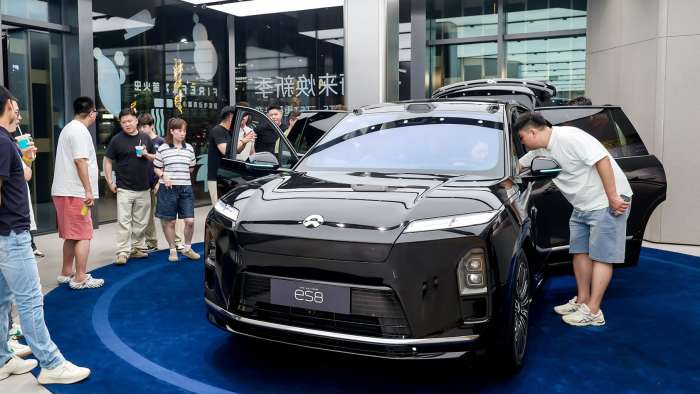
The company’s i6 competes directly with Nio sub-brand Onvo, which launched the five-seat L80 SUV earlier this month in the same segment.
The two companies have a history of friction that reignited during the parallel rollouts of the L80 and the new Li L9.
Onvo is scheduled to enter Europe in 2027.
Meanwhile, XPeng has expanded aggressively into the extended-range segment that Li Auto once had largely to itself among premium Chinese startups.
XPeng had previously produced only fully electric vehicles since its founding but began entering the EREV market in late 2025 with its Kunpeng Super Electric Platform.
The Guangzhou-based automaker plans to launch seven models in 2026 — including three extended-range variants of existing fully electric vehicles.
Its flagship GX SUV, available in both BEV and EREV configurations, opened pre-sales in April at 399,800 yuan and launched with a lowered price of 279,800 ($41,400), plus a 10,000 yuan promotion on top.
Organizational Reshuffle
Beyond its product strategy, Li Auto has been reshuffling its internal structure.
The company completed a new round of organizational restructuring for its foundation model department in late May, adding three new departments focused on embodied AI — embodied engineering, embodied interaction, and embodied behavior — as it accelerates its transition into an AI and robotics company.
The autonomous driving business was separated into an independent tier-two department as part of the reshuffle, with the three new embodied AI units operating in parallel.
The restructuring follows a January all-hands meeting where founder and CEO Li Xiang outlined his vision for the company’s AI future, predicting that Level 4 autonomous driving would be implemented by 2028 at the latest.