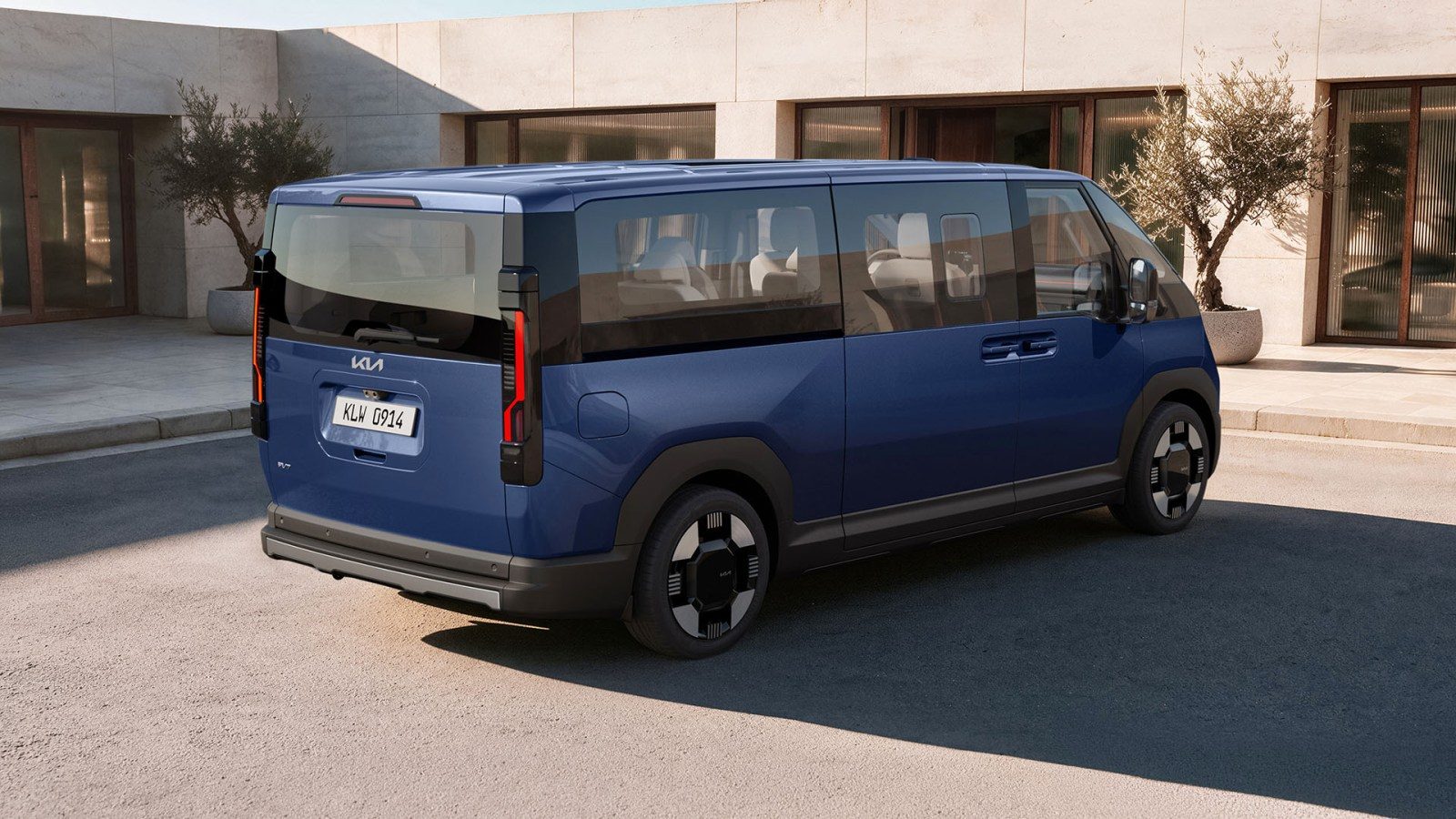

Kia gave its PV7 electric van a world premiere at IAA Transportation in Hannover on Monday, moving the company from the compact segment its PV5 has dominated this year into the larger light commercial class, and bringing an 800-volt architecture that none of its European rivals offers in the size.
The PV7 goes on sale in South Korea and Europe in the second half of 2027, with Australia following in the fourth quarter of that year. Kia gave no prices.
The long versions shown in Hannover measure 5,350mm long, 1,995mm wide and 1,990mm high on a 3,500mm wheelbase. They sit on E-GMP.S, the skateboard platform Kia built for these vehicles, with a flat floor throughout.
Two nickel cobalt manganese batteries, at 71.5 and 96.2 kWh. Up to 200kW and 420Nm through the front wheels depending on market and configuration, with an all-wheel-drive version promised later and no date given.
Kia quotes more than 460km of WLTP range for the Long Range Cargo, from its own internal measurement, with homologation still pending. The German-language release says up to around 460km where the international version says more than 460.
The 800-volt system charges from 10% to 80% in the mid-20-minute range on a 350kW direct-current charger, a figure Kia also describes as provisional. The PV5 runs at 400 volts.
Two charging ports, a combined alternating and direct current socket at the front and an optional alternating current socket at the rear, which Kia says is a first for one of its vehicles and is meant to save manoeuvring in tight depots.
Vehicle-to-load provides 230-volt sockets inside and out.
Cargo and Passengers
Cargo Long offers 6.1 cubic metres by the VDA standard, rising to 8.0 in a high-roof version not shown in Hannover, with a 550mm loading height and room for three Euro pallets. Payload is 1,165kg on the Long and 1,200kg on a shorter Compact version.
Passenger comes in seven and nine-seat forms globally, with an 11-seat version for Korea.
Kia says its Flexible Body System will support 23 PV7 variants including chassis cab and conversion models after launch. Across the whole range the company has promised more than 40 body types.
Inside, the Pleos Connect system runs on Android Automotive OS with Kia’s Gleo voice assistant, alongside a fleet management platform giving operators vehicle location, battery status and maintenance data.
Kia distinguishes the two vans by concept rather than size. The PV5 is an Open Box built for urban flexibility. The PV7 is a Tool Box built as a heavier business tool.
Why Europe First
Kia chose the European show for the reveal because the PV5 has performed better there than anywhere else.
The PV5 registered 13,116 units across the European Union, Norway, Switzerland and Britain in the first half, taking 37% of the C-segment electric van market and ranking first in twelve countries, on figures Kia cites from the European Automobile Manufacturers’ Association.
It took 63% of the segment in Denmark, 62% in Ireland, 59% in Sweden, 58% in Finland and 54% in Britain, its largest single market at 3,361 units, with Germany second at 2,206. In Denmark, the Netherlands, Norway and Sweden it outsold every van of any powertrain. The PV5 Cargo was named International Van of the Year 2026.
Kia had never built a van before last year.
What the PV7 Has to Carry
At its investor day in April, Kia set a target of 232,000 PBV sales a year by 2030, against a global electric light commercial vehicle market it projects at about a million units.
In Europe it is aiming for 133,000 sales by 2030 and an 18.6% share, split 63,000 PV5s, 52,000 PV7s and 18,000 PV9s.
That makes the PV7 the second-largest contributor to the European plan and gives the van unveiled on Monday about 39% of it to deliver.
The PV5 sold about 8,500 units in its first year and Kia is targeting 54,000 globally this year. The PV9, a larger model, follows in 2029.
Production of the PV7 runs at the Hwaseong EVO plant in Korea, which began building the PV5 in July 2025, alongside a conversion centre.
The Competition
The PV7 enters the segment occupied by the long-wheelbase Ford E-Transit Custom, Mercedes-Benz’s eVito and the medium Stellantis vans. At 5,350mm it sits below the full-size Sprinter and E-Transit, which Kia intends the PV9 to address.
Its advantage on paper is charging speed. The incumbents run 400-volt systems and cannot match 350kW without a new platform.
Against that, the PV7 does not go on sale for a year, its range figure is not homologated, its charging time is provisional and Kia has published no price.
“The PV7 marks the next step in our journey toward personalized mobility, building on the foundation established by the PV5,” said Ho Sung Song, Kia’s President and Chief Executive Officer.
“By bringing together hardware developed for specific applications, business-tailored software and dedicated PBV services, the PV7 goes beyond the vehicle itself to deliver a complete business solution,” Ho Sung Song added.