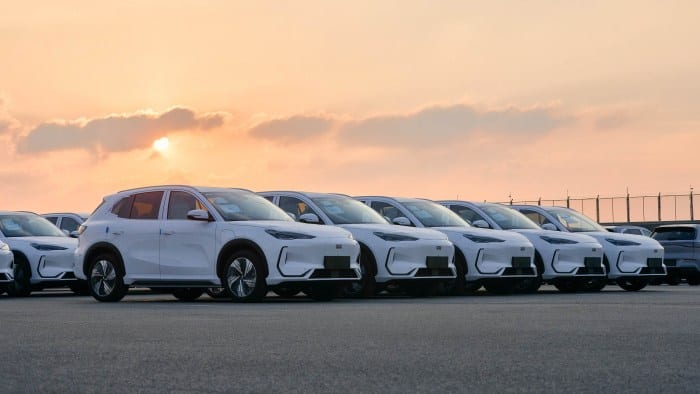

Kia released the first images and video of its PV7 electric van on Monday, confirming a debut date and almost nothing else about the vehicle.
Hyundai Motor Group’s newsroom account posted the teaser on X at approximately 8:45 p.m. US Eastern Time, which was Monday morning in Seoul, where Korean outlets carried it from about 9:30 p.m. Eastern.
The post introduces the van as the second PBV to join the lineup, names it The Kia PV7, and gives the debut as IAA Transportation on September 14.
That date is the trade fair’s press day.
The show itself opens to visitors on September 15 and runs to September 20 in Hanover, Germany.
The model features a black hood and pillar garnish set against the body colour, and front and rear lamp graphics that the company presents as a signature identity for its commercial vehicles.
No dimensions, battery capacity, motor output, payload, range, pricing or body variants were disclosed.
The Second Model, Not a Second Platform
The PV7 is the second vehicle in Kia’s Platform Beyond Vehicle line, following the PV5, and it uses the same architecture rather than a new one.
Both sit on E-GMP.S, the service-specific derivative of the platform underpinning the EV6 and EV9, which Kia describes as a skateboard chassis able to carry different upper bodies.
The platform runs a 400-volt electrical system rather than the 800-volt architecture used on Kia’s passenger EVs, a decision that lowers cost and suits the charging infrastructure fleets actually operate.
Kia showed all three original PBV concepts — the compact PV1, the mid-size PV5 and the large PV7 — at CES in January 2024.
The vehicle teased on Monday has been public in concept form for more than two and a half years.
Comparison
Kia UK executives have described the PV7 as mid-size, scheduled for 2027 ahead of the large PV9 in 2029, in briefings on the company’s British van plans.
The 2024 concept measured 5,270mm long, 2,065mm wide and 2,120mm tall on a 3,390mm wheelbase, and Korean reporting puts production versions between 5,270mm and 5,900mm depending on wheelbase.
At the upper end that is Mercedes-Benz eSprinter and Ford E-Transit territory rather than a Transit Custom rival, but Kia has published no production dimensions and the discrepancy between its own regional descriptions remains unresolved.
For comparison, the PV5 measures 4,695mm in standard form and 4,890mm long-wheelbase.
Why the Timing Works
The teaser lands on the back of a first half in which the PV5 took 37% of Europe’s electric C-segment van market, according to figures Kia published from European Automobile Manufacturers’ Association data.
Kia sold 13,116 PV5s across the EU, Norway, Switzerland and the UK in the six months to June, leading the electric C-segment in twelve countries and clearing half the segment in five: Denmark at 63%, Ireland 62%, Sweden 59%, Finland 58% and the UK 54%.
Britain is the largest single market at 3,361 units, ahead of Germany on 2,206, and across all powertrains the PV5 was the best-selling C-segment van in Denmark, the Netherlands, Norway and Sweden.
Kia originally planned about 4,000 PV5 registrations in the UK for 2026 and raised the figure to roughly 6,500 in April after taking more than 3,750 orders in under four months.
The PV5 Cargo was named International Van of the Year 2026 at Solutrans in Lyon last November, the first time a Korean manufacturer had won it.
Global cumulative sales passed 39,000 units in August, against roughly 8,500 for 2025 as a whole and a 54,000 target for this year.
The Factory
Kia completed the Hwaseong EVO Plant East and broke ground on EVO Plant West on the same day in November 2025, committing about 4 trillion won across roughly 297,000 square metres for a combined 250,000 units of annual PBV capacity.
EVO East builds 100,000 PV5s a year. EVO West, covering 136,671 square metres and due to open in 2027, is sized for 150,000 large PBVs including the PV7.
That is half again the PV5’s capacity, under construction for a model whose specifications remain undisclosed nine months after the buildings were commissioned.
Kia’s 2030 target, set out at its CEO Investor Day in May, is 232,000 PBV sales a year with Europe and Korea named as core markets — a figure distinct from the 250,000 of production capacity, which several accounts have conflated.
The Debut Event
The question the reveal has to settle is whether the swappable body survives from concept to product.
Kia’s CES material described interchangeable rear life modules attached by a hybrid electromagnetic and mechanical coupling, and chief executive Song Ho-Sung said in March that the PV7 is the platform for that technology and that the PV5 is too small for the complexity involved.
He also named the obstacle, telling Auto Express that a formal process for the swap is needed, because every market approves body styles individually.
Kia says it will use Hanover to set out its mid-to-long-term PBV roadmap and show PV5 derivatives alongside the PV7.
The van has not been confirmed for the US market, where a 25% duty applies to commercial vehicles built outside North America, though a PV5 was spotted testing in Michigan with US-specification marker lights in February.
Kia sold 3.14 million vehicles globally in 2025 and targets 3.35 million this year, of which 2.775 million overseas.