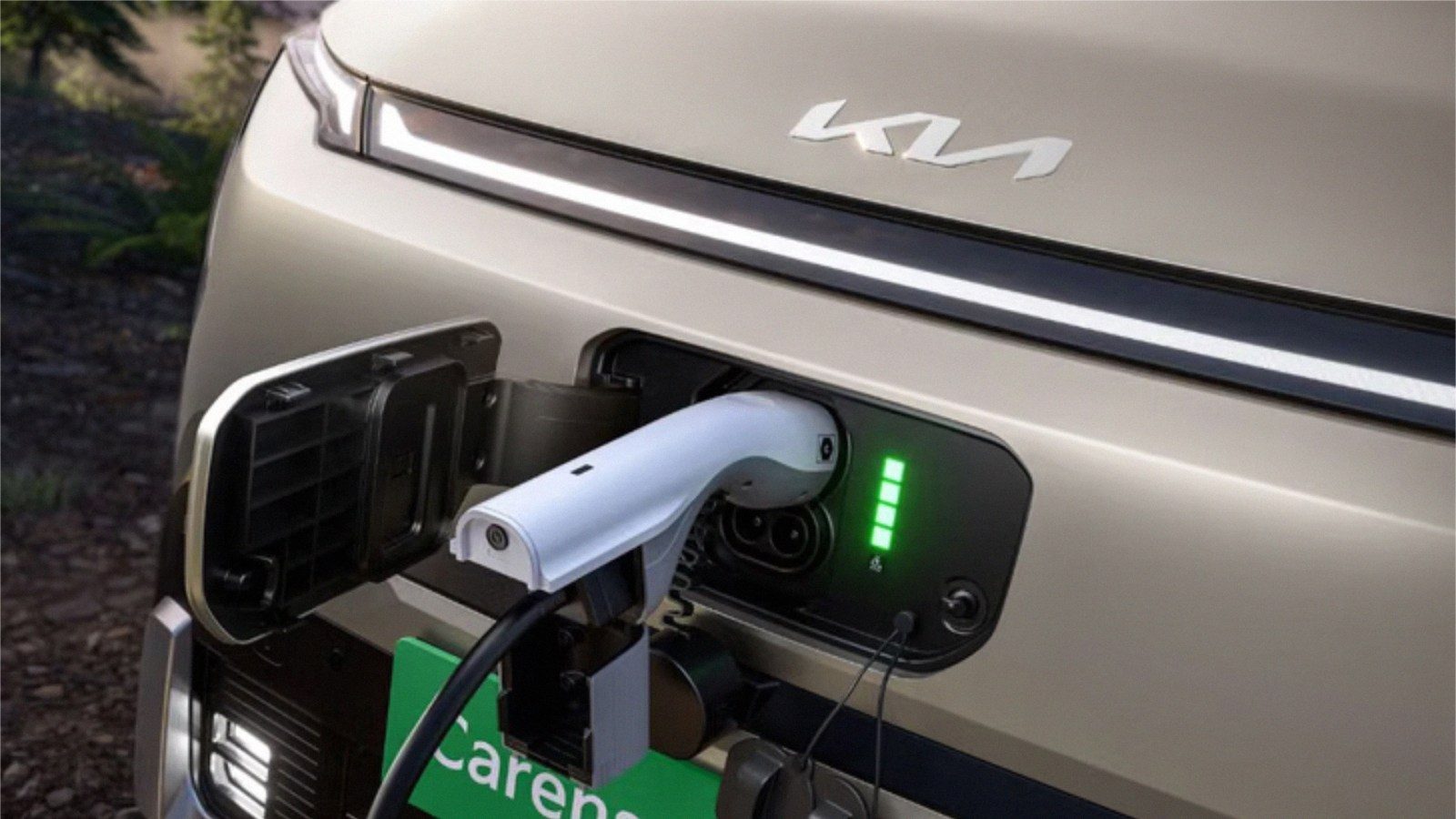

Kia India on Tuesday introduced a Battery as a Service (BaaS) finance program for the Carens Clavis EV, becoming the second automaker after Toyota to offer a battery rental scheme in the country’s growing EV market.
The program separates the battery and chassis into two independent loan accounts, allowing customers to finance the vehicle body through a standard auto loan while paying for the battery on a per-kilometer basis.
South Korea’s giant is charging 3.3 Indian rupees ($0.034) per kilometer for the battery across both pack sizes, with a chassis loan tenure of up to 60 months and a battery rental period extending up to 96 months.
Kia India’s Chief Sales Officer Sunhack Park framed the initiative as part of a wider ecosystem strategy.
The company said the BaaS model is designed to lower the financial barrier to EV ownership and make the transition to electric mobility more accessible for Indian consumers.
How It Works
Under the dual-loan structure, buyers of the Standard variant — equipped with a 42 kWh battery and priced at 1,799,000 rupees ($18,800) — can begin ownership with a down payment of 51,520 rupees ($540).
The chassis financing amount for this variant is 1,284,000 rupees ($13,400), with monthly installments starting from 26,650 rupees ($280) before the per-kilometer battery charge is added.
For the Extended variant, which carries a 51.4 kWh battery and starts at 2,199,000 rupees, the chassis financing amount rises to 1,594,000 rupees.
Monthly installments on this tier begin at 33,099 rupees. The per-kilometer battery rate remains the same.
Kia has partnered with five financial institutions to support the program — ICICI Bank, HDFC Bank, Axis Bank, Kotak Mahindra Bank, and Bajaj Finserv.
No Vehicle Changes
The BaaS scheme does not come with any changes to the Carens Clavis EV itself.
The model received a 2026 model year update in March that added new bumper designs, fresh alloy wheels, a six-seat layout option, and new trim levels including the GT-Line and X-Line.
Prices and specifications remain unchanged.
The Carens Clavis EV is Kia‘s first made-in-India electric vehicle. It is offered in 17 variants across nine trims, with the 42 kWh battery producing 135 hp and the 51.4 kWh pack producing 171 hp.
The company claims the range stands at 404 km for the smaller battery and 490 km for the larger one.
To support the ownership experience, Kia offers access to more than 15,000 charging points across India through its K-Charge feature on the MyKia app, which includes EV route planning, real-time charger availability, and integrated payment solutions.
More than 100 Kia dealerships in the country are equipped with DC fast chargers, and the company says it has over 267 EV-ready workshops.
A Growing Trend in India
Kia is the latest automaker to adopt a battery rental model in India, following Toyota, which launched its Urban Cruiser Ebella in January with a BaaS option.
Toyota’s program similarly allows customers to purchase the SUV without the battery and pay a separate subscription fee, though the Japanese automaker directed customers to dealerships for pricing details at the time.
SAIC-backed MG Motor had previously introduced a per-kilometer battery subscription model in India, charging around 3.5 rupees per km — slightly above Kia‘s rate.
Suzuki has also offered a similar option with the e-Vitara SUV.
Kia‘s 3.3-rupee per-kilometer pricing makes it among the more competitively priced BaaS options currently available in the market.
The approach addresses a key barrier to EV adoption in India: upfront cost.
By decoupling the battery — which accounts for a significant share of an electric vehicle’s total price — from the vehicle purchase, automakers can bring sticker prices closer to those of comparable internal combustion engine models.
In the case of the Carens Clavis EV, the chassis-only financing starts at 1,284,000 rupees, compared to the full ex-showroom price of 1,799,000 rupees.
Chinese Companies
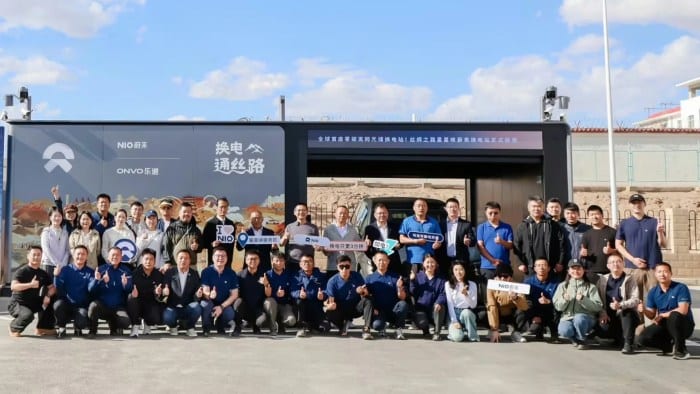
The first company to heavily invest in the concept of separating battery ownership from vehicle ownership was Chinese EV maker Nio.
Under Nio‘s model, customers purchase the vehicle at a reduced price — with deductions of up to 70,000 yuan ($10,300) at launch — and pay a monthly subscription fee for battery access.
The program is underpinned by Nio’s battery swap network, the world’s largest for passenger vehicles.
As of Wednesday, the company operated 3,845 battery swap stations in China, where a depleted pack can be replaced with a fully charged one in under three minutes.
Nio reached a milestone of 100 million cumulative battery swaps in February.
The company’s founder and CEO William Li said this week that Nio plans to add roughly 1,000 stations per year through 2028, targeting county-level coverage across China.
In China, 80% to 90% of Nio buyers purchase their vehicles through BaaS, according to Li.
The battery assets are held by Mirattery, a dedicated battery asset company established in partnership with CATL, Hubei Science Technology Investment Group, and a subsidiary of Guotai Junan International.
Nio‘s three brands — Nio, Onvo, and Firefly — all offer BaaS options.
The 2026 Nio ES6, for example, starts at 338,000 yuan with the battery included but drops to 230,000 yuan under BaaS — a price reduction of roughly 32%.
The battery swap model has since attracted broader industry participation in China.
CATL, the world’s largest battery manufacturer, launched its own “Choco-Swap” network in December 2024.
As of late April, CATL‘s network had grown to approximately 1,470 stations across 99 cities, with partnerships spanning six automakers — including Changan, Chery, GAC, Seres, SAIC–GM-Wuling, and BAIC.
CATL is targeting 4,000 stations by year-end.
Different Approaches
There is a key distinction between the Indian and Chinese implementations of BaaS.
In China, Nio‘s program is paired with physical battery swapping infrastructure — stations where a robotic system removes and replaces the battery pack in minutes.
The scheme allows BaaS subscribers to effectively “recharge” by swapping rather than plugging in, and to upgrade to larger battery packs without changing vehicles.
In India, the BaaS programs launched by Kia, Toyota, and MG Motor are purely financial arrangements. The battery remains in the vehicle at all times.
There is no swap infrastructure, and the per-kilometer or subscription-based payment model functions as a financing tool to reduce upfront costs rather than as a physical service layer.