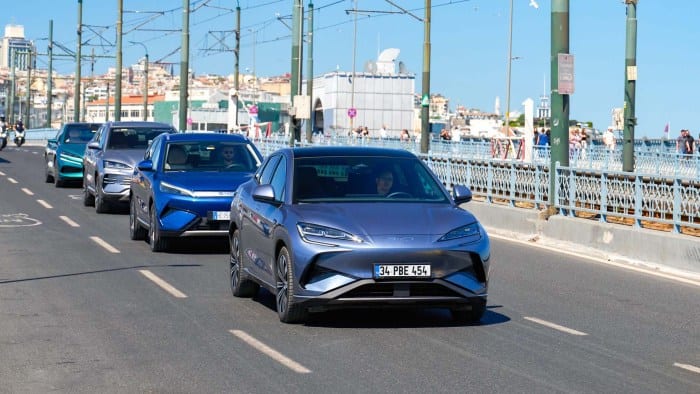
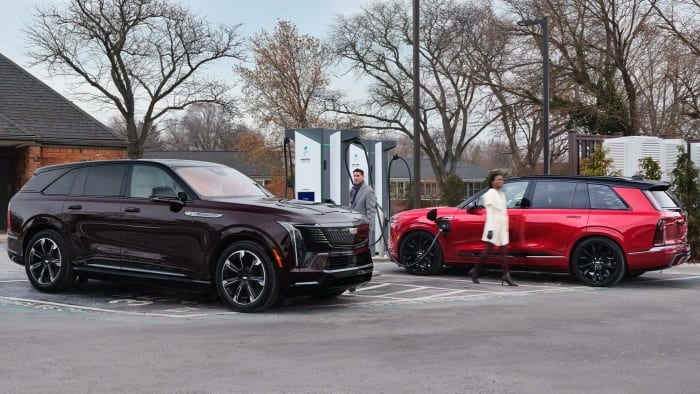
Nissan has taken back the title of Canada’s most affordable new electric vehicle, a month after Kia claimed it with the 2027 EV3, with the launch of the new Leaf S.
The EV3 launched at C$36,995 (US$26,700), while the new entry-level trim of the Japanese automaker’s small electric SUV is priced from C$34,998 (US$25,200).
With freight included, the Kia model jumps to CA$39,744, while the Leaf increases to C$37,966 considering all fees — nearly C$2,000 below the EV3’s starting price.
Both models qualify for Canada’s Electric Vehicle Affordability Program (EVAP) incentive, which brings its effective starting price under C$30,000 (US$21,600).
“With the addition of the LEAF S, we’re making electric mobility even more accessible for Canadians. The new grade brings the lowest-priced entry point into EV ownership for Canadians while maintaining many of the technologies and capabilities found elsewhere in the lineup,” Nissan Canada President Steve Rhind said.
EVAP eligibility depends on a vehicle’s price and place of manufacture, which is also why the Chinese-built EVs currently entering Canada under the country’s import quota, including Tesla’s Shanghai-built Model 3, do not qualify for it.
The S is a trim Nissan had appeared to abandon.
The third-generation Leaf launched in Canada last autumn with the 75 kWh battery only, and in February The Car Guide reported that the small-battery S “will not be coming” to Canada, as Nissan had already decided for the United States, where the tariff on Japanese-built cars made the trim unviable.
The US still has no Leaf S.
The Leaf S Specs
The Leaf S uses a 53 kWh battery paired with a single 174-horsepower motor, rated for up to 341 km (212 miles) of range.
Higher Leaf trims — S+, SV+ and Platinum+ — move to a 75 kWh pack and a 214-horsepower motor, extending range to 488 km (303.2 miles), with pricing starting above C$45,000 (US$32,500).
Both the Leaf S and the higher trims charge through an NACS port, recovering 10-80% in about 35 minutes.
The Leaf comes standard with dual 12.3-inch instrument cluster and infotainment displays, along with wireless Apple CarPlay and Android Auto.
How the Kia EV3 Compares
The EV3 is offered in five trims — Light, Wind, Land, GT-Line and GT — across two battery sizes.
The base Light trim pairs a 58.3 kWh battery with a single 201-horsepower motor for up to 356 km (221 miles) of range.
The Wind, Land, GT-Line and GT trims move to an 81.4 kWh pack rated for up to 517 km (321.3 miles).
Front-wheel-drive EV3s produce 201 horsepower from a single motor.
All-wheel-drive versions add a rear motor for a combined 261 horsepower, rising to 288 horsepower on the range-topping GT.
The EV3 charges slightly faster than the Leaf, going from 10-80% in about 29 minutes on its 58.3 kWh battery.
It shares the Leaf’s dual 12.3-inch display layout and wireless smartphone mirroring, and adds a 5-inch climate control screen the Leaf doesn’t have.
Neither is the cheapest EV to buy this month. Fiat Canada is advertising C$8,000 off the 500e, taking its C$39,995 MSRP to C$31,995 before fees, and Chevrolet C$4,200 off the 2027 Bolt, to C$35,799 for 410 km of range.
On MSRP per kilometre of rated range, the discounted Bolt is C$87, the Bolt at list C$98, the Kia EV4 C$100, the Leaf S C$103, the EV3 C$104 and the discounted Fiat C$141. The Leaf is the cheapest car and the fourth-cheapest kilometre.
China Competition
The Leaf’s new pricing follows a year in which Tesla cut its Canadian Model 3 price by shifting supply from Fremont to Shanghai, and in which competitors are preparing for Chinese automakers to arrive under the quota deal Prime Minister Mark Carney struck with Beijing in January.
China-built cars enter under the 6.1% most-favoured-nation tariff set by the quota agreement Prime Minister Mark Carney struck in January, instead of the 100% previously applies — and the 25% counter-tariff applied to US-built vehicles.
Tesla relaunched its Model 3 Premium AWD trim in Canada at (US$36,056) C$49,990 earlier this year after shifting Model 3 production for the Canadian market from its Fremont plant to Giga Shanghai.
The switch let Tesla cut Model 3 pricing well below where it sat before the move — though Shanghai-built cars are ineligible for Canada’s federal EV rebate, which is limited to vehicles built in free-trade partner countries.
At the same time, BYD is already testing four models in Canada — the Shark pickup, Sealion 7, Sealion 06 and Ti7 — with vehicles spotted in Ontario and Quebec.
The company has continued hiring in Toronto, including for roles tied to a planned Canadian dealer network and, more recently, a flash-charging infrastructure build-out. BYD has not announced a launch date, models or pricing for Canada.
Canada’s import quota for Chinese-built EVs opened its second six-month window on September 1 with 33,397 permits available, after the first window closed with just under 64% of its 24,500 permits used.
Almost all of the vehicles imported under the quota so far have been Shanghai-built Tesla Model 3s.
The US Comparison
Pricing looks different south of the border.
The Kia EV3 Light starts at US$29,890 in the US.
Nissan does not offer the smaller 53 kWh Leaf battery there at all — the cheapest US trim is the Leaf S+, starting at US$29,990 with the larger 75 kWh battery and up to 303 miles of range.
The US-spec EV3 Light keeps the smaller 58.3 kWh battery for up to 221 miles of range, with the 81.4 kWh option extending that to 321 miles.
Both US starting prices come out above C$41,000, well above what either automaker charges for its cheapest Canadian trim.
Neither the US Kia EV3 Light nor the US Nissan Leaf S+ has an equivalent to the EVAP-eligible pricing available in Canada.