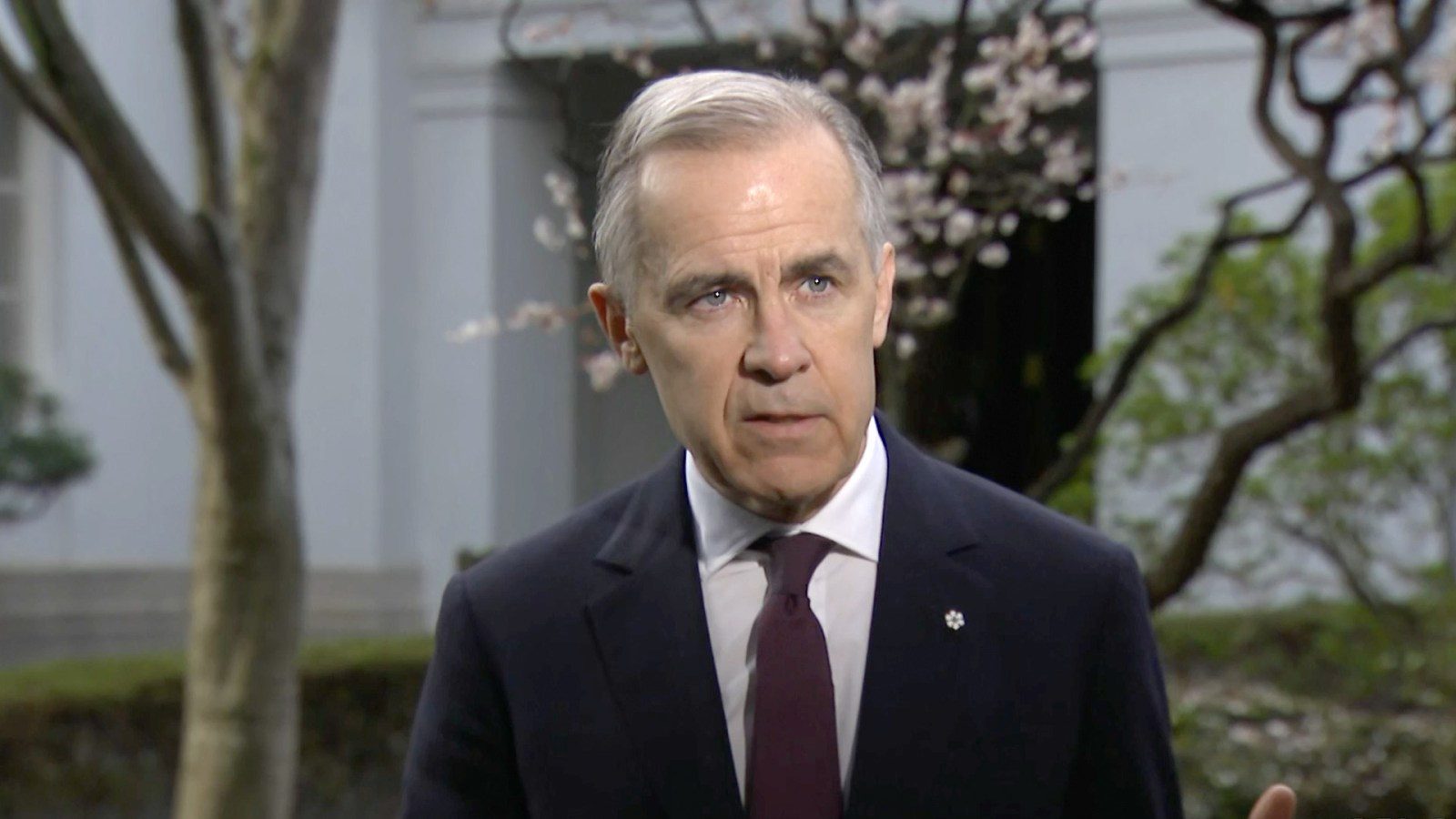

Prime Minister Mark Carney said Tuesday that Canada is pushing for a comprehensive trade agreement with Washington that covers the auto sector, hours after President Donald Trump’s new 50% tariff on Canadian goods thrust the industry back to the center of the dispute.
Trump signed three proclamations on Monday night imposing the tariffs under Section 338 of the 1930 Trade Act, citing what the White House called unfair Canadian “discrimination” against American autos, alcohol and dairy products.
The rate excludes energy, potash, fish and critical minerals, but reaches goods previously shielded by CUSMA, including autos.
The tariffs take effect in 30 days.
Carney: ‘We’re At the Table’
Speaking with reporters on Tuesday, Carney was asked directly whether he’d been caught off guard, and whether Canada would keep making concessions to bring the Americans back to the table — after Ottawa recently backed off the Gordie Howe Bridge dispute and rolled back both the Digital Services Act and the Online Streaming Act.
“We, well, we’re at the table,” Carney replied. “We’ll be having those more intense discussions. And, you know, what the issue has been for us has been a comprehensive agreement.”
The Prime Minister added that Canada understands “the US approach to strategic sectors, what they call strategic sectors,” which “under their definition, 232 definitions, that’s aluminum, that’s forest products, that’s steel, that’s automobiles, pharmaceuticals, copper, others.”
However, the first four are “the most important for the Canadian economy.”
The Canadian PM is clear. “We don’t want a partial agreement, we want something that addresses those sectors as well, so that there’s a viable approach going forward,” he stated.
Carney does not intend to discard the role of the Canada-US-Mexico Free Trade Agreeement (CUSMA) either, despite the US not being interested in pursuing it further.
“In our view, and the view of Madame Scheinbaum and the Mexican authorities, there are solutions that evolve CUSMA so that those sectors are globally competitive to the benefit of workers,” he added. “Of course, we’re working for workers in Canada first and foremost, but also workers across the other two authorities.”
Statement Singles Out Auto Tariffs
Carney’s office issued a written statement on early Tuesday, calling the new 50% tariff “the latest in a series of unilateral US trade actions that began with the US imposing a series of tariffs in direct violation of the Canada-United States-Mexico Agreement (CUSMA), the free trade agreement between Canada, the United States, and Mexico.”
The statement was explicit about the auto sector: “These include tariffs on the Canadian auto sector, in violation of CUSMA. Canada, as is its right, has merely matched those measures.”
Carney said Ottawa has made “a series of detailed and comprehensive proposals to resolve this dispute and to modernise CUSMA” over the past 18 months, and added: “We stand ready to intensify those discussions in the coming weeks.”
He pointed to more than 20 new economic and security partnerships signed by his government as evidence Canada “believes in the benefits of free and fair trade,” and wrote that the dispute “has raised costs for families, particularly in the US.”
According to Carney, “Canada stands ready to engage intensively to address outstanding issues with the US. to the mutual benefit of our citizens.”
“In all circumstances, Canada will work relentlessly and take any measures necessary to build our strength at home and to support Canadian workers, farmers, businesses, and families,” the statement concluded.
Autos Already Reshaped by the Dispute
The renewed focus on autos comes after the sector absorbed the brunt of the tariff fight over the past year and a half.
Canada’s counter-tariffs cut American auto exports to Canada by $5.6 billion between April 2025 and March 2026, a 22% drop from the year before, according to White House figures — while Canadian imports from Mexico, Japan, South Korea and Germany rose by $2.9 billion as automakers rerouted sourcing.
Hyundai and Subaru shifted production destined for Canada away from US plants, and Mazda and Nissan dropped certain US-built models from their Canadian lineups altogether.
Ford, GM, Honda, Stellantis and Toyota — the five automakers that build vehicles inside Canada — have been spared so far, after Ottawa granted them tariff-free access to US-built parts and vehicles in exchange for keeping their Canadian production and investment commitments intact.
However, the Detroit-based automakers have pulled back on Canadian-based manufacturing over the past year, choosing to reallocate part of that production to the US instead.
A Wider Three-Way Negotiation
Carney’s push for a comprehensive deal lands as North American trade talks intensify on multiple tracks at once.
Washington told Canada and Mexico on July 1 it would not renew CUSMA for a new 16-year term, though the agreement stays in force while the three countries negotiate a modernization.
Moreover, negotiations are being held separately. The US and Mexico have met for a third round of bilateral talks on Tuesday.
Ahead of the renegotiation, Canada has spent this year diversifying away from reliance on the US market — including through a low-tariff import framework for Chinese-built EVs.
Canada imported 9,235 Chinese-built electric vehicles since Ottawa’s quota framework opened on March 1, according to a Global Affairs Canada report executed last Friday.
The concentration of imports centers around a single importer — Tesla, which switched to imports from its Shanghai plant rather than its US-based ones.
Industry Minister Mélanie Joly visited China from June 14 to 23 and reported that three major Chinese automakers were open to building EVs in Canada through local joint ventures — through which Ottawa plans to recover its declining auto industry.
Reacting to the new tariffs on X, the opposition Conservative Party leader Pierre Poilievre wrote on Tuesday that “we must work together to fight for our workers against tariffs,” again asking for a Tariff-Free Auto Pact between the US and Canada.