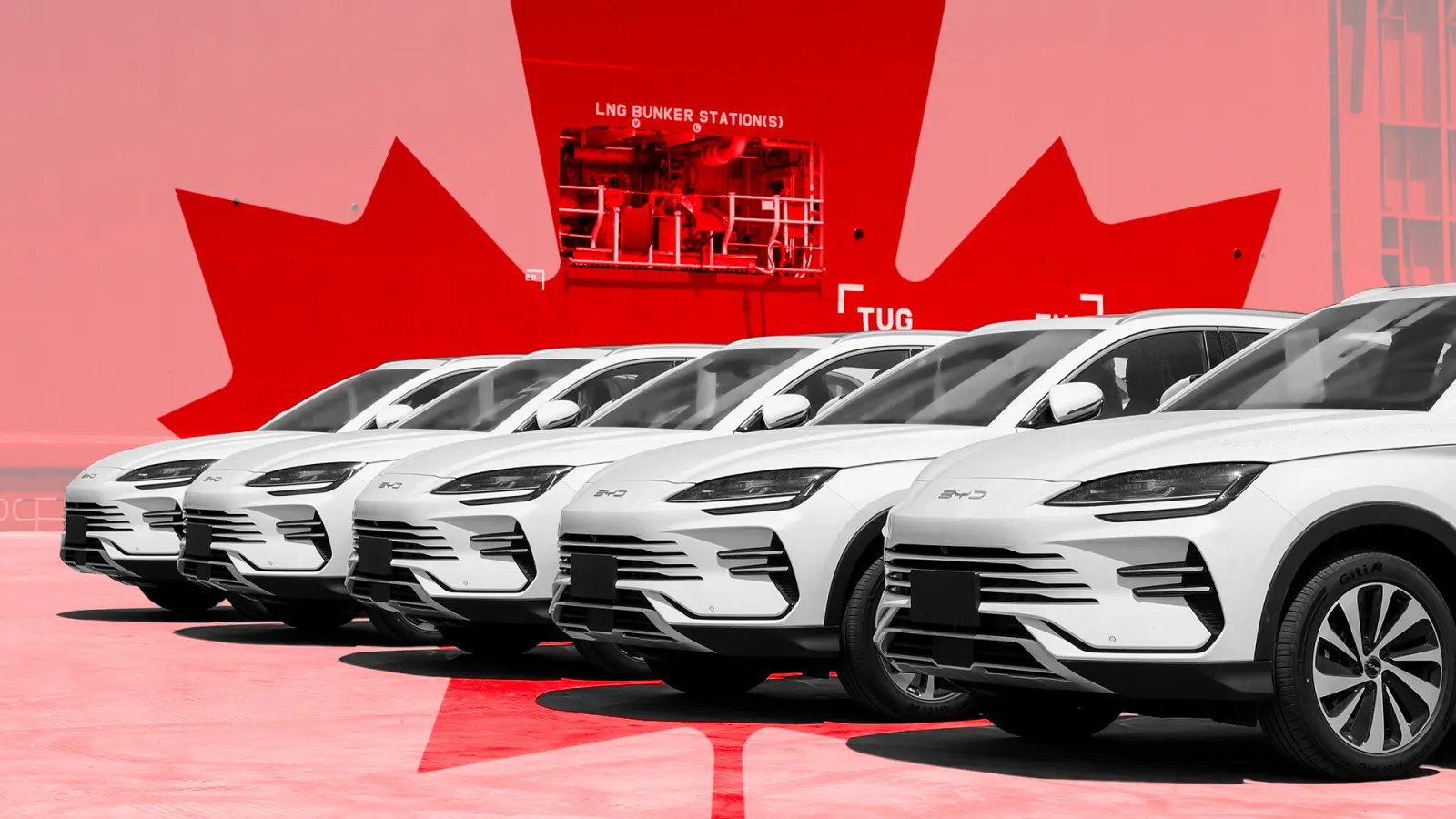
Canada imported 5,104 Chinese-built electric vehicles in the first 17 days of July alone, making the month the busiest since Ottawa’s quota framework opened on March 1, according to a Global Affairs Canada report executed last Friday.
Total imports under the 24,500-vehicle first-window quota now stand at 9,235, equal to 37.7% of the allocation available through August 31.
Some 15,265 permits remain.
A previous report executed on July 10 had shown 6,531 vehicles imported, suggesting 2,704 additional vehicles cleared customs in a single week. The July surge eclipses earlier monthly figures.
May — when Tesla began shipping Shanghai-built Model 3 sedans to Canada — logged 3,510 imports, then June fell to 621.
July’s partial-month tally of 5,104 already exceeds the entire prior cumulative total through June.
Lower-Value Imports
The Global Affairs Canada data breaks imports into three tariff categories under HS code 8703800010 and 8703800090, classified by customs value and vehicle type.
Electric passenger vehicles with a customs value at or below C$35,000 accounted for 4,192 of July’s 5,104 imports, or 82.1%.
The category had been nonexistent through May, first appeared in June with 465 vehicles, and has now reached a cumulative total of 4,657 — surpassing the over-C$35,000 passenger car tier for the first time.
Passenger cars valued above C$35,000 added 908 units in July, bringing the cumulative figure to 4,553. SUVs and passenger vans above C$35,000 contributed four vehicles in July for a total of 25.
Customs value refers to the declared import classification threshold, not the retail price consumers pay in Canada.
The shift is significant because Ottawa’s quota framework is designed to reserve a growing share for cheaper models — from 10% in the second year to 50% by the fifth.
The lower-value category now accounts for just over half of all imports at 4,657 of 9,235 vehicles, despite carrying no mandatory set-aside in the first year.
Whether new manufacturers have begun shipping qualifying vehicles or Tesla is classifying later Model 3 shipments under a different customs value remains unclear, as the report does not identify importers.
Still, Tesla is almost certainly responsible for the vast majority of imports.
The automaker launched a Shanghai-built Model 3 in Canada on May 1 at C$39,490, exploiting the 6.1% most-favoured-nation tariff — far below the 25% national-security tariff applied to US-built vehicles entering Canada.
No other importer has demonstrated anything close to that volume.
Chinese Competitors
The first Chinese-controlled brand to ship vehicles under the quota in early July was Lotus, landing 18 Eletre SUVs built at its Wuhan plant.
The Geely-owned brand launched the Eletre in Canada in April at C$119,900, down from C$313,500 under the old 100% surtax. Still, the price tag is way above the affordable threshold.
BYD and Chery have not yet shipped vehicles for Canadian sale.
China’s ambassador to Canada, Wang Di, said in late June that both companies were still completing regulatory steps and hoped to enter in the autumn.
BYD‘s Executive VP Stella Li has said the company would likely begin Canadian sales next year, with plans for around 20 dealerships and a local factory.
Dongfeng has signaled its intent to enter the market earlier this month, showcasing EVs at an event in Montreal on July 14.
The state-owned automaker aims to introduce its first two models as early as 2027.
Dongfeng operates joint ventures with Stellantis and Nissan, with Nissan having disclosed in May that it is considering exporting vehicles from its Dongfeng JV to Canada.
Responding to a question by EV in Munich last week, XPeng has also signaled long-term interest in the Canadian market, though shipments remain further out.
Outlook
The concentration of imports around a single importer — Tesla — has previously prompted Ottawa to consider capping how much of the quota any single automaker can claim.
Global Affairs Canada opened consultations in April on moving to per-manufacturer allocations for the second quota window, which begins September 1.
Industry Minister Mélanie Joly visited China from June 14 to 23 and reported that three major Chinese automakers were open to building EVs in Canada through local joint ventures.
Prime Minister Mark Carney has set conditions including joint-venture partnerships, Canadian control, substantial value-add and Canadian labour standards.
Joly has said the only routes for Chinese automakers into Canada are the quota system or a joint venture with a Canadian company.
Despite the quickening pace, significant first-window capacity remains.
With 15,265 allocations available and roughly six weeks until the August 31 cutoff, importers have room to accelerate without hitting the cap.
Any unused first-window permits carry over into the second quota period starting September 1, meaning the combined available allocation could approach 40,000 vehicles if the current window is not fully used.
Trump Escalates Tariffs
US President Donald Trump announced on Sunday a 50% tariff on a broad range of Canadian goods — citing what he called discriminatory treatment of US cars, dairy and alcohol.
The duties, imposed under Section 338 of the Tariff Act of 1930, take effect in 30 days and cover roughly $20 billion in annual Canadian imports. Energy, potash, critical minerals and fish are exempt.
One of the three proclamations Trump signed targets Canada’s 25% counter-tariff on US-built vehicles — the same levy that gave Tesla a cost incentive to source Canadian Model 3s from Shanghai rather than Fremont.
A White House fact sheet noted that Canadian imports of US motor vehicles fell approximately 22%, or $5.6 billion, between April 2025 and March 2026.
The fact sheet also singled out Canada alongside China as the only two countries to have retaliated against Trump’s tariffs rather than negotiate.
Canada’s EV quota arrangement with Beijing — the same framework under which the 9,235 vehicles entered — emerged directly from that bilateral reset.
Canada agreed in January to admit up to 49,000 Chinese-built EVs a year at the 6.1% tariff, replacing a 100% surtax imposed under former Prime Minister Justin Trudeau.
The annual cap rises 6.5% each year toward roughly 70,000 vehicles by 2030.
Carney called the tariffs a violation of the USMCA and said Canada stood ready to “intensify” trade talks.
The new duties add to existing US levies of 15% to 50% on Canadian steel, aluminium and copper, a 35% tariff on softwood lumber, and a 25% tax on non-US auto parts — all of which remain in force alongside Canada’s own counter-tariffs on US goods.