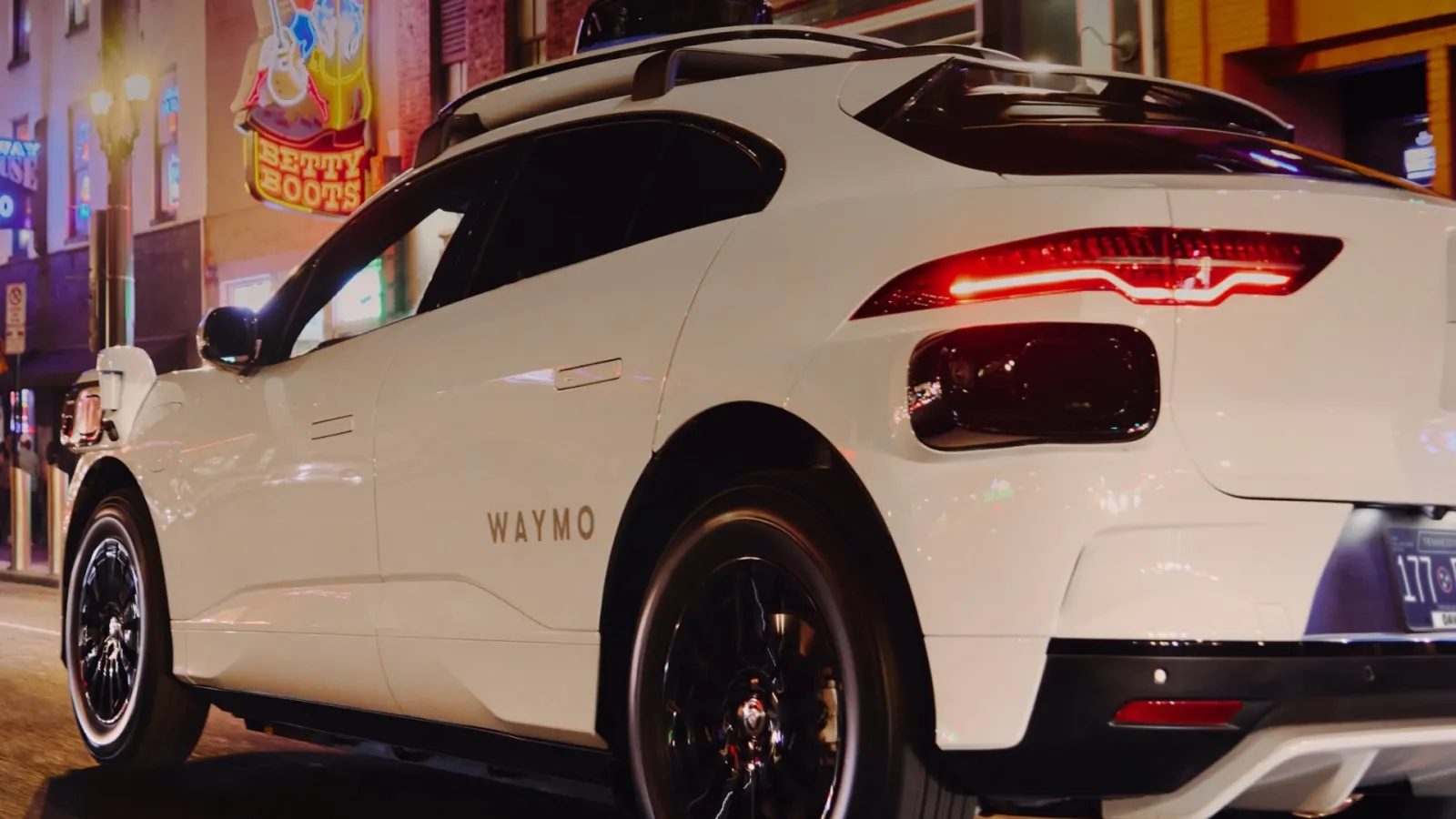

Waymo rides became available on the Lyft app in Nashville on Wednesday, making Tennessee’s capital the first US city where the Alphabet-owned robotaxi operator dispatches vehicles across both its own platform and a ride-hailing partner’s network at the same time.
Riders requesting a Standard, Priority Pickup, Wait & Save or Extra Comfort trip that starts and ends inside the Waymo service area can now be matched with a fully autonomous Jaguar I-Pace at no additional cost, the companies said in a joint press release.
Availability will expand gradually over the coming weeks.
Nashville had been a Waymo-app-only market since April 7, when Waymo began paid rides on a rolling-invite basis with “dozens of vehicles” across an initial 60-square-mile area, and dropped the waitlist on June 25.
Lyft integration adds a second demand channel without removing the first.
Nashville is Lyft’s second US city with autonomous rides, after a May Mobility pilot in Midtown Atlanta, as it works to close the gap with Uber, which has offered Waymo rides in Austin since March 2025 and Atlanta since June 2025.
Supply-Sharing System
A dynamic supply-sharing mechanism lets the same fleet serve requests from both the Waymo and Lyft apps — the first deployment of its kind for Waymo.
The Austin and Atlanta exclusivity is ending.
Waymo plans to launch its own app in both cities in 2028, The Next Web reported on Wednesday, which would leave Nashville’s two-app model as the template rather than the exception.
Nashville splits the difference — Lyft and Waymo dispatch vehicles from a single pool, with the system routing each car to whichever platform generated the next eligible request.
Eligible routes must start and end within a zone covering Downtown/Broadway, North Nashville/Germantown, East Nashville, Midtown and South Nashville, according to the press release.
Riders who prefer a human driver can decline an individual robotaxi match or opt out of autonomous assignments entirely through their Lyft account settings.
Human drivers will continue to serve riders throughout and around the service area, creating what the companies call a hybrid network.
Flexdrive Handles Fleet Operations
Lyft’s wholly owned subsidiary Flexdrive is providing end-to-end fleet management for the Nashville deployment — cleaning, charging, maintenance, inspections and depot operations.
The arrangement differs from Waymo’s partnership with Uber in Austin and Atlanta, where fleet management is handled by Moove, a mobility company.
An 80,000-square-foot purpose-built facility near Nashville International Airport on Elm Hill Pike is scheduled to open in October.
More than 70 full-time positions have been created, including technicians, fleet coordinators and operations leads. About half of those hired so far are former Lyft drivers, Flexdrive said in an April blog post.
The fleet plan targets “low-digit hundreds” of vehicles, with satellite charging and cleaning sites to be added around the city as the operation scales.
Waymo has previously said the Nashville fleet will grow to hundreds of Jaguar I-Pace SUVs — at a time when the company is upgrading its fleet to the Ojai robotaxi, built by China’s Zeekr.
A Partnership
While Nashville represents the most significant commercial collaboration between Waymo and Lyft, the relationship stretches back to 2017.
Waymo and Lyft signed a non-exclusive collaboration agreement in May of that year, The New York Times reported.
Talks had begun the previous summer between Lyft co-founders Logan Green and John Zimmer and then-Waymo CEO John Krafcik.
The deal produced a small Phoenix pilot in mid-2019, in which Waymo placed 10 Chrysler Pacifica Hybrid minivans on the Lyft platform in the Chandler, Mesa, Tempe and Gilbert area with safety drivers present, according to TechCrunch.
The pilot wound down around 2020 as Waymo expanded its own app in Phoenix.
Waymo later described the deployment as a useful building block for the Nashville deal.
Lyft CEO David Risher framed the Nashville partnership at its September 2025 announcement as a combination of autonomous technology and fleet expertise.
Waymo co-CEO Tekedra Mawakana highlighted Flexdrive’s fleet-management capabilities as the reason Lyft was the right partner for the city, according to the original BusinessWire release.
The release promised Waymo-app rides first and Lyft matching “later in 2026.” Wednesday’s launch fell inside that window, three weeks short of the anniversary.
Uber Takes Over
Between the 2019 pilot and September 2025, when the Nashville partnership was announced, Lyft fell behind Uber in the autonomy race.
Uber signed a multiyear deal with Waymo in 2023 and began offering robotaxi rides in Phoenix later that year before expanding to Austin and Atlanta, where Waymo vehicles remain exclusive to the Uber platform.
Waymo and Uber quietly ended the Phoenix portion of their collaboration this May, after reaching the contracted end date.
An Uber spokesperson called the Phoenix deployment an “intentionally limited” effort of just over a dozen vehicles.
Nashville Amid a Broader Push
Lyft integration arrives as Waymo pushes deeper into new US markets.
Paid robotaxi rides went live in Denver, San Diego and Tampa on September 1, extending the company’s fully autonomous ride-hailing network to 14 US cities.
Waymo completes more than 500,000 paid trips a week and has logged over 200 million fully autonomous miles.
About 300 of its next-generation Ojai robotaxis — built by Zeekr in Ningbo, China, and fitted with sensors at a Magna facility in Mesa, Arizona — were in commercial service as of mid-August, a spokesperson told TechCrunch.
Research firm MoffettNathanson projects a total fleet of 5,000 by year-end.
Beyond the US, about 100 Jaguar I-Paces are testing across 19 London boroughs.
Waymo announced Munich as its second European city with rides targeted for late 2027, registered entities in Spain and France earlier this summer and filed a Korean subsidiary in July.
Tokyo has also been named as a future market.