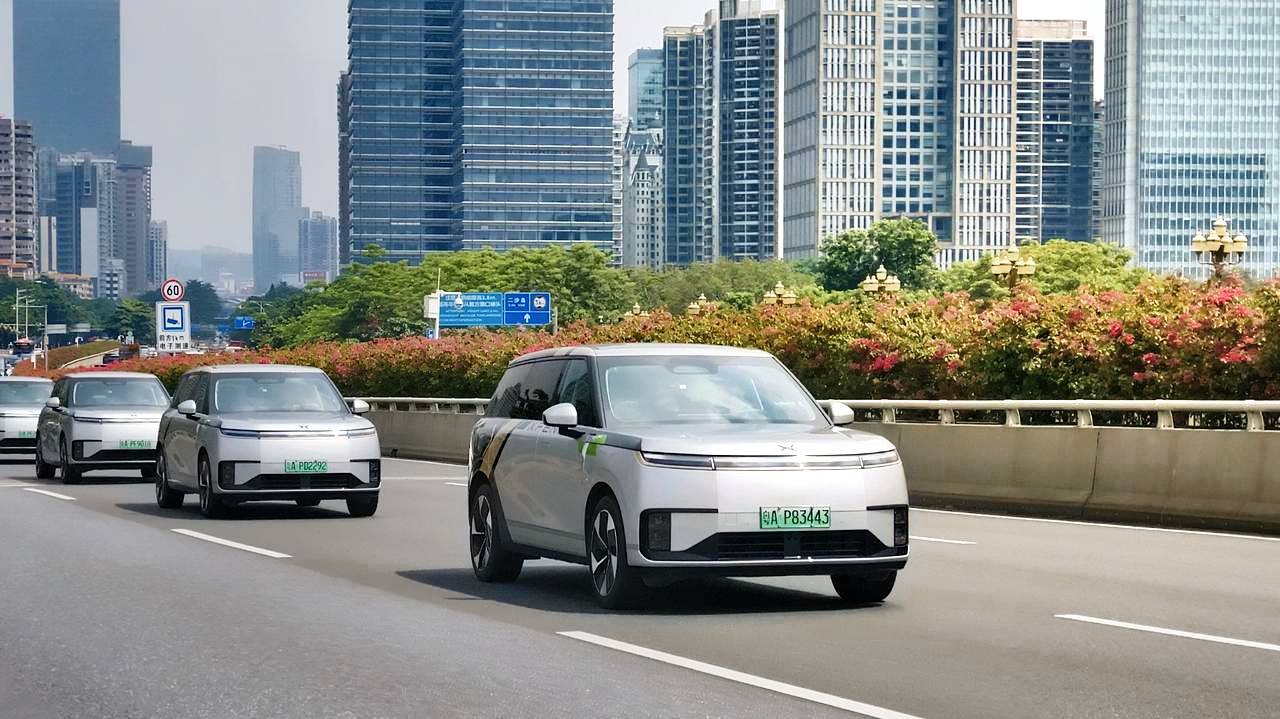

XPeng named its robotaxi business XPENG YOYO on Thursday and opened online registration for the service in China, with access to be granted through invitation codes, as the Chinese carmaker moves its driverless program out of internal testing.
The service is being tried in Guangzhou, where XPeng is headquartered, through a dedicated booking mini-program and a new page on the company’s website.
“This marks the transition from technical validation into a new stage of marketization and industrialization,” the brand said.
XPeng did not disclose how many robotaxis are in service, where in Guangzhou they operate, what riders will pay or whether a safety operator will be on board for invited riders.
It has said it aims to carry passengers without safety officers in 2027, and Chairman and Chief Executive Officer He Xiaopeng has said the Guangzhou business could break even on a per-vehicle basis as early as the second half of that year.
The Vehicle
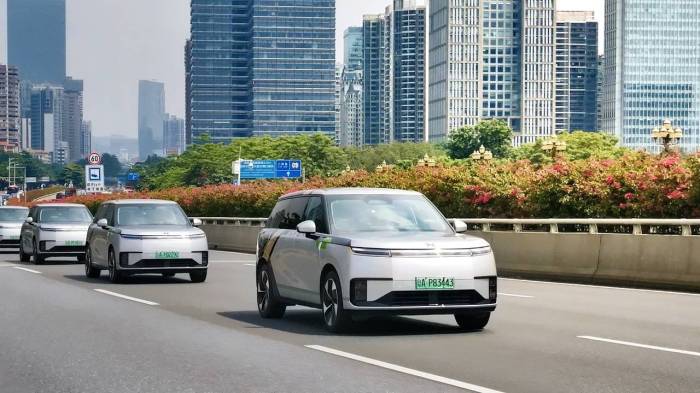
XPeng’s robotaxi is built on the GX, a six-seat flagship SUV that went on sale to consumers on May 20 and passed 20,000 deliveries by late August.
Each robotaxi carries four of XPeng’s in-house Turing AI chips, which the company says deliver 3,000 TOPS of effective computing power, and runs its second-generation VLA, or vision-language-action, driving model.
XPeng said in May that the vehicle has redundant perception, steering, braking, communications, energy and computing systems.
The system does not use LiDAR or high-definition maps, relying on cameras instead, and XPeng says it bridges Level 2 driver assistance and Level 4 autonomous driving.
XPeng has said the model’s response time is under 80 milliseconds, and it said in August that a first major upgrade at the end of that month would increase the number of on-vehicle model parameters 3.5 times.
Riders can set the cabin temperature and switch on a fragrance system before boarding, and the cabin has zero-gravity seats, massage functions and a large entertainment screen, the company said.
From Pledges to Pilot
The launch caps a program whose timeline has shifted several times.
He pledged in July 2024 to launch “a highly competitive Robotaxi in 2026,” but in April 2025 he declined to give a timeline, citing “huge challenges” and saying the process could take “at least 10 years.”
At its AI Day in November 2025, where it had been expected to unveil new details of the project, XPeng said it would launch three robotaxi models, with five, six and seven seats, in 2026 and begin trial operations in China, naming Alibaba-owned navigation app Amap as its first global ecosystem partner.
A day earlier, a Chinese newspaper had reported that XPeng had dropped plans for a dedicated robotaxi model in favor of models already in development.
So far, XPeng has shown one robotaxi, based on the GX, and plans a cheaper model designed for robotaxi service in 2027.
XPeng began road testing in Guangzhou last January and set up a dedicated robotaxi business unit in March.
The unit, a first-tier division covering product definition, research, testing and operations, is led by Yuan Tingting, who joined XPeng in 2024 from Alibaba’s DAMO Academy, where she headed autonomous-driving operations.
Its first mass-produced robotaxi rolled off the line in Guangzhou on May 18.
XPeng describes it as “China’s first fully in-house developed Robotaxi to achieve pre-loaded mass production,” meaning the self-driving hardware is fitted at the factory rather than retrofitted.
He took the first internal test ride on July 9, describing the experience as “smooth throughout.”
XPeng said it had taken eight months from announcing the program to starting employee trials in July.
“We will go from an L2 company to an L4 company, and Robotaxi is of great significance to XPeng,” He told staff at the unit’s first all-hands meeting.
XPeng said at the time that it aimed to complete trial operations and small- to medium-scale regular demonstration operations within 2026, using Guangzhou as a model city.
By the time XPeng reported second-quarter results on August 24, its robotaxis had completed more than 2,000 internal test orders, including paid trips priced at 1 yuan to test payments and service flows.
In August, XPeng received a Guangzhou remote-testing qualification that allows road tests with no safety officer in the driver’s seat on designated Class I, II and III test roads, and it said it had finished building a cloud platform for remote intervention.
XPeng had said in May that it planned to start passenger demonstration operations in Guangzhou in the third quarter.
Partners, Not a Fleet
XPeng says it will not run robotaxi fleets itself.
“We only make the product and take a commission, and do not directly participate in operations,” management said on the first-quarter earnings call in May.
Revenue will come from hardware sales, services and commission sharing, with offline operations entrusted to global partners, He said in Thursday’s statement, adding that XPeng would supply a combined package of its vehicle platform, autonomous-driving software and AI capabilities.
The founder told The Wall Street Journal in July that XPeng was in talks with dozens of potential partners, more than half of them outside China, and that he expected most of the robotaxi business to come from overseas.
Breakeven depends mainly on how densely vehicles are deployed within an operating area rather than on total fleet size, and a few hundred robotaxis could be enough in a smaller city, he told the newspaper.
“Our goal is to become a full-stack hardware and software solution provider,” he said.
XPeng has said it is in talks with potential partners in Europe, the Middle East and Southeast Asia, but has not named any overseas markets, launch dates or operating partners beyond Amap.
Production Scale
XPeng has not disclosed how many robotaxis it has built, and its only scale guidance has come from President Brian Gu, who told Reuters in April that the company would likely build hundreds to thousands of robotaxis over the following 12 to 18 months.
Daiwa Securities estimated in November 2025 that XPeng would produce about 1,000 robotaxis in 2026, with output staying within a few thousand units a year in 2026 and 2027.
Bernstein estimated at the time that an XPeng robotaxi could cost under 200,000 yuan ($29,800) to build.
XPeng has said a wider rollout will come later, with He saying broader robotaxi operations would come in 2028 and management describing the business in May as a major opportunity after 2028.
Xianming Liu, head of XPeng’s General Intelligence Center, placed Level 4 autonomy in the company’s 2028 technology roadmap in July.
The company has also said it plans to bring its VLA-based assisted driving to Europe in early 2027, after testing it in Germany.
Financial Backdrop
XPeng is funding the push while still losing money. The company reported a second-quarter net loss of 1.34 billion yuan ($199.2 million) on revenue of 19.74 billion yuan ($2.94 billion), up 8% from a year earlier.
Vehicle deliveries in the quarter were 103,295, and the company guided for 115,000 to 121,000 deliveries in the third quarter.
XPeng had 40.48 billion yuan ($6.03 billion) in cash at the end of June.
Volkswagen became the first external customer for XPeng’s Turing chip and second-generation VLA platform last year.