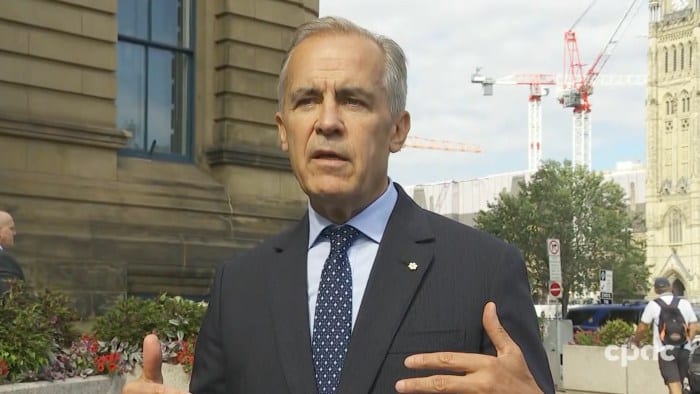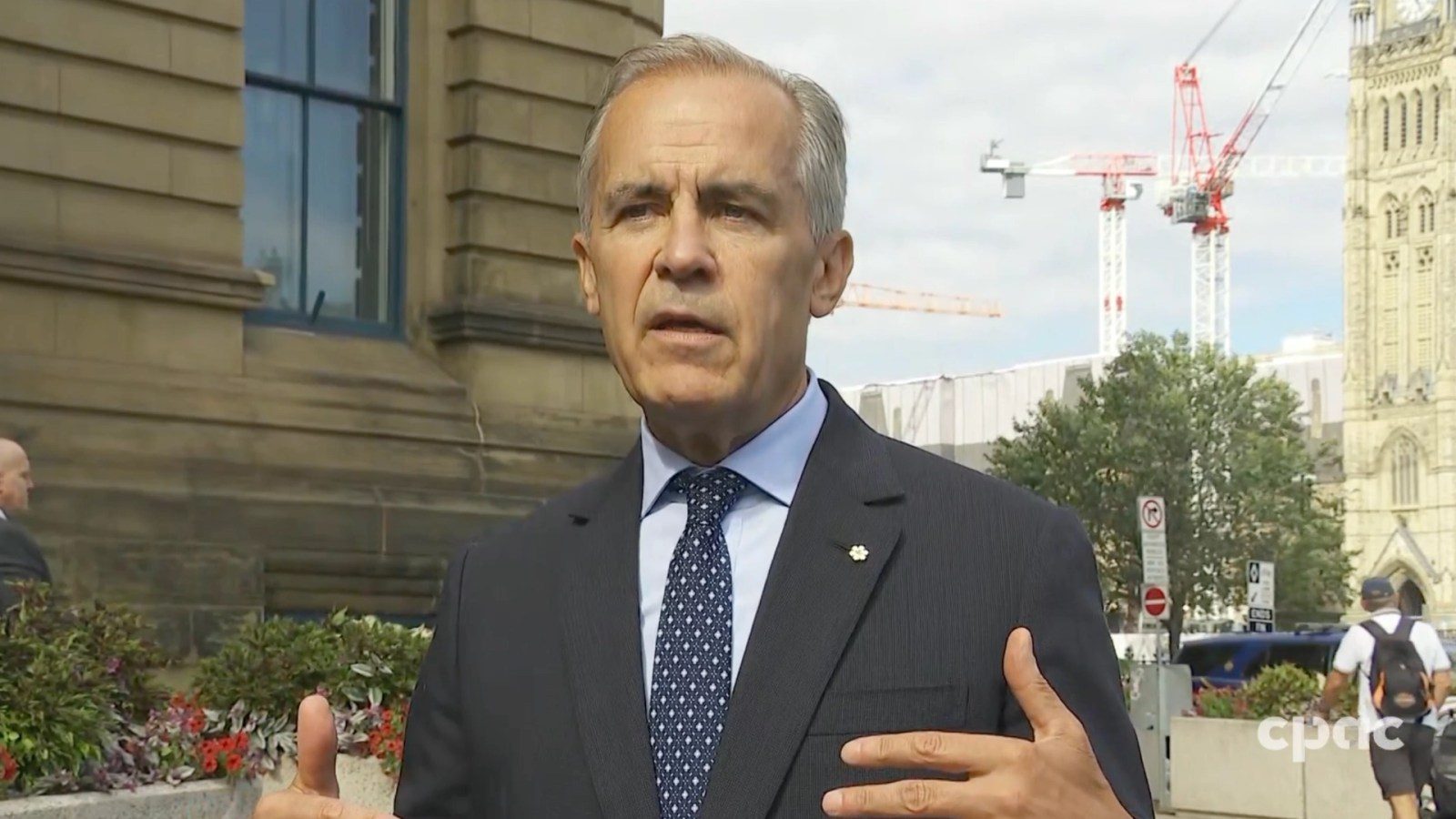

Prime Minister Mark Carney said on Tuesday that United States negotiators had approached last month’s trade talks with an attitude that would have left Canada’s core industries, the auto sector among them, operating as subsidiaries of their American counterparts or wound down until they were wiped out.
“The attitude of the United States in these discussions, and subsequently, has been one that core Canadian industries either would be subsidiaries effectively of the United States industries, or would put in place terms where those industries would be gradually wound down in Canada and wiped out,” he told reporters outside his office in Ottawa.
“Of course, we’re not going to accept those terms.”
The characterisation is Ottawa’s.
No draft text has been published by either side, and Carney was describing an attitude he encountered and an outcome he expects from the tariff design rather than quoting a written demand.
He called the American position misguided. “The United States auto industry is made stronger by the Canadian and the Mexican auto industries,” he said.
The remarks came two days after President Donald Trump wrote on Truth Social that he had revived and saved the American automobile business, naming Canada as one of the worst abusers on trade.
A Deal That Diverged
Carney said elements of a mutually beneficial agreement had been in play before the two sides drifted apart, while stopping short of claiming one had been reached.
“There were elements of that mutually beneficial deal that we were moving towards, which is why we were still at the table,” he said. “But we never viewed that we had that deal. And it diverged towards the end. At some point, maybe it’ll converge again.”
He said Canada would return to the table when the Americans “stop doing memes, stop throwing shade, stop trying to be tough and start being serious.” Of the posts accompanying the standoff, he added: “It’s not constructive, but that’s their democracy.”
“At a time of big, big change in auto, it’s important that we work together,” he said. “That’s why I say, yes, there is a mutually beneficial deal.”
How the Talks Broke Down
The rupture came late on Friday, August 21, when Carney suspended negotiations, saying last-minute American terms were unfair, uneconomic and called into question the reliability of any deal.
Ottawa’s account is that the demands would have curtailed Canada’s ability to sign trade agreements with third countries, pressed on French-language and cultural protections, and left medium- and heavy-duty trucks outside any auto tariff relief.
The two governments do not agree, and the disagreement turns on trucks.
US Trade Representative Jamieson Greer said Canada had declined to finalise the deal on terms agreed earlier that week, blaming new demands and walk-backs.
He later told CBC he had been clear for weeks that medium- and heavy-duty trucks sat under a separate Section 232 action and were never part of the proposed cut in auto tariffs from 25% to 15%. Commerce Secretary Howard Lutnick has said the phrase was first raised on the Friday afternoon.
Canada disputes that and says truck coverage was essential to keeping its assembly plants viable.
Ford is bringing its Oakville plant back online for Super Duty trucks after abandoning an electric vehicle conversion there, and General Motors has committed to next-generation Sierra HD production at Oshawa.
Both are heavy-duty programmes, and both sit in the category Washington says was never on the table.
No response to Tuesday’s remarks had come from the White House or the Trade Representative’s office at the time of writing.
The Measures
Washington allowed previously announced tariffs of 50% on roughly $20 billion of Canadian goods to take effect on August 22.
Canada answered with counter-tariffs at 15%, 25% and 50% across C$27.6 billion of American goods, effective September 8, aimed at steel, dairy, appliances, agricultural equipment, pulp and paper, electronics and similar categories.
Ottawa also announced a C$7.5 billion support package for affected workers and businesses.
The new list adds no fresh auto duties, which is not the same as sparing the sector. Canada’s existing counter-tariffs on American vehicles remain in force.
A figure of roughly $110 billion has circulated in the political argument.
It traces to industry commentary, including from Auto Parts Association President Flavio Volpe, putting added costs on the North American sector from tariffs and disruption over about the past eighteen months at that level.
The Backdrop
On August 24, Trump said all cars, trucks, auto parts and steel from Canada would face a 50% tariff from January 1, 2027, and that firms building in the United States would face zero tariffs.
He followed on Sunday, August 30, writing that he wanted no Canadian cars, parts or anything else, naming Canada as one of the worst abusers and accusing it of ripping off the United States for decades.
He credited tariffs with reviving the American industry and pointed to Ford’s Dearborn Truck Plant as evidence.
The rhetoric sits awkwardly against how intertwined the two industries are. The Canadian Vehicle Manufacturers’ Association puts vehicles at a C$46.5 billion Canadian export in 2024, with 92% of that value going to the United States, and domestic consumption at about 9.4% of Canadian output.
Canadian plants function largely as a manufacturing base for American buyers rather than as a separate market.
Canadian output was down 15% year on year through April, according to the Center for Automotive Research, with Canada accounting for 45% of the market share the United States lost among trading partners over that period.
Automakers Caught in the Middle
The standoff has landed on an industry already retreating from electric vehicles in Canada.
General Motors permanently ended BrightDrop electric van production at CAMI in Ingersoll last October, idling about 1,100 workers, and eliminated the third shift at Oshawa Assembly in late January, cutting more than 700 direct jobs in a move the union Unifor blamed on American tariffs.
Ford’s Oakville plant sat idle for two years of retooling after the company scrapped an electric conversion in favour of Super Duty trucks, with Ottawa contributing C$464.5 million.
Both have kept investing north of the border.
General Motors locked in about C$1.1 billion of Ontario investment under a new Unifor contract, a figure that includes previously announced money, covering Sierra HD production at Oshawa and a transmission line at St. Catharines, while agreeing not to sell or close its idled CAMI plant during the contract.
So the two plants at the centre of Canada’s negotiating position are also the two that replaced electric vehicle programmes with heavy-duty trucks.
The Other Border
While Ottawa fights Washington over access for the vehicles it builds, it is widening the door for the ones it does not.
Under the quota agreed between Carney and Xi Jinping in January, which replaced Canada’s 100% surtax on Chinese electric vehicles with 49,000 permits a year at a 6.1% tariff, the first six-month window closed on August 31. It ran materially undersubscribed: 15,063 of 24,500 permits had been taken up by the August 21 report, and the final figure looks likely to land near 71% to 73%.
Global Affairs Canada‘s notice provides for unused volume to roll forward, so the second window opened on Tueday with 24,500 permits plus whatever the first left behind — a pool of about 31,000 units.
Chinese-built vehicles remain ineligible for Canada’s federal consumer rebate of up to C$5,000, which is restricted to vehicles made in free-trade partner countries.
Neither government has signalled that a new round of talks is imminent.