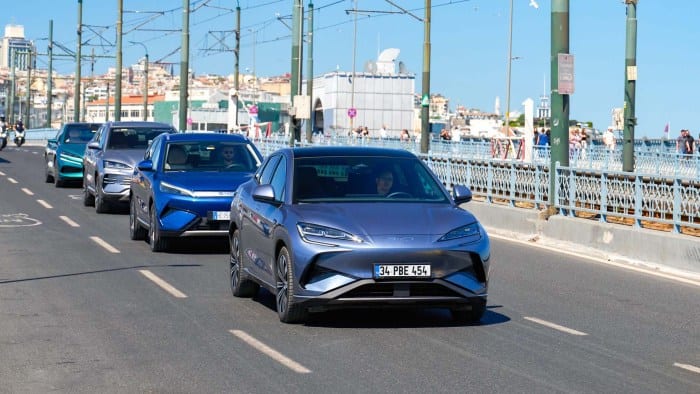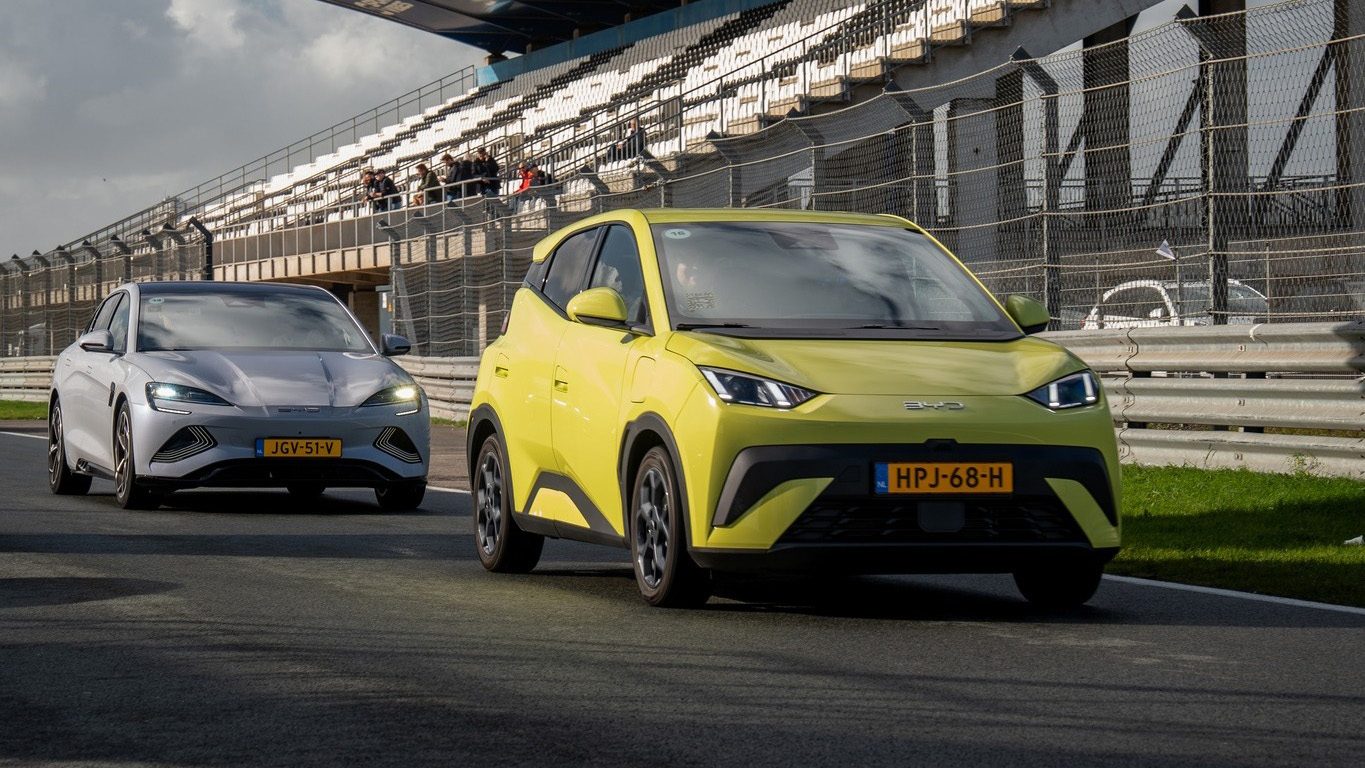

Chinese-owned carmakers tightened their hold on the European market in the first five months of 2026, as BYD, MG-owner SAIC, Chery, Leapmotor and Geely Group all gained ground.
According to May figures released by the European Automobile Manufacturers’ Association (ACEA) on Tuesday, BYD registered 135,307 vehicles between January and May across the EU, EFTA and the UK.
SAIC registered 141,490 and Chery 122,843 units.
Tesla, which only offers fully electric models at a higher average selling price, sold 118,068 units in the first five months of the year.
A year ago, all three Chinese brands trailed the Elon Musk-led company.
Combined, the five groups registered 619,353 cars across the EU, EFTA and the UK between January and May, about 10.6% of the market, by EV‘s calculation from ACEA’s per-manufacturer data.
The figure counts Chinese ownership rather than badge, so it includes Geely Group, whose European volume is led by Volvo, Polestar and other marques it owns rather than China-branded models.
A Modest Market With an Electric Core
New EU car registrations rose 4% in the first five months of 2026, to 4,748,801 units, ACEA data show, a steady start set against persistent geopolitical strain on the outlook.
Battery-electric cars led the increase as registrations climbed 35.7% to 950,521 across the EU, lifting their share to 20% from 15.3% a year earlier — or one in five new cars.
Momentum carried into the latest month, with battery-electric registrations across the EU up 42.9% in May alone, to 203,417 cars.
Hybrid models remained the single most popular choice at 37.8% of the market, while plug-in hybrids took 9.7%, up from 8.3%.
Petrol registrations fell 18.2% to a 22.4% share, down from 28.5%, and diesel dropped 16.6% to 7.6%, leaving the two combustion fuels at a combined 30.1% of the market, against 38% a year earlier.
Growth in battery-electric demand was concentrated in the large southern and western markets, with Italy up 75.7%, France up 55.4% and Germany up 40.9% over the five months, while Belgium lagged at 2.8%.
BYD and Tesla’s Detailed Figures
The clearest duel remains BYD against Tesla.
In May alone, BYD registered 32,380 cars across the EU, EFTA and the UK, up 136.6% year on year, against 28,610 for Tesla, itself up a sharp 107.9% from a deeply depressed May 2025.
BYD‘s monthly tally rebounded from 27,008 in April, though it stayed below the 37,580 peak the brand hit in March.
Over the five months, BYD holds a 2.3% share of the combined market to Tesla‘s 2.0%.
BYD‘s totals count both its battery-electric cars and its growing line of plug-in hybrids, such as the Seal U DM-i.
Brussels imposed its anti-subsidy duties on China-made battery-electric cars in October 2024, and is now considering whether to extend tariffs to hybrids as well.
Such a move would land immediately on every brand importing hybrids from China, then ease over time as those brands start and scale up production inside Europe, where locally built cars escape the import duties.
Tesla sells only battery-electric cars at an average price well above most of its Chinese rivals, while BYD spans far cheaper segments, with its smallest model, the Dolphin Surf, starting in the low €20,000s.
Chery and Leapmotor
The fastest growth came from newer arrivals.
Chery, which ACEA counts together with its Omoda & Jaecoo and Jetour brands, registered 122,843 cars over the five months, a 316% jump, and 27,412 in May, up 244.1%.
That places Chery ahead of Tesla on a year-to-date basis barely 18 months after entering most European markets.
Much of Chery‘s volume, however, is petrol and hybrid, with plug-in and combustion versions of the Omoda 5 and Jaecoo 7 doing the bulk of the work, making its surge as much a combustion story as an electric one.
Leapmotor, the Chinese brand sold through a Stellantis joint venture, grew fastest of all in percentage terms, registering 43,037 cars over the five months, up 552.9%, and 9,945 in May, up 465.1%, albeit from a tiny base.
SAIC, whose European sales run almost entirely through the MG badge, remains the largest Chinese-owned seller by volume at 141,490 cars year to date, though its growth has cooled to 11.6% as the brand matures.
MG‘s range now spans battery-electric models such as the MG4 alongside hybrids and petrol cars, a mix that mirrors the broader Chinese shift away from pure electric.
Geely Group, the largest Chinese-owned group in Europe at 176,676 cars, sits in a different category, with its volume dominated by Volvo, Polestar and other European-facing marques rather than a China-badged challenger.
What the Brand Totals Hide
Two cautions apply to any reading of the ACEA manufacturer tables.
ACEA reports each carmaker’s total registrations across every fuel type, so the headline Chinese figures bundle battery-electric cars together with plug-in hybrids, full hybrids and, for some brands, petrol models.
The Chinese advance in Europe is real, but it is no longer a purely electric one, and treating these totals as battery-electric sales overstates the segment.
Several Chinese brands do not appear as separate lines in ACEA’s data.
MG is folded inside SAIC, Polestar, Zeekr, Lynk & Co, Lotus and smart inside Geely, and Omoda & Jaecoo and Jetour inside Chery, while smaller entrants such as Nio and XPeng fall below the disclosure threshold and are not broken out at all.
The disclosed brand figures therefore understate the true Chinese footprint and blur where the volume sits.
Legacy Volume Slips
The Chinese climb came partly at the expense of established players.
Volkswagen Group remained Europe’s largest carmaker, with a 25.8% share across the EU, EFTA and the UK, but the core Volkswagen brand fell 4% over the five months.
Ford dropped 16.9% and Nissan 11.4%, both ceding ground as lower-priced Chinese rivals expanded their line-ups and dealer networks.
Renault Group slipped 5.4%, while Stellantis, helped by Leapmotor and a recovering Fiat, edged up 5.3%.