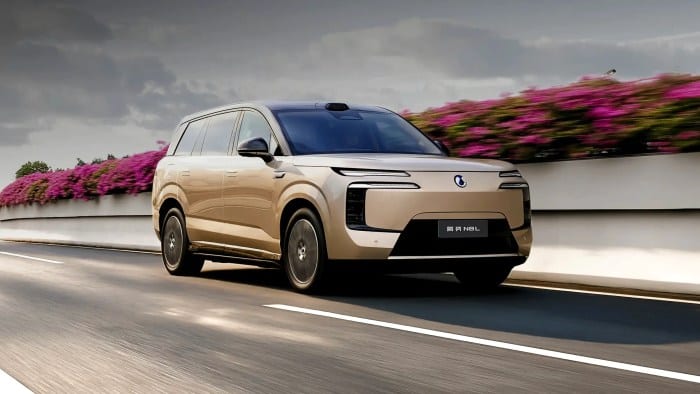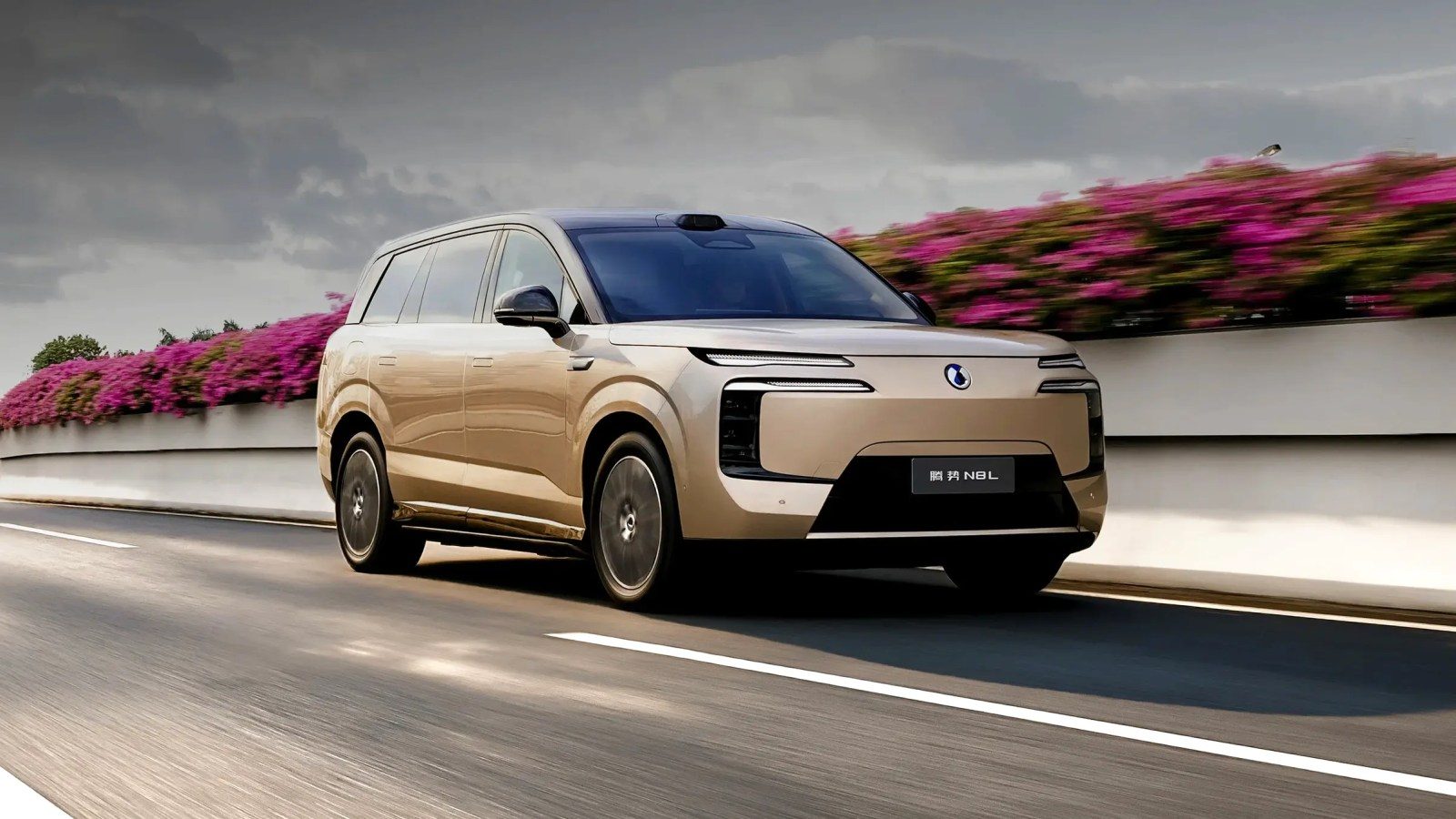

Denza, BYD’s premium brand, launched a battery-electric version of its N8L six-seat SUV in China this week at a starting price 20,000 yuan ($3,000) below the plug-in hybrid it already sells, despite carrying a battery 73% larger.
The fully electric version opens at 299,800 yuan, about $44,700, against 319,800 yuan for the flash-charging hybrid that replaced the original N8L in June. A second trim is priced at 329,800 yuan, about $49,100.
It uses a 130.15 kilowatt-hour second-generation Blade battery on an 800-volt architecture, against 75.26 kilowatt-hours in the hybrid, and a single rear motor rated at 370 kilowatts.
Denza claims a range of 960 kilometres on China’s CLTC cycle.
The Charging Claim
The headline figure is the charging speed, and it is the number that will decide how the car is received.
Denza says the N8L will charge from 10% to 97% in nine minutes, and from 10% to 70% in five. On a 130.15 kilowatt-hour pack, the five-minute claim means moving about 78 kilowatt-hours, an average of roughly 937 kilowatts sustained across the session.
The nine-minute claim averages about 755 kilowatts.
Both are megawatt-class rates held for the length of the charge rather than momentary peaks. Neither has been independently tested.
The company also claims 12 minutes from 20% to 97% at minus 30 degrees Celsius.
The figures depend on BYD’s proprietary flash-charging network. Denza said 10,000 such stations have been built in China, with 20,000 planned by the year end.
What the Money Buys
Both trims share the powertrain.
The more expensive one adds powered doors, welcome-light projection, a zero-gravity front passenger seat, a 17.3-inch rear entertainment screen, a digital rear-view mirror, a motorised pretensioning seatbelt for the driver and an occupant-monitoring camera.
The car measures 5,200mm long, 1,999mm wide and 1,820mm tall on a 3,075mm wheelbase, unchanged from the hybrid, in a 2+2+2 layout.
The electric version gains a 208-litre powered front boot with a capped drain, which the hybrid does not have. Rear cargo space runs to 1,128 litres with a 51-litre underfloor compartment.
The chassis pairs double-wishbone front and five-link rear suspension with DiSus-A air suspension, continuously variable damping and rear-wheel steering.
Driver assistance is BYD’s God’s Eye 5.0, using one LiDAR unit, five millimetre-wave radars, twelve ultrasonic sensors and twelve cameras, and covering highway and urban navigation, automated parking and automated U-turns.
The Trade-Off
The electric car gives up performance to the hybrid.
It is rear-wheel drive, with a single motor producing 370 kilowatts. The hybrid is tri-motor all-wheel drive with a combined system output of about 560 kilowatts and reaches 100 kilometres an hour in 3.9 seconds.
Denza has published no comparable figure for the electric version, nor an energy consumption or kerb weight figure.
The 960-kilometre range is a CLTC figure and will not be matched in use, as with all Chinese test-cycle numbers. The charging times assume BYD’s own flash-charging piles rather than public chargers.
The Sales Record
The N8L has sold more than 34,000 units since launching as a hybrid in late October 2025. It sold 1,071 in October, 5,443 in November and 6,510 in December, for 13,024 in 2025, with December alone accounting for exactly half the year.
A further 21,174 followed across the first eight months of 2026, an average of about 2,600 a month. Monthly volumes recovered to between 4,000 and 4,500 over the summer, after the flash-charging hybrid arrived in June.
A Denza N8L was BYD’s 15 millionth new energy vehicle, rolled out at Jinan on December 18, and the 15,000th N8L built.
The Bet
The launch sets Denza against the Nio ES8 in China’s large electric SUV segment, and the two answer the same question differently.
The six-seat ES8 starts at 406,800 yuan with a 102 kilowatt-hour pack and 635 kilometres of CLTC range. It is dual-motor all-wheel drive at about 520 kilowatts, against 370 in the Denza, and offers battery swapping in about three minutes alongside Nio’s battery-as-a-service rental, which separates the cost of the pack from the car.
A five-seat version starts lower, at 382,800 yuan.