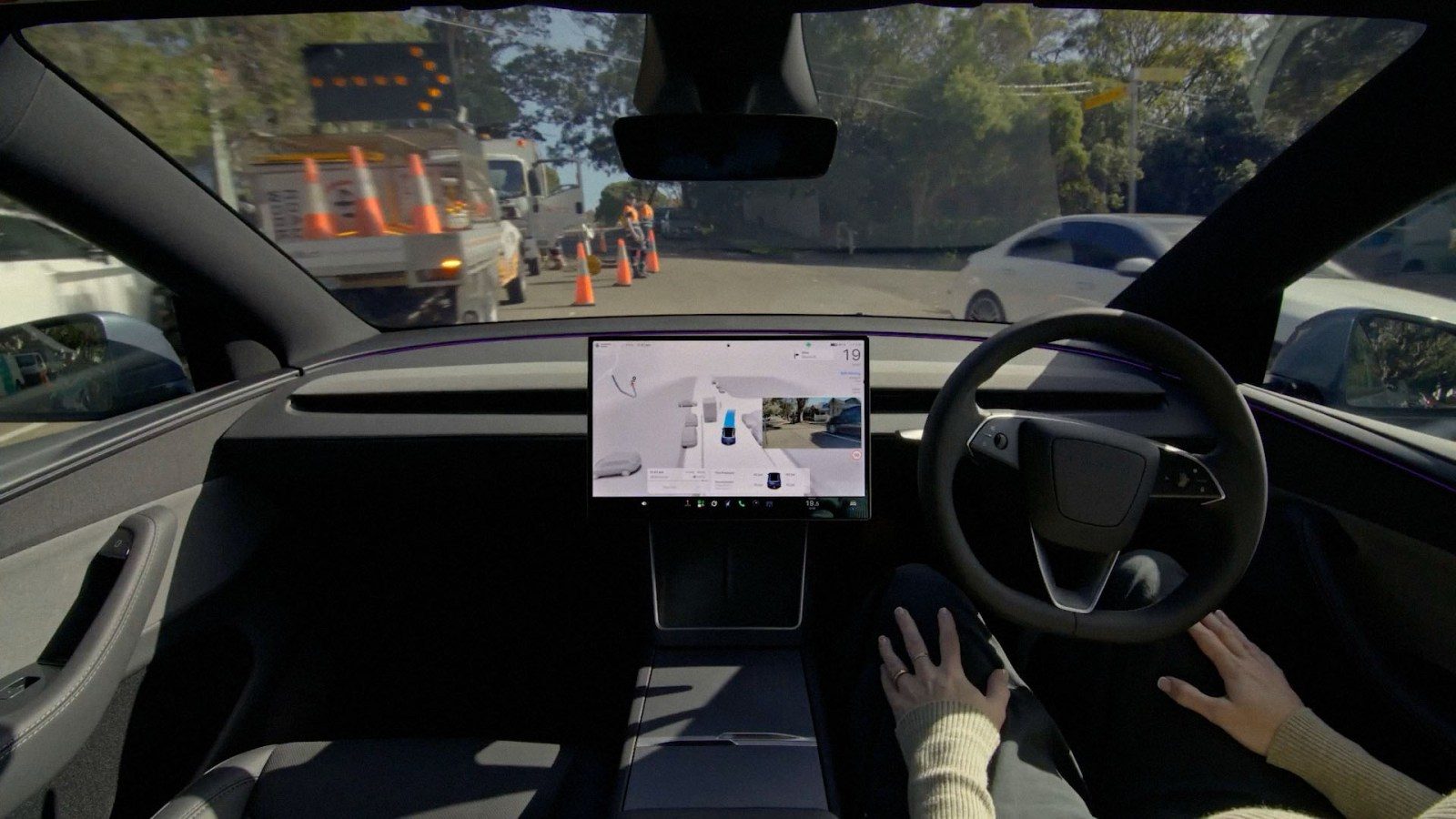

Tesla marked one year of FSD (Supervised) in Australia and New Zealand with a claim that vehicles running the software crashed 40% less often per kilometre than Teslas driven manually.
Owners covered more than 160 million kilometres with the system engaged between September 17, 2025 and September 16, 2026, the company said, describing the distance as about 4,000 laps around Earth.
The figure covers all road types across both countries and is drawn from Tesla’s own vehicle telemetry.
The Claim
Tesla measured those 160 million kilometres against 2,403 million kilometres driven manually in Teslas with active safety features switched on, over the same period and in the same markets.
Vehicles on FSD recorded one collision, major or minor, every 1.78 million kilometres, against one every 1.07 million kilometres for manual driving.
Applied to the distances Tesla gives, that implies about 90 collisions on FSD and about 2,250 in manual driving, although the company published neither count.
The behavioural gaps are wider.
Automatic emergency braking fired once every 17,432 kilometres on FSD against once every 5,989 manually, a 66% reduction. Harsh braking fell 90%, from one event every 180 kilometres to one every 1,823. Harsh acceleration dropped 86% and harsh lateral acceleration 76%.
Drivers on FSD sounded the horn once every 3,233 kilometres, against once every 643, which Tesla counts as an 80% reduction.
The control group is not the Australian or New Zealand vehicle fleet.
It is Teslas, driven by Tesla owners, with Tesla’s own collision-avoidance systems active, which the company’s methodology page describes as a materially safer baseline than a typical vehicle.
Who Is Actually in the Dataset
The 160 million kilometres come from a fraction of Tesla’s local fleet.
FSD in both markets runs only on Hardware 4 cars, meaning the current Model 3 and the newer Model Y, and has never been available on the Hardware 3 vehicles that make up a large share of Teslas sold in Australia and New Zealand since 2019.
Those owners are still waiting. Tesla Australia told them in an email on August 28 that v14 Lite was in active development for the region while already rolling out in North America and South Korea, without naming a build or a date.
Tesla has said Hardware 3 will not support unsupervised operation or the next software generation, which makes v14 Lite the end of the line for that fleet rather than a step toward anything further.
Owners on Hardware 4 have moved quickly this year. Version 14 arrived on June 19 as v14.3.3, nine months after launch and well behind markets that received FSD later, followed by v14.3.5 in late July and v14.3.9 around September 16, which closed the gap to the global fleet to a matter of days.
Subscription Only Since April
Tesla withdrew the outright purchase, priced at A$10,100, for orders placed after April 1. FSD is now available only by subscription at A$149 a month in Australia (about $104) and NZ$159 in New Zealand (about $92).
Owners who bought the software before the cut-off keep it.
Adoption was immediate at launch. Owners logged the first million kilometres inside two weeks, at about 80,000 kilometres a day, a rate Tesla framed then as 67 laps of Australia.
Average daily use is now more than five times higher than at launch, and Australian cars alone had passed 132 million kilometres by mid-September.
The Numbers
The anniversary data lands days after Zurich began treating FSD as a rating factor on InsureMyTesla, the first Australian insurer and the second globally to do so.
That product rates the presence of the software rather than its use, relies on Tesla-supplied figures comparing FSD cars with regular EVs, and sits alongside a 5% commission plus GST that Tesla earns on the first year’s premium when a buyer reaches Zurich through its referral link.
Cybercab Debut
Tesla brings its Cybercab to Sydney from Monday, September 21, touring Australian locations through the end of the year and reaching New Zealand in early 2027. It will sit in showrooms.
Neither country permits unsupervised operation.
Australia has no dedicated automated vehicle statute in force, with national legislation not expected before 2027, and existing proper-control rules leave the licensed driver responsible no matter what the car is doing.