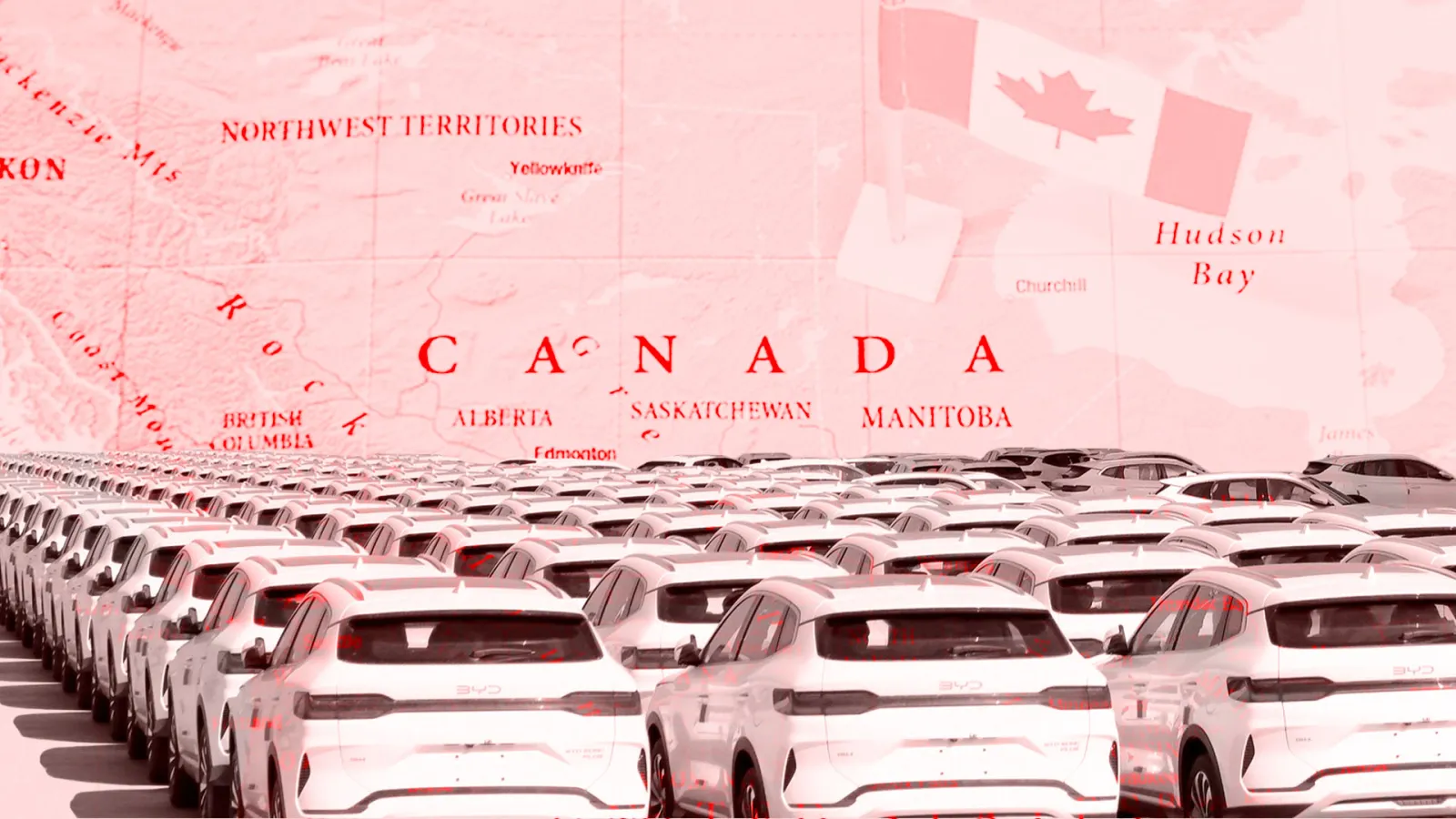
BYD will not let higher European tariffs affect consumers’ choice of its cars and will open new plants in Europe “soon,” a senior executive said, as Brussels moves to cap Chinese hybrid imports and Beijing trims export support.
“Europe is a very important regional market for BYD. We will not let tariff increases affect local consumers’ choice of BYD,” VP Liu Xueliang, told the South China Morning Post in an interview published on Sunday.
Liu said BYD had not yet decided whether to raise prices in overseas markets to pass on higher tax costs, because competition on price is also intensifying, the newspaper reported.
He also acknowledged that BYD faces “many challenges” abroad.
Liu was appointed VP by BYD’s board in April and also heads its Asia-Pacific auto sales division and leads BYD’s Japanese unit. He joined BYD in 2004.
Plants in Europe
Liu said BYD was expanding its local footprint, with new European plants due to start “soon.”
BYD’s first European car factory, in Szeged, Hungary, is about a year behind its original schedule. Executive VP Stella Li said at the Paris Motor Show earlier this month that BYD was preparing to start mass production there in the fourth quarter.
The plant was originally due to build the Dolphin Surf from the end of 2025. It also faces a review by Hungary’s new government of investment agreements signed with Chinese companies under Viktor Orbán.
BYD’s second planned European plant, in Turkey, is on hold. Li said in June that construction had not started and gave no timeline for production.
What Stella Li has been saying
Li has spent the past five months setting out where the next plants could go. Speaking to reporters in Berlin on June 11, she said BYD was looking to take over an existing factory in southern Europe for its second European plant, with Spain among the countries on its shortlist.
“We would prefer to take over an existing plant,” she said. A day earlier, in London, she had called Hungary “the number one priority right now.”
At the Paris Motor Show on October 12, she said BYD aims to build two more plants in Europe and put France in the running. “France is on the shortlist because your energy is very competitively priced,” she told BFM Business, adding that BYD was closely studying a French factory.
She told Bloomberg the same day that BYD’s European workforce, soon to pass 10,000, would be “absolutely over 40,000 in 2030.” “BYD’s commitment in Europe is very deep, and it is long-term,” she said.
On the hybrid deal, Li said in Paris that she did not yet have the details and could not yet assess its impact.
Asked in a Bloomberg TV interview the following day whether BYD would raise prices in Europe, she said she did not expect price to be a challenge because buyers see BYD as a brand built on value. That is in line with Liu’s position that no decision has been made.
Alfredo Altavilla, BYD’s Special Adviser for Europe, said on July 1 that BYD was close to deciding on buying an existing plant, with two teams evaluating sites in different jurisdictions. No site has been announced.
In September, after Hungary’s new government said it would review deals signed with Chinese companies, Li said BYD had complied with all local rules and remained committed to Szeged.
BYD’s planned capacity outside mainland China totaled 1 million vehicles as of October, with only 30% of it in Europe, Morgan Stanley said in an October 13 note cited by the Post.
The hybrid cap
Liu spoke after the EU and China reached an understanding on hybrid trade at talks in Beijing on October 8 and 9.
The EU plans a four-year safeguard capping Chinese hybrid imports at 350,000 vehicles in the first year, rising 6% a year after that.
“With Minister Wang Wentao we’ve reached a shared understanding to halve HEV, PHEV exports,” Trade Commissioner Maroš Šefčovič wrote on X on October 9. The joint text Beijing published gave no figure.
BYD, Geely and Chery backed the understanding in statements on October 14, without mentioning a cap. Li said in Paris that she did not yet have the details.
Chinese plug-in hybrid exports to Europe have grown since the EU imposed duties on Chinese-made battery electric cars in 2024, which do not apply to hybrids.
Those duties reach up to 35.3% on top of the standard 10% import tariff, for a maximum of 45.3%. BYD’s own additional rate is 17%, for a total of about 27%.
Squeeze at home
The pressure is also coming from Beijing. China’s Ministry of Finance and State Taxation Administration said on October 12 that the export VAT rebate for new energy vehicles, covering battery electric and plug-in hybrid cars, will fall to 9% from 13% from April 1, 2027.
China also reintroduced a 2% consumption tax on lithium-ion batteries on September 1, ending an 11-year exemption. It is due to rise to 4% in September 2027.
Together, the measures could hurt the profitability of China’s EV industry “faster than expected,” JPMorgan said in a note last week, the Post reported.
Liu expects the rebate cut to have limited impact on sales in Southeast Asia, where BYD already builds cars, including at its plant in Thailand, the newspaper said.
He added that BYD would keep adding overseas capacity as the global oil shock lifts demand for EVs.
Growth in Europe
BYD’s European push is gaining ground. Its registrations in the EU rose 154.4% to 206,002 in the first nine months of 2026, data from the European Automobile Manufacturers’ Association (ACEA) show. That lifted its share of the EU market to 2.4% from 1% a year earlier, the Post calculated.
In September alone, BYD’s EU registrations rose 111.4% to 28,309. Across the EU, EFTA and the UK, they rose 134.6% to 283,997 in the nine months.
BYD’s European share more than doubled in August data as Brussels turned its attention to Chinese hybrids. The company entered North Macedonia, its 38th European market, this month.
Weaker at home
Overseas growth has not offset weakness in China. BYD’s first-half net profit fell 20.5% to 12.33 billion yuan ($1.8 billion), and revenue fell 7.1% to 344.82 billion yuan ($51.7 billion).
The company’s global sales rose 17% in September as exports climbed 154%.
To lift profitability, BYD has pushed premium models abroad. Its Denza brand, which debuted the Z9GT in Europe in April, launched the model in Hong Kong on Friday from HK$998,000 ($127,200), with Liu attending the launch. The model starts at 269,800 yuan ($40,500) in mainland China.
Toyota and the 2030 goal
Chairman Wang Chuanfu told shareholders at BYD’s annual meeting on June 9 that the company would become “the world’s No. 1 in terms of scale” by 2030, overtaking Toyota.
Liu played down that target. He said reducing reliance on fossil fuels through global EV scale was far more meaningful than reaching the No. 1 spot, the Post reported.
Analysts turn cautious
Analysts have grown more cautious on the stock.
CLSA analyst Xiao Feng lowered his price target on BYD’s Hong Kong shares to HK$104 from HK$120 on October 23, keeping a ‘High-Conviction Outperform’ rating, according to Price Target, EV‘s sister publication, which archives Wall Street research word for word.
JPMorgan analyst Nick Lai downgraded BYD to ‘Neutral’ from ‘Overweight’ on September 30, cutting his target to HK$88 from HK$124.