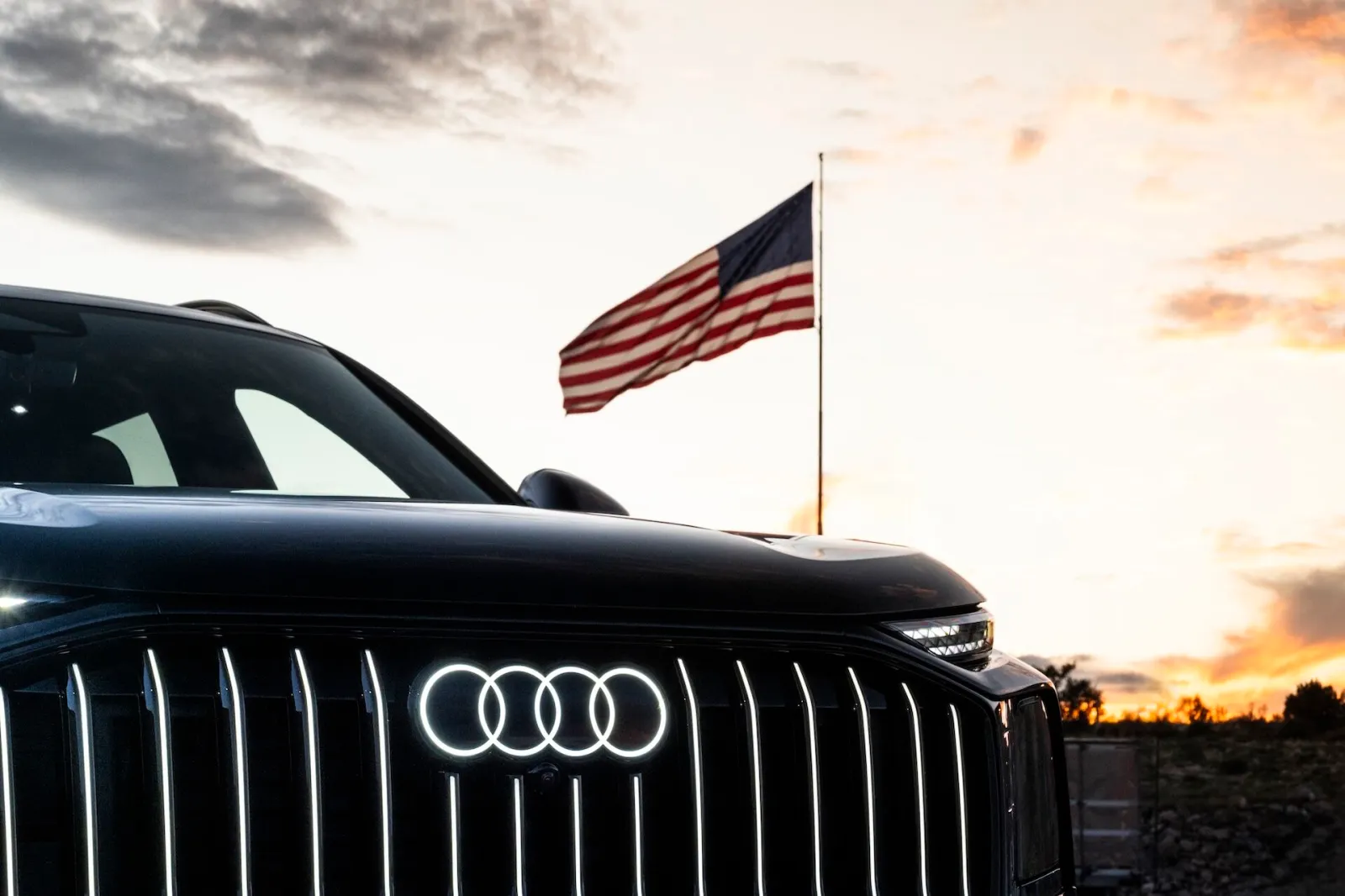
Audi said it has no plans to close its Mexican factory, contradicting President Donald Trump’s claim on Sunday that the carmaker was “closing up in Mexico and Canada” to build its new plant in Georgia.
“There are currently no plans to do so. Mexico is an important part of our global production network,” an Audi spokesperson said in a statement shared on X by Reuters reporter David Shepardson.
“Our U.S. investment plans are part of the further development of our localization strategy and therefore of our North American footprint. Our aim is to move closer to the market, our customers, and their needs,” the spokesperson added.
The statement came hours after Trump announced Audi’s first US factory at a campaign rally in Perry, Georgia.
The AUDI AG release says the Georgia site “complements the existing production network” and will make North America “a third major pillar of Audi’s global production network alongside Europe and China.”
What Trump said
Trump made the claim in a phone interview with Fox News’ Sunday Morning Futures, in a clip posted by the White House’s Rapid ‘Response 47’ account.
“Audi is going to build one of the largest plants — they’re going to make 200,000 cars a year,” Trump said. “They’re closing up in Mexico and Canada,” he said, adding that “they’re coming into our country with a brand new, gorgeous plant right in Georgia.”
Parts of that are in line with Audi’s own description. Audi says the plant is designed for “an annual production capacity of up to 200,000 vehicles,” and Audi of America calls the site “among one of the brand’s largest production footprints globally.”
The claim about Mexico and Canada does not match Audi’s footprint or its statements.
No plant in Canada
Audi has no factory in Canada to close. The Audi Group, which includes Bentley, Lamborghini and Ducati, says it produces at 21 locations in 12 countries.
Its list of production sites names locations in Germany, Hungary, Slovakia, Mexico, Brazil, India and China, among others, and none in Canada or the United States.
Audi Canada sells only imported cars. Parent Volkswagen Group‘s Canadian manufacturing project is a battery cell plant in St. Thomas, Ontario, run by its PowerCo unit, which pushed the start of production back to 2029 from 2027 in September.
The Mexican factory
Audi’s only North American plant is in San José Chiapa, in the state of Puebla. It opened on September 30, 2016, and builds the Q5, including the plug-in hybrid and the current generation launched in 2024.
The plant built 146,784 vehicles in 2025, down from 175,626 in 2023, according to Audi. It reached 1.5 million Q5s in August, ahead of its tenth anniversary last month, and employs about 5,000 people directly, Audi México said.
It supplies the Q5 to every market except China, where the model is built locally. That includes the United States, where the Q5 is Audi’s best-selling model.
Puebla Governor Alejandro Armenta announced 800 new jobs at the plant in May after meeting André Richter, Executive President of Audi México.
He used the occasion to dismiss rumors that Audi might close or scale back its operations in the state. “Audi is standing firmer than ever,” he said.
Different cars, different plants
The Georgia plant is expected to build the Q7, Q8 and Q9, a US official told Reuters. None of the three is made in Mexico. Audi has not said that any Q5 production would move to the United States.
Audi said construction is scheduled to begin in 2027, with production planned to start in the early 2030s. The state’s timeline puts grading in 2027, construction in 2028 and full production in 2031.
That means every Audi sold in the US will remain an import for at least five more years, much of it from Mexico.
The investment of about $4 billion and 4,500 jobs still needs the approval of Volkswagen’s supervisory board. Audi of America said it “looks forward to sharing additional U.S. investment announcements in the future.”
Tariffs behind the move
The Mexican-built Q5 does not comply with the USMCA trade agreement and is exposed to US tariffs, Bloomberg reported. Audi says tariffs on autos, steel, aluminum and parts cost it about €1.2 billion ($1.3 billion) in 2025, and it expects a similar hit this year.
Audi of America’s deliveries fell 16% to 107,667 in the first nine months of 2026. The Q5 bucked the decline, rising 17% to 11,371 in the third quarter.
Audi said a stronger presence in North America would help it “reduce exposure to trade and currency risks.”Trump has used the plant to argue that his tariffs are bringing manufacturing back. “Without tariffs, they wouldn’t be coming in,” he said at Saturday’s rally.
Döllner defends the decision
Gernot Döllner, Chairman of the Board of Management of AUDI AG, defended his appearance alongside Trump when speaking to reporters on Sunday.
“This decision was preceded by many months of careful planning and intense negotiations,” he said. “If the American president invites you, you accept the invitation.”
He declined to give full details of the deal, including whether it involves tariff relief.
In the release, Döllner said the project “is about building a stronger Audi business in America — not only about building a factory.” Gerd Walker, Member of the Board of Management for Production and Logistics, said building from the ground up allows Audi “to rethink manufacturing from day one.”
The release also stresses that “Germany and Europe will remain the industrial backbone of Audi.” Manfred Döss, Chairman of the Supervisory Board of AUDI AG, said Audi’s future “will not be secured by cost reductions, increased efficiency and outstanding technology alone.”
The move drew criticism in Germany, where Volkswagen is cutting costs and union pressure is mounting. A spokesperson for the IG Metall union called Döllner’s decision “hard to understand.”
Olaf Lies, Premier of Lower Saxony, Volkswagen’s second-largest shareholder, said: “Growth in America must secure jobs and value creation here and must not displace them.”
Election backdrop
Trump announced the plant 10 days before the November 3 midterm elections, in a battleground state where Democratic Senator Jon Ossoff faces Republican Representative Mike Collins.
The Fox interview was part of a weekend of campaigning in which Trump leaned on the economy and new factory announcements.
At Saturday’s rally, he also said construction would start next month, earlier than the schedule given by both Audi and the state.