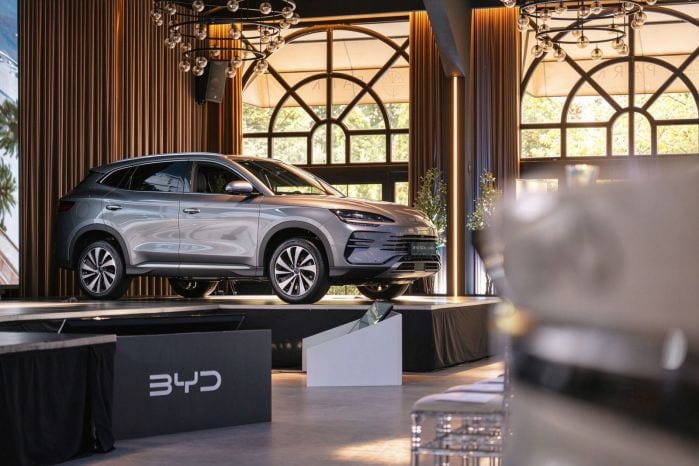
Hungary’s government is reviewing investment and subsidy agreements signed with Chinese companies under Viktor Orbán and tightening environmental enforcement at their factories, Nikkei reported on Thursday, adding political risk to a BYD plant in Szeged that is already a year behind schedule.
The review lands on BYD in two places: the terms of its Szeged investment, negotiated by former Foreign Minister Péter Szijjártó, who joined BYD in July, and a police investigation into the removal of contaminated soil from the construction site. Executive VP Stella Li has said the company complied with all local rules and remains committed to the plant.
Prime Minister Péter Magyar, whose Tisza party defeated Orbán in April and took office in May, told parliament on May 9: “We will build a Hungary where investors, every investor, respects our laws, our environment, our workers, and the safety of our local communities.”
On July 17 he announced what he called the strictest environmental rules in the European Union, higher charges on polluters and the end of tax incentives for multinationals, measures Bloomberg said would fall hardest on the Chinese battery and vehicle plants that Orbán’s government had drawn to the country.
Transport and Investment Minister Dávid Vitézy said there would be “no compromises and no flexibility” in enforcing the rules and that the government would not overlook breaches in favour of Chinese industrial interests, according to Daily News Hungary.
On August 16 his ministry said projects designated as key national investments would no longer be exempt from environmental, nature-conservation and planning rules, and that violators could be barred from new construction permits for at least six months.
Vitézy also said the aim was not to unwind the relationship but to keep it while ensuring full compliance with Hungarian and European rules, the outlet reported.
What Has Reached BYD
The soil case has two tracks.
The Csongrád-Csanád county government office found in February that BYD had moved topsoil from the site to about 20 hectares of farmland without the required tests, a tenth of it contaminated with alkylbenzenes, and filed a police complaint in May.
Accredited tests between April and June found the contamination no longer above legal limits, the office said on June 24, closing its environmental proceedings with a 10 million forint ($32,000) fine and a requirement that any further soil removal be tested and approved in advance.
Affected farmers were told to destroy crops grown on the land.
The police investigation, opened on May 19, is separate and has not been reported as concluded. “That is a false claim,” Li said of the allegations in June, adding that BYD had hired lawyers to respond.
Magyar went further on July 20, five days after Szijjártó’s appointment. “We will examine all the decisions, negotiations and state commitments made by Péter Szijjártó that were related to the BYD Hungary investment,” he said, according to the Associated Press.
He added that the review would cover subsidies, tax breaks, permits, environmental exemptions and publicly funded works granted to large multinationals during Orbán’s tenure.
Szijjártó, foreign minister from 2014 until the election, announced BYD’s Szeged plant in December 2023 and resigned his parliamentary seat in July to become the company’s Director of External Relations, a global role BYD Hungary said sits outside its Hungarian management, as EV reported at the time.
Bloomberg has reported that he is separately under investigation over ties to the Kremlin.
The amount of state support attached to the Szeged project has never been disclosed. The European Commission opened a preliminary investigation under its Foreign Subsidies Regulation in March 2025 and has sent formal information requests to the Hungarian government.
It has announced no finding.
A Plant Already Late
Szeged was to have started building the Dolphin Surf by the end of 2025.
Trial production began on January 29 with 960 people hired, and Li told Reuters on June 9 that vehicle assembly would begin in the fourth quarter of 2026 with equipment still being installed.
“Hungary is the number one priority right now,” she said, adding that the second priority was a second European site, preferably an existing plant, and that the $1 billion Turkey factory announced in 2024 was on hold with construction never begun and no timeline.
The plant is planned for 200,000 vehicles a year at full ramp, a figure Chinese sources put as high as 300,000, and BYD has said it will run well below that for at least two years.
The Neighbours
The enforcement has been felt first in the battery cluster around Debrecen.
The Hajdú-Bihar county government office barred CATL on August 25 from working in three areas of its €7.34 billion cell plant, the electrode laser-cutting, winding and drying shops, after nine workers showed elevated nickel levels during commissioning, and said only equipment testing may continue until protective-equipment gaps are fixed, Caixin reported. Cell production had not yet begun.
The plant’s first-phase permit was issued the same day. Its second-phase application was rejected on August 19 over errors in the site plan, and the company was fined 10 million forints for breaches of its environmental permit.
CATL is supplying Mercedes-Benz from other plants in the meantime.
Semcorp, a Chinese separator-film maker on the same industrial park, was shut down in June after metals were found in groundwater beneath its factory. Samsung SDI and SK On are also covered by the August 16 rules.
Building in Hungary was meant to let BYD sell into the EU without the countervailing duty of 17% on top of the standard 10% tariff that the Commission imposed on its China-built EVs in late 2024.
BYD’s European registrations rose 270% in 2025 to almost 188,000, and it has moved its European headquarters to Budapest.
The company has been in Hungary since 2016, when it opened an electric-bus plant at Komárom.