
Volkswagen Group estimates the total cost of job cuts and potential plant closures under its landmark restructuring at about €16 billion ($18.6 billion), putting a concrete price on the biggest overhaul in the carmaker’s history.
A person familiar with the matter disclosed the figure to Reuters on Thursday.
Approached by Reuters, a Volkswagen spokesperson declined to comment on the costs.
About €10 billion has been set aside for severance and related expenses tied to cutting up to 60,000 positions worldwide.
Phasing out production at the Emden and Zwickau plants would cost about €1 billion each, while the Neckarsulm and Hanover sites would each run to about €2 billion, the source said.
Europe’s largest carmaker has framed the overhaul as an existential response to competition from China, punishing tariffs and chronic overcapacity across its European factory network.
The Plan
Volkswagen’s supervisory board approved the restructuring on September 3, voting unanimously and a day ahead of schedule.
The plan calls for 50,000 additional job cuts by 2030, layered on top of about 50,000 reductions already agreed with unions in late 2024, taking the cumulative total toward 100,000.
New cuts represent about 8% of the group’s global workforce, which stood at 667,164 at the end of 2025.
The restructuring also shrinks the vehicle lineup by as much as half by 2035 and acknowledges more than 500,000 vehicles of excess European capacity.
Reaching the board vote required months of internal struggle.
Manager Magazin first reported in late June that Volkswagen was weighing as many as 100,000 reductions and the closure of four German plants, a story that sent shares to 16-year lows.
Chief Executive Oliver Blume presented the proposal to the supervisory board in July, but labor representatives blocked it, exercising their power under Germany’s co-determination rules, which grant employee representatives half the board’s seats.
Blume then wrote to staff warning the company faced a cost disadvantage of about 20% against rivals and describing the additional 50,000 cuts as a theoretical deduction needed to close the gap.
Four EV Plants
Four German factories, Emden, Zwickau, Hanover and Neckarsulm, have been identified as sites for which Volkswagen cannot demonstrate a competitive use case. Together they employ more than 45,000 people.
Reuters describes them as plants that “will eventually run out of models during the next decade,” for which the plan involves “exploring alternatives.”
Each has until June 2027 to secure an alternative production concept or face closure or major structural reallocation after 2031.
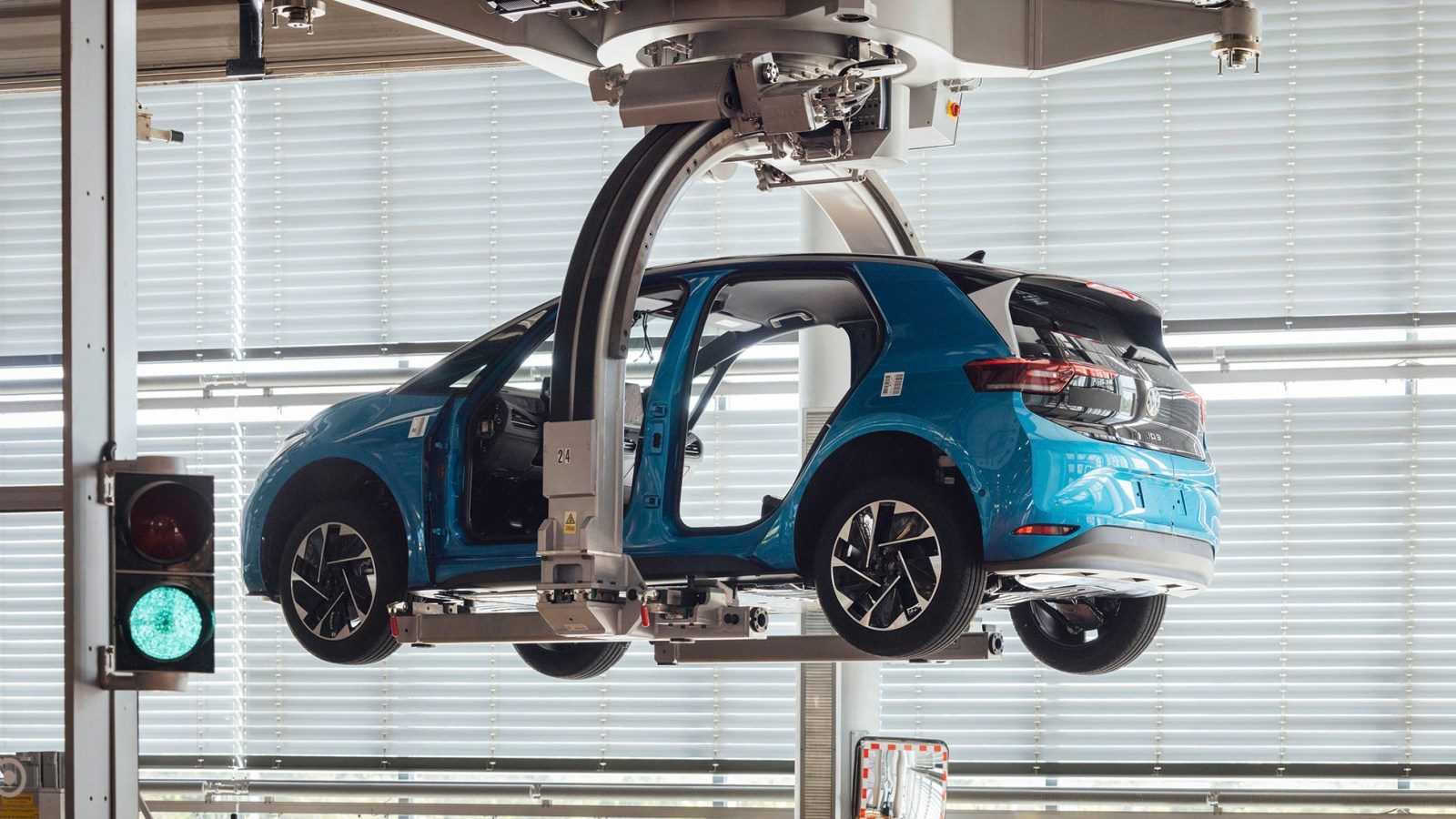
All four sit at the center of the group’s electric strategy rather than on aging combustion lines, a detail that sharpens the stakes. Zwickau was converted entirely to electric production in 2020 and builds the ID.3 and ID.4.
Emden assembles the ID.4 and ID.7. Hanover produces the battery-powered ID.Buzz alongside the combustion Multivan. Neckarsulm, an Audi site, builds the e-tron GT and A6 e-tron.
European electric volumes have not filled the capacity built for them.
Volkswagen brand chief Thomas Schäfer has cast outright closures as a last resort, telling the Financial Times Future of the Car summit in London in May that defence-sector partnerships rank among the active fixes for overcapacity.
Osnabrück as a Template
One plant already has an exit route.
Volkswagen agreed on September 7 to sell its Osnabrück factory to the State of Lower Saxony and Israeli investor Aurelius Capital.
Rafael Advanced Defence Systems, the maker of Israel’s Iron Dome, will serve as the first industrial partner, and the site will become a competence center for security and defence solutions.
Works council chair Daniela Cavallo said the deal could secure about 1,400 of the site’s 1,800 jobs.
Osnabrück had been scheduled for closure since 2024 and was not among the four plants on notice under last week’s restructuring, but the structure — a state-backed investor buying a plant Volkswagen no longer needs and bringing in an industrial partner from outside the car industry — offers a model for the larger sites.
Blume has said there are more intelligent solutions than closing plants. Whether similar arrangements can be replicated across four factories with more than ten times the combined headcount of Osnabrück remains untested.
Labor’s Red Lines
IG Metall chief Christiane Benner and Cavallo secured several concessions before voting for the September 3 package.
No plant closure has been formally agreed.
A proposed separation of the passenger-car and components businesses was taken off the table.
Job security guarantees from the December 2024 settlement, which rule out forced layoffs through the end of the decade, remain in place.
Blume told the board the company’s position was more than critical and warned that even 50,000 further cuts might not be enough to secure long-term competitiveness.
The plan ties reductions to a target of lifting the group’s operating return from about 4% to 9% by 2030.
What the First Half Showed
The restructuring is being paid for in Germany for a decline that happened in China. Volkswagen delivered 4,125,700 vehicles in the first half of 2026, down 6.3%. China fell 26% to about 973,000, a loss of 340,800 vehicles, while Europe rose 3.5% to 2,041,000, South America 8.3% to 327,200 and North America slipped 3.1% to 447,500.
Excluding China the group grew about 2%. Consolidated revenue was nevertheless flat at €158.1 billion, because the Chinese joint ventures are not consolidated: Asia-Pacific revenue fell €4.4 billion to €15.0 billion while Europe and other markets rose €3.9 billion to €104.6 billion.
The operating margin for the half was 3.8%, against a 7.9% peak in 2022, and the Chief Financial Officer has put the annual tariff cost at about €4 billion.
The plan’s 9% target is set against that 3.8%.
Chinese Competition
The pressure driving the restructuring traces most directly to China, for years Volkswagen’s most profitable market.
BYD knocked the German group off the top of the Chinese market in 2024, and Geely overtook Volkswagen for second place in 2025.
Chinese manufacturers have now reached Europe.
BYD, Chery, SAIC and Leapmotor doubled their combined European share through May from a year earlier, pressing into the VW Group’s home market with cheaper, software-rich models.
Volkswagen’s 2025 net profit fell 44% to about €6.9 billion. Operating profit dropped 53% to €8.9 billion, cutting the operating margin to 2.8%. US tariffs added €2.9 billion in costs.
The €16 billion figure gives the restructuring a price tag for the first time. Completion depends on negotiations with unions at each plant, regulatory reviews for any sales to outside investors and the search for alternative uses at the four sites Reuters says will run out of models in the next decade.