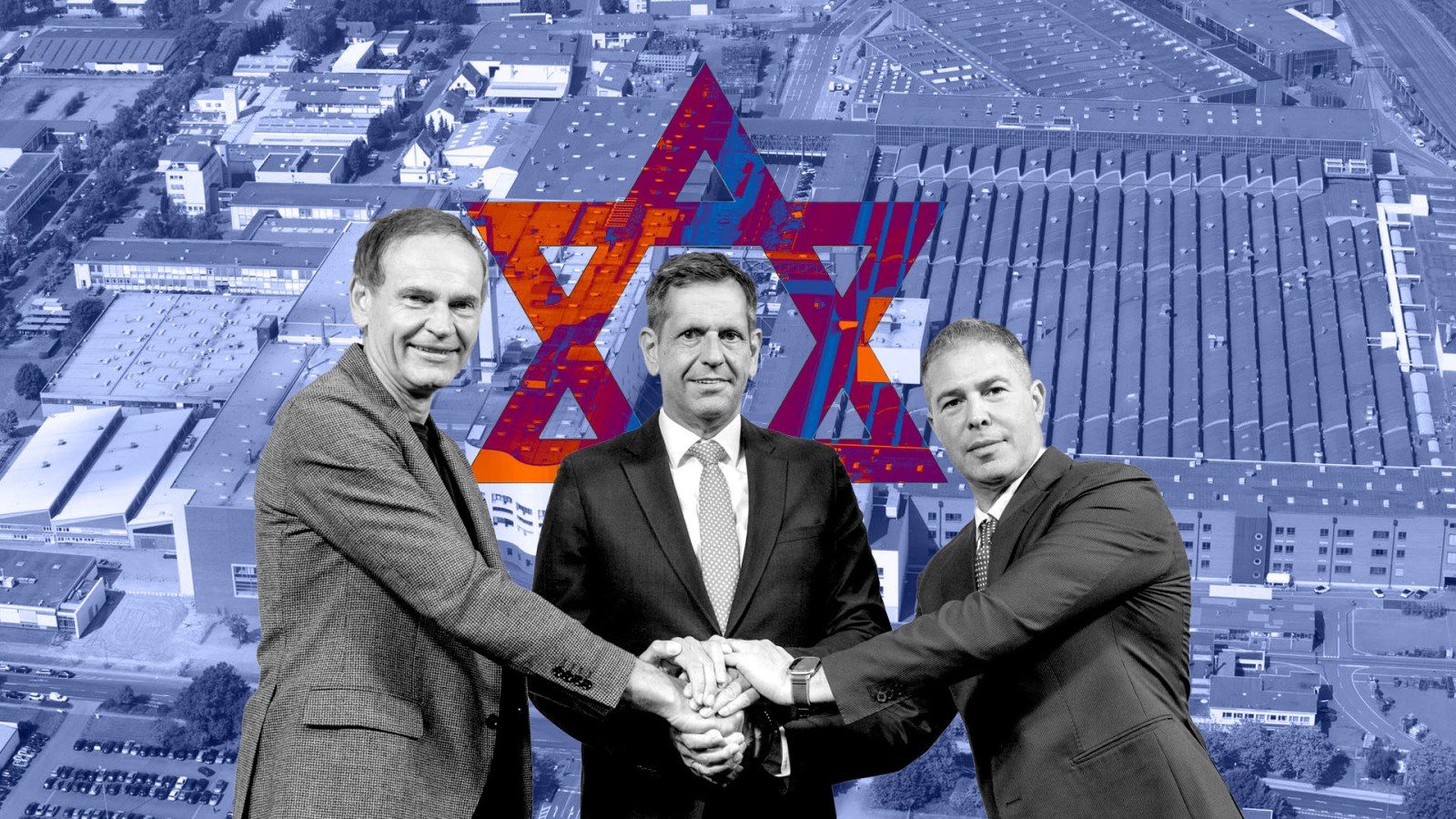

Volkswagen agreed on Monday on key terms to sell its Osnabrück factory to the State of Lower Saxony and Israeli investor Aurelius Capital, who plan to turn the site into a “competence center for security and defense solutions” with Rafael Advanced Defense Systems, the maker of Israel’s Iron Dome, as the first industrial partner.
The agreement provides for Aurelius to take a majority of Volkswagen Osnabrück GmbH alongside the state, which is Volkswagen’s second-largest shareholder.
The parties did not disclose the purchase price, the exact stakes Aurelius and Lower Saxony will hold, or who will pay to convert the plant from car production to defence work.
Completion depends on final contracts, corporate approvals and regulatory review, and Volkswagen said details of activities, timetable and employment “will be communicated as soon as reliable results are available.”
The plan “involves the potential manufacture of systems and components for air defense systems for Germany and Europe,” Volkswagen said, with Rafael contributing technology and the Osnabrück workforce “a central role in establishing manufacturing operations and industrializing production.”
The anchor project is meant to “pave the way for further partnerships and projects under the umbrella of the new company,” the company added.
Volkswagen’s works council said the deal could secure about 1,400 of the site’s 1,800 jobs, and council chair Daniela Cavallo said “more than 1,200 people now have a prospect for their future at their site,” while adding that the council would keep working “to ultimately ensure that the entire core workforce has a future perspective.”
The sale comes four days after Volkswagen’s supervisory board that adds 50,000 job cuts by 2030 to those agreed since late 2024, taking the cumulative total toward 100,000, shrinks the lineup by as much as half by 2035.
The updated plan also acknowledges more than 500,000 vehicles of excess European capacity and gives four factories, Emden, Zwickau, Hanover and Neckarsulm, with more than 45,000 employees between them, until June 2027 to find an alternative production concept or face closure or reallocation after 2031.
Osnabrück was not on that list, having been scheduled for closure since 2024, but it is the first Volkswagen site to be given the kind of alternative use the plan holds out for the others.
Blume has said there are “more intelligent solutions than closing plants.”
What Would Be Built
Rafael said the letter of intent “anchors the joint commitment of the parties to examine and formulate an agreed outline for the development of the Osnabrück site,” and its CEO, Yoav Turgeman, said the technology “will be manufactured entirely in Germany.”
Tamir interceptors, the missiles the Iron Dome fires, would not be made at Osnabrück, according to The Jerusalem Post and JFeed.
The site is expected to produce the system’s supporting hardware, launchers, the transport vehicles that carry batteries and power generators, with production possible 12 to 18 months after approval, a timeline first reported by the Financial Times in March.
Rafael, which is owned by the Israeli government and also builds the David’s Sling and Arrow systems, has operated in Germany for more than 20 years through local subsidiaries, and received a landmark Israeli order in November 2025 to accelerate Iron Dome serial production, funded largely from a $8.7 billion US assistance package.
Volkswagen itself will not make weapons: the company said in March that “the production of weapons by Volkswagen AG remains ruled out,” and the structure signed on Monday keeps the carmaker outside the venture, contributing only “its industrial experience, expertise in development and industrialization, as well as the existing infrastructure” during the transition.
Why the Structure Matters
The consortium form was not the original plan.
Talks between Volkswagen and Rafael surfaced in the Financial Times on March 25 and were confirmed to Reuters by sources in May.
Blume acknowledged publicly that a defence solution was under review at the Financial Times event held in London in mid-May.
According to WirtschaftsWoche, the direct cooperation ran into opposition from Qatar Investment Authority, which holds about 10% of Volkswagen’s shares and 17% of its voting rights, and the parties devised the sale to Lower Saxony and Aurelius instead, with Rafael as a partner of the new owner rather than of Volkswagen.
Bloomberg reported in late August that a deal could be reached within weeks after the shareholder’s objections had threatened to derail it.
Aurelius Capital, headquartered in Tel Aviv and not to be confused with the Munich-based Aurelius private-equity group that some early German reports named, invests in defence, cybersecurity, AI and critical infrastructure companies and lists drone and satellite technology among its focus areas.
Founding partner Tomer Yaakov, who signed as Tomer Jacob, called the agreement “only the first step in a strategic cooperation that will continue to grow over time.”
Lies said the site’s “security reality has changed completely” and that “Germany and Europe must strengthen their capabilities and become more independent,” while IG Metall chair Christiane Benner said the step “does not absolve Volkswagen of its responsibility to create reliable future prospects for the remaining employees.”
The Plant
Osnabrück has built cars for 125 years, as coachbuilder Karmann from 1901, maker of the Beetle convertible from 1949, until its insolvency, after which Volkswagen took the site over at the start of 2010 as a centre for small-series and special vehicles.
Since then, it has built the Golf Cabriolet, the Porsche Boxster and Cayman under contract and, most recently, the T-Roc Cabriolet.
Volkswagen decided in 2024 to end vehicle production there in summer 2027, and the plant did not appear in the future plan approved last week.
The works council secured a commitment during the December 2024 wage talks that a viable future would be found for the site, which Cavallo cited on Monday as the origin of the deal.
The works council’s workforce figures on Monday put them at 1,800 people, of which about 1,400 jobs could be preserved, and the difference reflects departures since the 2024 decision.
A Possible Template
The Osnabrück structure, a state-backed investor buying a plant Volkswagen no longer needs and bringing in an industrial partner from outside the car industry, is the “alternative use” that last week’s compromise promised to explore for the four larger sites.
All four locations build electric vehicles: Zwickau the ID.3 and ID.4, Emden the ID.4 and ID.7, Hanover the ID.Buzz, Neckarsulm the e-tron GT and A6 e-tron.
Lower Saxony holds a 20% blocking stake in Volkswagen under the Volkswagen Law, federal defence minister Boris Pistorius was mayor of Osnabrück from 2006 to 2013, and Berlin’s defence-spending expansion supplies the demand.
Rheinmetall had looked at the site earlier and declined, according to German reports.
Two constraints remain outside the parties’ control.