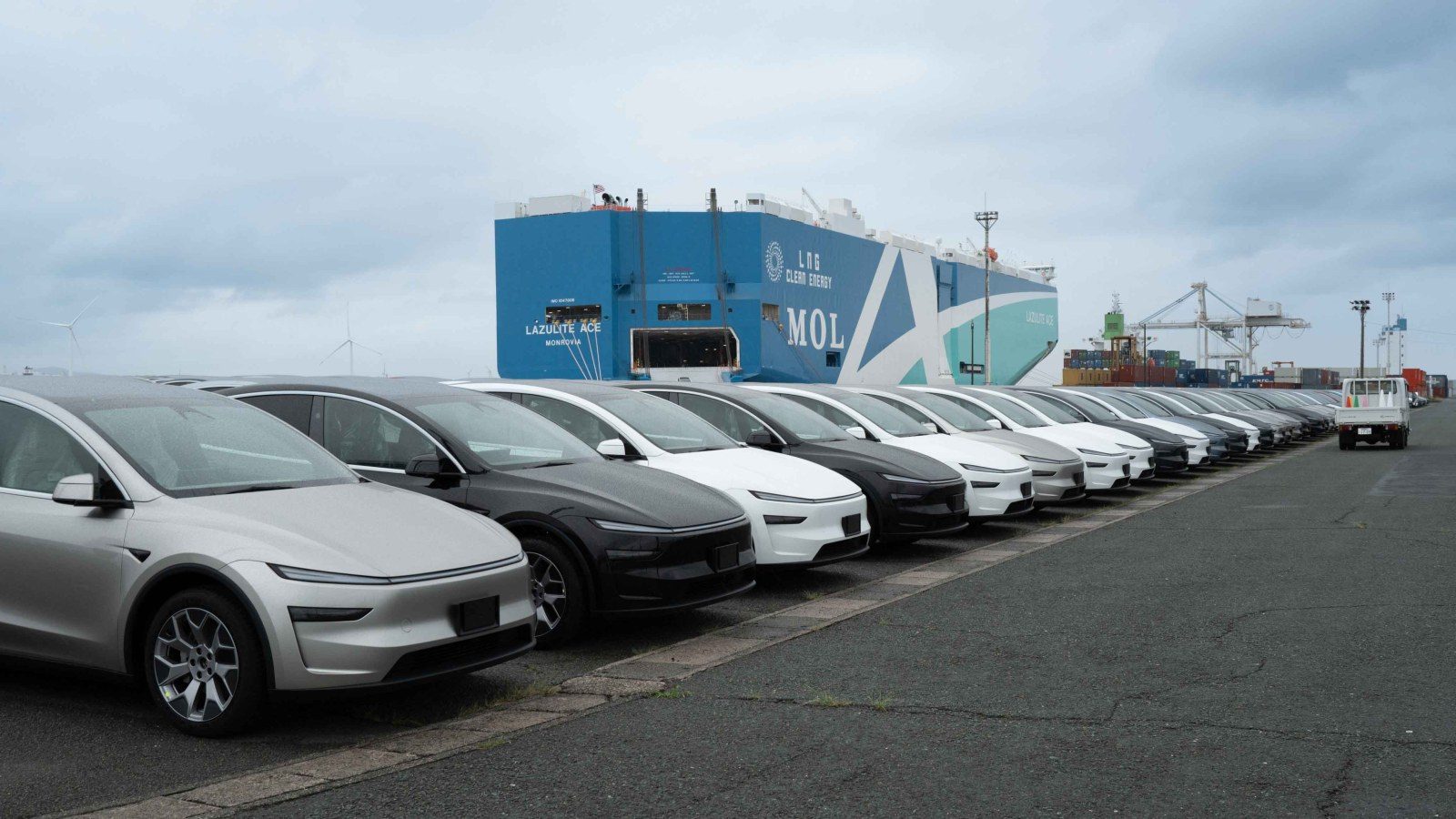

Tesla docked a large number of Model Y L vehicles at the Toyohashi port, ramping up supply of the six-seat version of the SUV as first-half registrations in the country surpassed the company’s entire 2025 total.
A video shared on X by automotive journalist Ken Maeda showed a large car-carrier vessel loaded with what he claimed to be “thousands” of Tesla vehicles docked at one of Japan’s main vehicle import hubs.
“A large vessel loaded with thousands of Tesla has docked in Toyohashi — and I got to see the cars arriving up close,” Maeda wrote.
As of Monday, Tesla‘s Japanese configurator shows new orders for the Model Y L Premium AWD can expect delivery within approximately one month.
Strong First Half
In the same post, Ken Maeda wrote that “Tesla‘s registration in June ranked #2 in the import segment.”
Tesla registered approximately 12,200 vehicles in Japan during the first half of 2026, according to data from the Japan Automobile Importers Association (JAIA).
The figure eclipses the roughly 10,600 units the company sold in the country across all of 2025 — itself a record at the time, representing 90% year-over-year growth from 2024.
June alone accounted for 3,997 registrations, a 183% increase from the 1,411 units recorded in the same month a year earlier and Tesla‘s best single month ever in Japan.
Second-quarter registrations reached 7,034 units, making it the strongest quarter on record for the company.
Monthly figures for the first half break down as follows: January saw 1,080 registrations, February 1,524, March 2,523, April 1,041, May 1,996 and June 3,997.
The quarterly pattern — a sharp spike in the final month of each quarter — mirrors Tesla‘s well-documented global delivery cadence, where shipments from Giga Shanghai cluster toward quarter-end.
As with previous monthly reports, the company’s figures appear under JAIA’s ‘Others’ category — as it does not separately disclose registration data in Japan.
A JAIA official told Japan Today that Tesla accounts for nearly all of the vehicles listed under that heading, a characterisation Nikkei Asia has corroborated in its own reporting.
Tesla ranked second among all imported brands in Japan by June registrations, according to Maeda, trailing only Mercedes-Benz.
In May, the Model Y became the single best-selling imported car model in the country — the first time a Tesla vehicle had topped that chart.
Model Y L expands the lineup
The Model Y L — a stretched, three-row version of Tesla‘s best-selling SUV — launched in Japan in early April 2026 as part of a broader rollout across 11 Asia-Pacific markets.
Showroom displays began on April 3, with deliveries starting by the end of that month. Giga Shanghai produces all Model Y L units shipped to Japan.
Tesla offers the variant in a single Premium AWD configuration priced at 7,490,000 yen ($46,200) before subsidies.
The six-seat SUV is eligible for Japan’s Clean Energy Vehicle (CEV) subsidy of 1,270,000 yen ($7,800), bringing the effective price down to roughly 6,220,000 yen ($38,400).
Residents of Tokyo can claim an additional metropolitan subsidy of 400,000 to 800,000 yen ($2,500–$4,900), depending on eligibility, which would lower the cost further to between approximately 5,420,000 and 5,820,000 yen ($33,500–$35,900).
Compared with the standard five-seat Model Y, the L adds approximately 179 mm to the overall length and 150 mm to the wheelbase, creating room for a 2+2+2 seating layout.
With all rear seats folded, cargo volume reaches 2,539 litres — 401 litres more than the standard Model Y.
The Model Y L rides on an adaptive air suspension with electronically controlled dampers.
WLTC-rated range stands at 788 kilometres, with a 0-to-100 km/h time of 5.0 seconds and a top speed of 201 km/h.
Incentives and Retail Expansion
Tesla is currently offering three years of free Supercharging on orders placed between April 1 and July 31, a promotion the company extended from its original June deadline to sustain demand.
The promotion covers the Model Y L alongside the rest of the Model Y and Model 3 range.
Separately, Tesla offered 0% APR financing on the Model 3 and Model Y through the first quarter; EVwire reported in June that a low-interest financing offer remained available.
The sales surge has coincided with an aggressive retail build-out under Japan country manager Richi Hashimoto.
Tesla operated 35 stores and 14 directly run service centres as of April, with plans to expand the service network to more than 30 locations this year.
Hashimoto told Reuters in April that the company aims to grow its store count to at least 60 and ultimately become the top imported car brand in Japan.
In areas without a directly operated service centre, Tesla has partnered with more than 50 third-party auto care facilities nationwide.
Japan’s Ministry of Economy, Trade and Industry revised clean-energy vehicle subsidies on April 1, increasing Tesla’s per-vehicle allocation to 1,270,000 yen — up from 400,000 yen under the previous framework — largely because the Model Y and Model 3 use Panasonic battery cells manufactured in Japan.
The same revision slashed BYD’s subsidy to a flat 150,000 yen per vehicle, widening the cost gap between the two brands.
Broader Context
Tesla‘s first-half performance in Japan tracks with a wider global rebound.
The company delivered 480,126 vehicles worldwide in the second quarter, a 25% year-over-year increase that crushed Wall Street’s consensus estimate of approximately 406,000 units.
The Model Y L played a role in that result, having also broadened the lineup in South Korea — where Tesla captured a 30.5% share of imported car sales in the first half — and in Australia, where the SUV launched in March.
Late last week, Tesla opened US orders for the Model Y L at $61,990 in a Launch Series configuration built at Giga Texas, with American deliveries expected in September.
Tesla also began testing its Full Self-Driving software on Japanese roads with employees last year.
Hashimoto has said the company is targeting an FSD launch in Japan this year, though regulatory approval has not yet been granted.
The Supercharger network currently spans 726 charging points across 146 locations nationwide, with a target of exceeding 1,000 charging points by 2027.
At the current run rate, Tesla is on pace for more than 24,000 registrations in Japan this year — a figure that would more than double last year’s record.