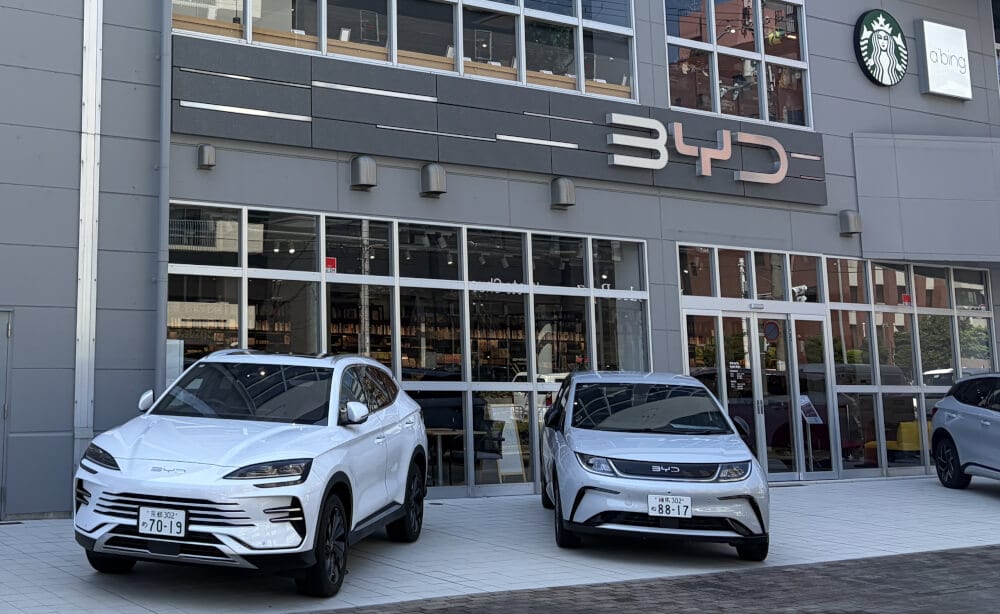

BYD registered 363 passenger vehicles in Japan last month, a 12.7% decline from the 416 units recorded in the same month a year earlier, according to data from the Japan Automobile Importers Association (JAIA).
The drop marks the first year-over-year monthly decline for the Chinese automaker in Japan this year, following four consecutive months of gains.
Cumulative registrations through the first five months of 2026 reached 1,798 passenger cars, a 60.0% increase from the 1,124 units registered during the same period in 2025.
BYD ranked 16th among all imported brands in Japan by cumulative registrations through May, capturing a 1.25% share of the market.
Mercedes-Benz led with 18,552 units, followed by BMW at 11,493 and Volkswagen at 10,535.
Post-March Deceleration
BYD‘s year-over-year growth rate in Japan has decelerated sharply since the start of the year.
January registrations of 156 units represented a 271% year-over-year surge from just 42 units in January 2025.
February followed with 439 units, a 154% increase. March reached 625 units — the strongest single month so far in 2026 — with a 91% gain over the prior year.
April brought a notable slowdown.
Registrations fell to 215 units, still 30% above the prior-year figure of 166, but well below the March peak.
May’s 363 units then swung into negative territory for the first time, falling below the 416-unit figure from May 2025, when BYD had first cracked JAIA’s top 10 imported-brand ranking on the back of strong Sealion 7 demand.
Japan’s Revised Subsidy
A major headwind arrived on April 1, when Japan’s Ministry of Economy, Trade and Industry (METI) implemented a revised Clean Energy Vehicle subsidy framework.
Under the new rules, BYD‘s per-vehicle subsidy was slashed from 350,000–400,000 yen ($2,200–$2,500) to a flat 150,000 yen ($940).
The change reflected new scoring criteria that prioritize domestically manufactured battery packs, locally sourced supply chains, and battery security provisions under Japan’s Economic Security Promotion Act.
By contrast, Toyota‘s bZ4X retained the maximum subsidy of 1.3 million yen ($8,100).
Tesla‘s Model Y and Model 3 saw their subsidies increased to 1.27 million yen ($7,900), largely because those vehicles use Panasonic batteries produced in Japan.
The gap between BYD‘s 150,000-yen subsidy and Toyota‘s 1.3-million-yen top bracket now stands at 1.15 million yen — a differential that significantly erodes BYD‘s price competitiveness at the point of sale.
BYD Auto Japan President Atsuki Tofukuji addressed the subsidy disparity publicly earlier this year, questioning whether the scoring formula was implicitly penalizing BYD for being a Chinese manufacturer.
METI’s own documentation cited the US-Japan tariff agreement and the need for “fair competitive conditions” as rationale for the revision.
Japan’s Import Market
Total imported vehicle registrations in Japan reached 26,673 units in May, a 3.0% increase from 25,900 a year earlier, JAIA data showed.
The cumulative total through May hit 148,339 units, up 5.9% year over year from 140,056.
Foreign-manufacturer passenger cars, however, declined.
Registrations fell 1.6% in May to 17,770 units and were down 6.0% year to date at 90,532 units.
The overall growth was driven primarily by Japanese-brand overseas-produced vehicles — particularly Suzuki, which surged to 29,350 cumulative units through May, a 122.4% year-over-year increase — and by Toyota, whose imported-vehicle registrations jumped to 8,535 cumulative units from just 1,113 a year ago.
Among premium European marques, several posted declines.
BMW cumulative registrations fell 18.8% to 11,493 units, while Volkswagen dropped 26.4% to 10,535 and Audi slid 14.5% to 7,797.
Mercedes-Benz registered 18,552 units year to date, down 8.5% from 20,286.
‘Racco’ Kei Car
BYD is preparing to launch the Racco, its first-ever electric kei car, in Japan this summer.
The vehicle is BYD’s first model developed exclusively for an overseas market and represents a direct push into the kei segment, which accounts for roughly one-third of all new vehicle sales in Japan.
Kei cars — miniature vehicles subject to strict dimensional and power output limits — benefit from lower taxation, reduced insurance costs, and favorable parking regulations, making them a fixture of Japanese urban mobility.
The Racco measures 3,395 mm in length, 1,475 mm in width, and 1,800 mm in height, adhering to Japan’s kei car regulations.
Power comes from a front electric motor paired with a 20 kWh lithium iron phosphate (LFP) Blade battery, delivering a WLTC-rated range of 180 km. DC fast charging at up to 100 kW is supported.
BYD has set a starting price of approximately 2.5 million yen ($16,340), positioning the Racco close to Nissan‘s Sakura electric kei car, which starts at 2.53 million yen.
To develop the vehicle, BYD recruited Hirohide Tagawa, a former Nissan engineer with roughly 25 to 30 years of experience, according to a report from Nikkei.
Tagawa was closely associated with Nissan‘s kei car strategy, contributing to the product planning and development of the Dayz and Sakura models.
His involvement underscores BYD‘s commitment to understanding the specific engineering and consumer requirements of the kei segment.
Competition in the Segment
BYD will not be alone in targeting Japan’s kei market for long.
Chery Automobile announced in late May that it would enter the Japanese market through Electric Mobility Technologies (EMT) — a Singapore-registered joint venture involving Jiangsu Yueda Group, battery maker Gotion, Japanese car parts retailer Autobacs Seven, and compressor manufacturer Anest Iwata.
The venture will sell vehicles under a new brand called Emta, with its first electric kei car scheduled for launch in 2027.
The Emta brand is positioning itself to compete directly with the Racco.
EMT officials said the vehicle would be priced comparably to gasoline-powered kei cars — potentially undercutting both BYD and Nissan‘s Sakura.
Autobacs’ existing nationwide retail network gives Emta a distribution advantage BYD has had to build from scratch.
BYD’s global overseas push continued to accelerate in May, with total deliveries outside China reaching a record 160,644 vehicles, an 80% year-over-year increase.
Japan remains a small fraction of that total, but the upcoming Racco launch represents the company’s most targeted effort to crack one of the world’s most insular automotive markets.
BYD will manufacture the Racco in China.