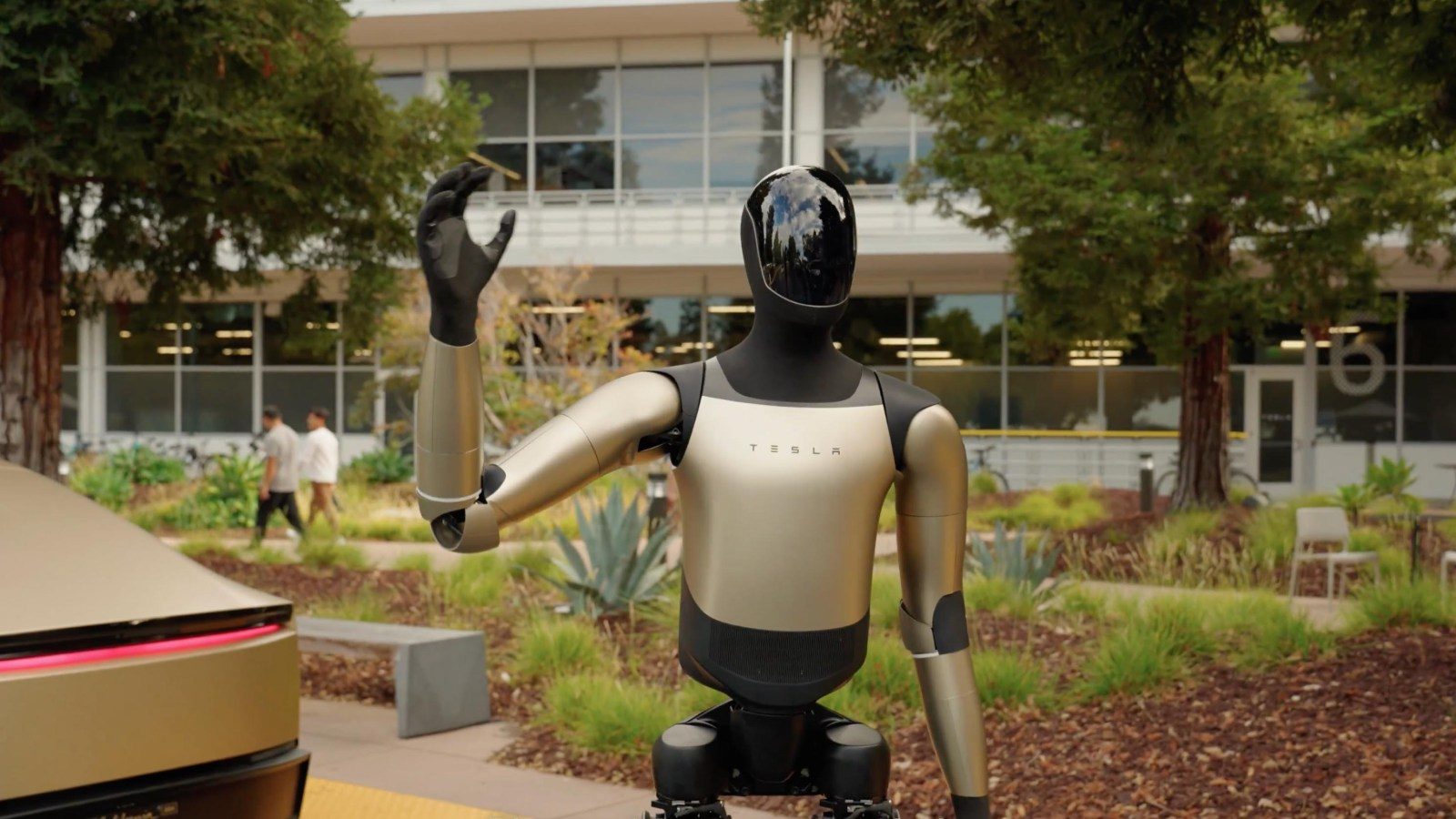

The first Optimus robots off Tesla‘s Fremont line will go to an internal training programme rather than to factory work or customers, the company said on Wednesday, while holding to a production start during 2026 without naming a month.
Initial builds “will be used in our Optimus Academy,” the shareholder deck said, “for training data collection and further functionality development.”
Tesla said it had “decommissioned the manufacturing lines for Models S & X” at Fremont and was “installing the first-generation lines for Optimus,” where it expects “to start production soon.”
A conference call with chief executive Elon Musk and other members of management follows the results at 5:30 p.m. Eastern time.
What the sentence does and doesn’t say
Each clause sits in a different tense, and the sequence tracks how far the programme has actually travelled.
Decommissioning is complete and installation is under way.
Production is expected “soon,” a word the deck does not attach to a month, a rate or a unit count.
The line being fitted is designed for one million robots a year, a figure Musk gave on the first-quarter call rather than in this document.
Two other passages date the same milestone differently. The highlights page says production is “anticipated later this year,” while the outlook section says lines are being installed “in anticipation of production in 2026.”
None of the three formulations names a month.
The first robots are not for sale
The initial units will be deployed inside the development programme, gathering training data and extending functionality, rather than in factories or with buyers.
That is the first time the Optimus Academy has appeared in a quarterly update. Musk described the concept in February as a plan to train an army of humanoid robots using millions of simulated robots in a simulated world.
The distinction matters because Tesla has no equivalent for the robot of the fleet data underpinning its driving software.
An institutional shareholder asked management before the call how to think about data availability for Optimus, given the billions of real-world miles collected by vehicles.
Tesla told Goldman Sachs in March that the hand and forearm remain the primary engineering focus, and described imitation learning in which the robot observes human motion and translates it into corresponding actions, as EV reported.
Simulation and imitation are different approaches, and the deck does not say which dominates.
Texas is a building site
The third sentence covers the second factory, and places it well behind Fremont.
Tesla said it “continued site development at Gigafactory Texas,” with “building construction now in full swing.”
Site development and building construction describe a shell, not tooling. Musk said in April that the Texas plant would “probably start production around summer next year.”
Both Optimus entries in the installed annual manufacturing capacity table read construction, in California and at Gigafactory Texas, with a dash in the capacity column for each.
The same table moved the Cybercab from pilot production to production during the quarter and attached capacity above 125,000 units a year to it without updating Optimus timeframe.
Two photographs in the deck carry the caption “Optimus – first generation production line in Fremont,” showing robotic arms over an assembly line and a team standing in front of installed tooling.
Compute
Onsite AI training capacity in Texas more than doubled in megawatt terms during the first half of the year.
Cortex 1 is listed at more than 90 MW and Cortex 2 at more than 115 MW, both in production. Tesla said Cortex 2 “supports the development of both vehicle and humanoid robot autonomy software” and will ramp further across the rest of the year.
That is the only line in the deck placing a specific asset behind the robot programme.
What it costs
Operating expenses rose 47.0% year on year to $4.35 billion. Research and development reached $2.37 billion, up 21.8% in three months.
Tesla attributed the increase to “AI and other R&D projects,” alongside stock-based compensation including the 2025 CEO Performance Award, and administrative costs.
Capital expenditure reached $5.79 billion, up 142.0% year on year and more than double the first-quarter figure.
Free cash flow was negative $1.09 billion. Operating income fell 57.0% to $398 million, leaving a margin of 1.4%.
The company framed that spending as deliberate, describing itself as “in its largest and most exciting period of investment” and telling shareholders that “scaling will be non-linear.”
Elsewhere the deck says Tesla is “making the necessary investments that will deliver Amazing Abundance” — the recently updated company’s motto.
What Musk promised in April
Asked on the first-quarter call when production would start, Musk gave a date.
“Start of production is, we’re assuming, somewhere around the late July, August timeframe,” he said.
Wednesday’s deck does not repeat it. The first of those two months is almost over.
Musk tied the reveal to that date, saying he wanted to “push the Optimus 3 unveil maybe closer to production.”
The CEO’s reason was competitive. Rivals “literally do a frame-by-frame analysis and copy everything we’re doing,” he said.
The third-generation design was “almost ready to demonstrate,” he said earlier this year, needing only polish because “there’s some aesthetic elements that need to be finalized,” and “probably middle of this year, we should be able to show it off.”
On volume, he declined to forecast at all. “I don’t know what the production rate of Optimus will be this year,” Musk said. “It is impossible to predict.”
He attributed the caution to novelty rather than difficulty, saying Fremont involved a “totally new supply chain, totally new technology” and that “the production S curve is always very slow in the beginning.”
Output would “ramp up to significant numbers next year,” he added, with a second Optimus factory at Gigafactory Texas set to “probably start production around summer next year.”
Walking the installed Fremont line on July 1, Musk wrote that production would be extremely slow at first because everything is new, and that the process is not like making a car.
The record before that
An earlier commitment had already lapsed.
Tesla‘s fourth-quarter 2025 earnings release in late January said the third generation would be unveiled during the first quarter of 2026.
With days of that quarter remaining, Musk wrote that the robot was walking but needed finishing touches before it could be shown.
Musk told an October 2025 call that the robot carries roughly 10,000 unique components, and that the absence of a humanoid supply chain would require Tesla to build much of it in-house.
A shareholder question submitted for Wednesday’s call asks whether the company is sticking with July or August for the start of production.
Shareholders pressed management on the Fremont conversion before the first-quarter call, as EV reported.
Lars Moravy, VP of Vehicle Engineering, later left open the possibility of the Model S and Model X returning, as EV reported in May.
Cost and scale
The official goal is $20,000 in cost of goods sold per robot at scale, stated by the company in November 2025. Musk has separately spoken of a price target below $20,000.
At the All-In Summit in September 2025 he said that at a million units a year the artificial intelligence chip alone would cost between $5,000 and $6,000.
The Fremont line is designed for one million robots a year and Gigafactory Texas for ten million, figures given on the first-quarter call rather than in this deck.
Musk said in September 2025 that roughly 80.0% of the company’s value would eventually come from the robot programme.
Shareholder attention
The second-highest-voted question of the quarter asked for the current status of the production ramp, initial factory deployment and external sales volumes for 2027.
Analysts had flagged the Optimus timeline as a key catalyst before earlier calls, as EV reported on Cantor Fitzgerald’s preview.
Capital spending also funds the Cybercab, which the company confirmed this week will carry integrated Starlink hardware, and the semiconductor programme.