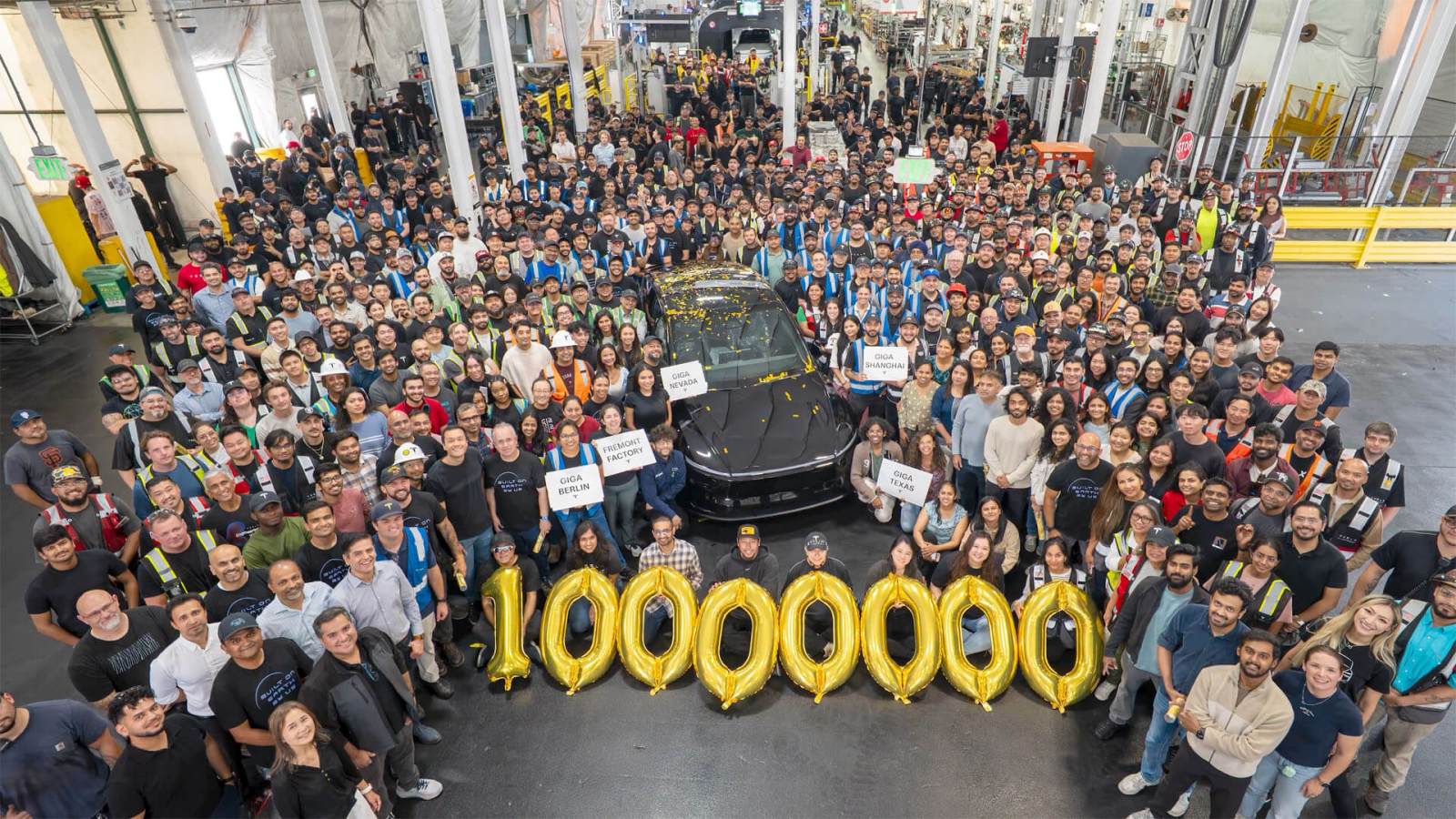

Tesla announced on Thursday that it produced its 10 millionth vehicle globally “this week,” adding one million units to its cumulative total in seven months — matching, rather than beating, the fastest sustained rate in its 18-year manufacturing history.
The nine millionth vehicle, a Model Y, rolled off the line at Gigafactory Shanghai on December 30, 2025.
Similarly, the 10 millionth Tesla vehicle produced across the globe was also a Model Y, but manufactured at the company’s Fremont factory in California.
The roughly 209-day interval between the two marks represents the shortest gap yet between successive million-unit milestones, compressing a trajectory that took more than 12 years to reach the first million.
Fremont — the California plant Tesla acquired from Toyota in 2010 and where Model S production began in June 2012 — produced both the one millionth vehicle in March 2020 and the 10 millionth this week.
Reacting to the milestone on X, CEO Elon Musk congratulated the Tesla team, writing that “10 million vehicles manufactured is an incredible amount of work.”
The milestone lands in a difficult week for the company’s shares, which fell below $300 on Wednesday for the first time since August 2025, roughly 20% down since second-quarter results.
Q2 Production Accelerates
The milestone arrives after a second quarter in which Tesla‘s factory network showed renewed momentum.
Production reached 451,758 vehicles between April and June, a 10.6% sequential increase from the 408,386 units assembled in the first quarter.
Model 3 and Model Y accounted for 442,936 of the total, with the remaining 8,822 split among Cybertruck, Cybercab, Semi and the final units of the now-discontinued Model S and Model X.
The Elon Musk-led company delivered over 480,126 vehicles globally in the quarter, a 25% year-over-year increase that beat the company-compiled analyst consensus of 406,024 by more than 74,000 units.
The result marked Tesla‘s best-ever second quarter — surpassing the 466,140 vehicles delivered in Q2 2023 — and represented the first quarterly year-over-year growth after two consecutive years of declining sales.
Tesla drew down roughly 28,000 units of inventory rather than building stock — a reversal from the first quarter, when a gap of more than 50,000 vehicles went into storage.
Combined first-half 2026 production reached 860,144 vehicles, according to Tesla‘s SEC filings.
The figure puts the company on track for a potential return to annual growth after output fell 3.9% in 2024 and a further 7.2% in 2025.
Milestone Compression
Tesla took more than 12 years — from the first Roadster in 2008 to March 2020 — to build its first million vehicles.
The second million followed in roughly 18 months.
Each subsequent million arrived faster as new factories came online and capacity expanded at existing ones: three million in August 2022, four million in March 2023, five million in September 2023, and six million at Fremont roughly six and a half months later.
From six million to seven million at Fremont in October 2024 took about six and a quarter months, the quickest single million on record.
The pace then eased rather than accelerated.
Seven million to eight million, reached at Giga Berlin in June 2025, took roughly seven and a half months. Eight to nine narrowed to 207 days, and nine to ten came in at about 209.
Tesla has now added two consecutive millions at close to a seven-month rate, holding its recent pace without setting a record.
Factory and Capacity
Tesla‘s production network spans four vehicle assembly plants.
Gigafactory Shanghai is the highest-volume site, with installed annual capacity exceeding 950,000 vehicles and a role as the primary export hub for Asia-Pacific and Europe.
The plant produced approximately four million cumulative vehicles by late 2025 and generated the global ninth-million milestone.
Fremont operates above 550,000 units of annual capacity for the Model 3 and Model Y. Gigafactory Berlin-Brandenburg runs above 375,000 units of Model Y capacity, and produced the eight millionth vehicle last June.
Gigafactory Texas in Austin assembles the Model Y, Cybertruck and Cybercab, with combined installed capacity exceeding 500,000 vehicles across the three model lines.
Total installed automotive capacity sits above 2.35 million vehicles per year, though actual utilisation remains below that ceiling.
CFO Vaibhav Taneja warned during the Q2 earnings call that supply chain bottlenecks continue to constrain output.
“Not only batteries but also various electronic components remain in short supply,” Taneja stated.
The constraint is the clearest explanation for why the pace has flattened rather than continued to compress: installed capacity of 2.35 million a year implies a million vehicles in roughly five months at full utilisation, against the seven Tesla is actually taking.
Factories in Transition
Fremont’s product mix is shifting even as it adds another milestone to its record.
Tesla discontinued the Model S and Model X in May, ending production of the two vehicles that established the brand.
Over their combined production run, the two models delivered more than 610,000 vehicles worldwide.
VP of Vehicle Engineering Lars Moravy said the decision was strategic rather than final.
“Now is not the right time to keep this one going. It doesn’t mean it goes away forever,” Moravy stated during a May appearance on the Ride the Lightning podcast, recorded at the Fremont factory.
The former Model S and Model X lines are being converted to manufacture Optimus, Tesla‘s humanoid robot, with a target of up to one million units of annual capacity.
Low-volume Optimus production at Fremont is planned for later this year, according to the company’s Q2 2026 shareholder deck.
A dedicated Optimus facility at Gigafactory Texas is under construction.
At the other end of the product line, Cybercab production started at Gigafactory Texas in February, about two months ahead of the April target Musk had outlined at the 2025 annual shareholder meeting.
Installed annual capacity for the two-seat autonomous vehicle now exceeds 125,000 units.