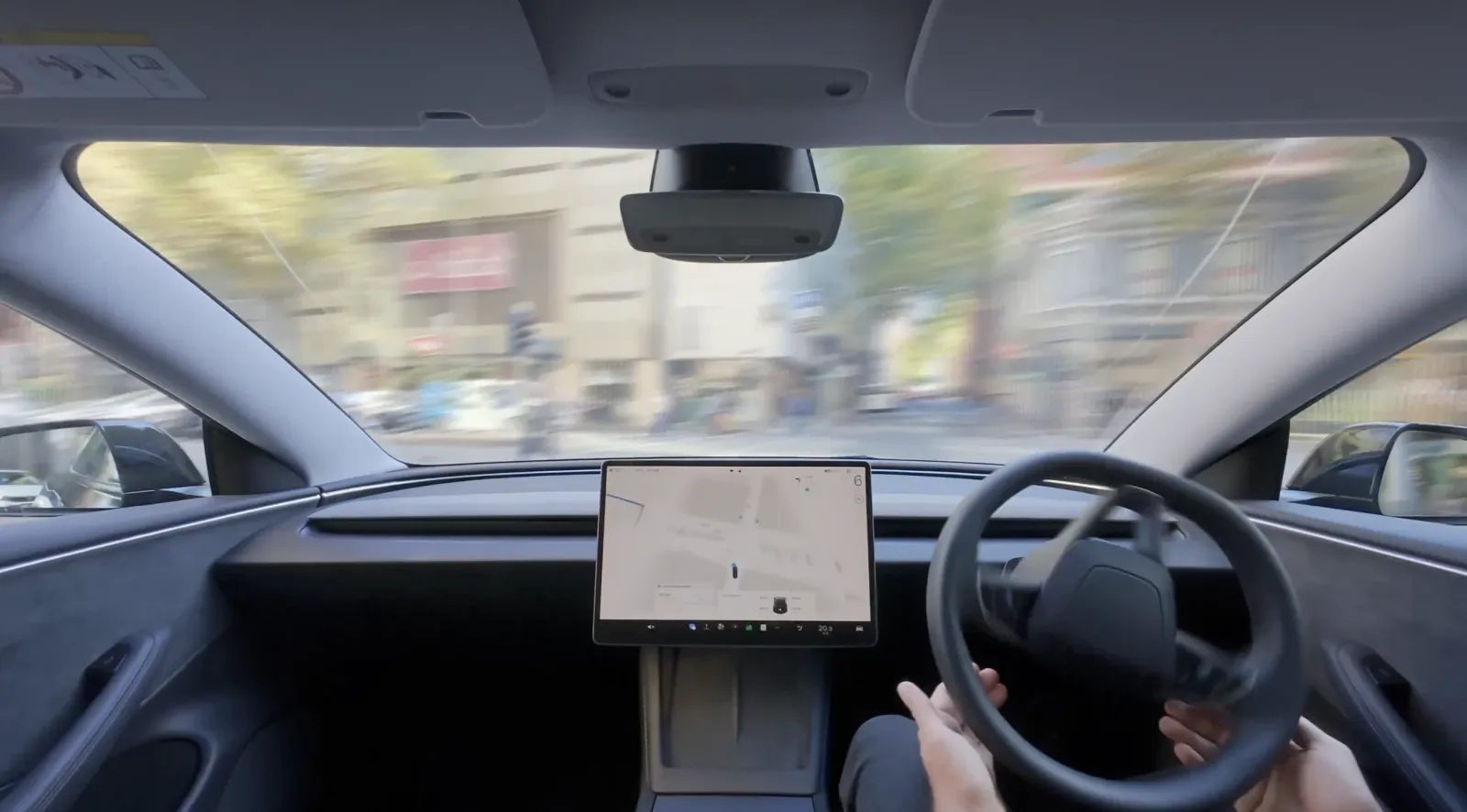

Zurich Australian Insurance has made Tesla’s Full Self-Driving (Supervised) software a rating factor in its Tesla motor product, the first Australian insurer to do so, and says it is the second globally.
The change applies to the InsureMyTesla product and covers eligible Model 3 and Model Y owners with FSD (Supervised) technology in their vehicle, who will now be assessed as lower-risk policyholders.
Zurich did not disclose a discount figure, saying the factor sits alongside standard pricing inputs such as age, location and claims history.
Australian media outlet Drive obtained one from Zurich’s quote engine.
For a 35-year-old man in Chatswood, New South Wales, with a Model 3 Long Range rear-wheel drive, the annual premium is A$2,357 without FSD, A$2,239 with a monthly subscription and A$2,329 for an owner who bought the software outright.
That is a saving of A$118, or 5%, for the subscriber and A$28, or 1.2%, for the lifetime owner.
Tesla promoted the change on its Australian and New Zealand account on X, writing that “FSD Supervised is making driving safer & now cheaper” and that Zurich “is the first insurer in Australia to offer Tesla owners lower premiums, reflecting fewer collisions & fewer claims”.
Tesla earns a commission of 5% plus GST on the first year’s premium when an Australian buyer reaches Zurich through a Tesla referral link, according to Tesla’s own Australian website.
What Zurich Is Pricing
Zurich cited Tesla data indicating that “vehicles using this technology have seven times fewer major or minor collisions compared with regular EVs”.
The comparison is with other electric cars rather than with all vehicles, and the figure is Tesla’s.
The rating is based on the presence of the software rather than its use. Tesla does not publish whether FSD was engaged at the time of a given crash, and Zurich’s release describes a product that “draws upon local and international Tesla data” rather than per-incident analysis.
On that basis a driver who has the feature and never engages it is priced the same as one who uses it daily.
Alex Morgan, Head of General Insurance at Zurich, said the move reflects the pace at which vehicle technology and driver behaviour are evolving. “It is critical that we continue to innovate alongside this change,” he said, adding that the product offers “a more affordable cost due to the reduced risk associated with supervised self-driving”.
Thom Drew, Tesla’s Country Director for Australia and New Zealand, said the data makes a clear case that FSD (Supervised) is making driving safer and that Zurich’s decision reflects the reduced risk for Tesla owners.
Adoption in Australia
Tesla launched FSD (Supervised) in Australia and New Zealand a year ago, making the two countries the first right-hand-drive markets to receive the software.
The company confirmed over-the-air updates began reaching Model 3 and Model Y vehicles equipped with Hardware 4 in September 2025.
Adoption accelerated quickly.
Owners logged one million kilometres on FSD within two weeks of launch, before the monthly subscription option was even available.
Australians drove roughly 264 billion kilometres last year, so FSD accounts for about 0.05% of the national task.
FSD is available to new buyers only as a monthly subscription, at AU$149 a month, after Tesla withdrew the AU$10,100 outright purchase for orders placed after April 1.
Owners who bought it before then keep it, which is why Zurich still rates the two separately.
Tesla reported 1.48 million active FSD subscriptions worldwide in its second-quarter figures.
Under Australian road rules, the technology remains classified as Level 2 driver assistance, leaving legal responsibility with the person behind the wheel.
3 Products, 3 Methods
Zurich’s release says no other Australian provider recognises FSD as a rating factor and calls this “the second instance of an insurer doing so globally”. It does not name the first, and there are two candidates.
Tesla’s own insurance began giving an FSD discount in Arizona and Texas in February 2025, worth up to 10% on certain coverages where half or more of the previous 30 days’ miles were driven with the system engaged.
In April this year Safety Score 3.0 went further, assigning every FSD mile a score of 100 while judging manual miles dynamically. It applies to new policies in Indiana, Tennessee, Texas, Arizona, Virginia and Illinois, with Florida and Maryland added on April 28.
Lemonade launched its Autonomous Car product in January, offering about 50% off per-mile rates for every mile driven with FSD engaged. It uses Tesla’s Fleet API to distinguish FSD miles from manual ones automatically, with no self-reporting.
It began in Arizona and Oregon and has since added Colorado, with the rollout continuing state by state. Vehicles must run Hardware 4 or higher.
The three are not the same instrument. Tesla Insurance prices the share of miles. Lemonade prices the miles themselves. Zurich prices the feature.
Morgan Stanley analyst Andrew Percoco , who covers Tesla with an Equalweight rating, wrote in January that Lemonade’s product represents “a notable step in legitimizing autonomous driving” in the eyes of the insurance industry and predicted a positive feedback loop in which lower insurance costs accelerate FSD adoption.
No Other Market
As of Monday, no insurer outside the United States and Australia currently prices coverage around FSD use.
Tesla Insurance does not operate beyond the US and Lemonade’s Autonomous Car product remains US-only.
Searches across Canada, the United Kingdom, New Zealand, Switzerland, the European Union, and China produce no equivalent product.
China has manufacturer-backed ADAS liability programmes, but those differ structurally from consumer-facing premium discounts linked to specific driver-assistance software.
Zurich Group has partnered with Tesla in Switzerland since 2016, and Zurich has served as Tesla’s preferred insurance provider in Australia since 2024.
The Swiss partnership has not yet produced an FSD-specific rating factor.
Critics Flag Data Limitations
Safety researchers have raised questions about the basis for Zurich’s risk assessment.
Drive reported that Zurich is relying on data provided by Tesla rather than on its own claims analysis, a distinction that matters while the local record runs to twelve months.
Zurich’s own accounts differ on that point. Its release says the product draws on Tesla data combined with “Zurich’s sophisticated underwriting technology and motor expertise”.
Morgan told Insurance Business that underwriters had observed fewer collisions on automated trips in early claims data.
Tesla’s published safety figures compare FSD collision rates to what the company describes as the US average, mixing definitions and driving conditions.
NHTSA upgraded its probe into approximately 3.2 million Tesla vehicles in March, opening an engineering analysis into whether the camera-based FSD system adequately detects degraded visibility conditions before crashes occur.
Global FSD subscriptions reached 1.48 million by mid-2026.