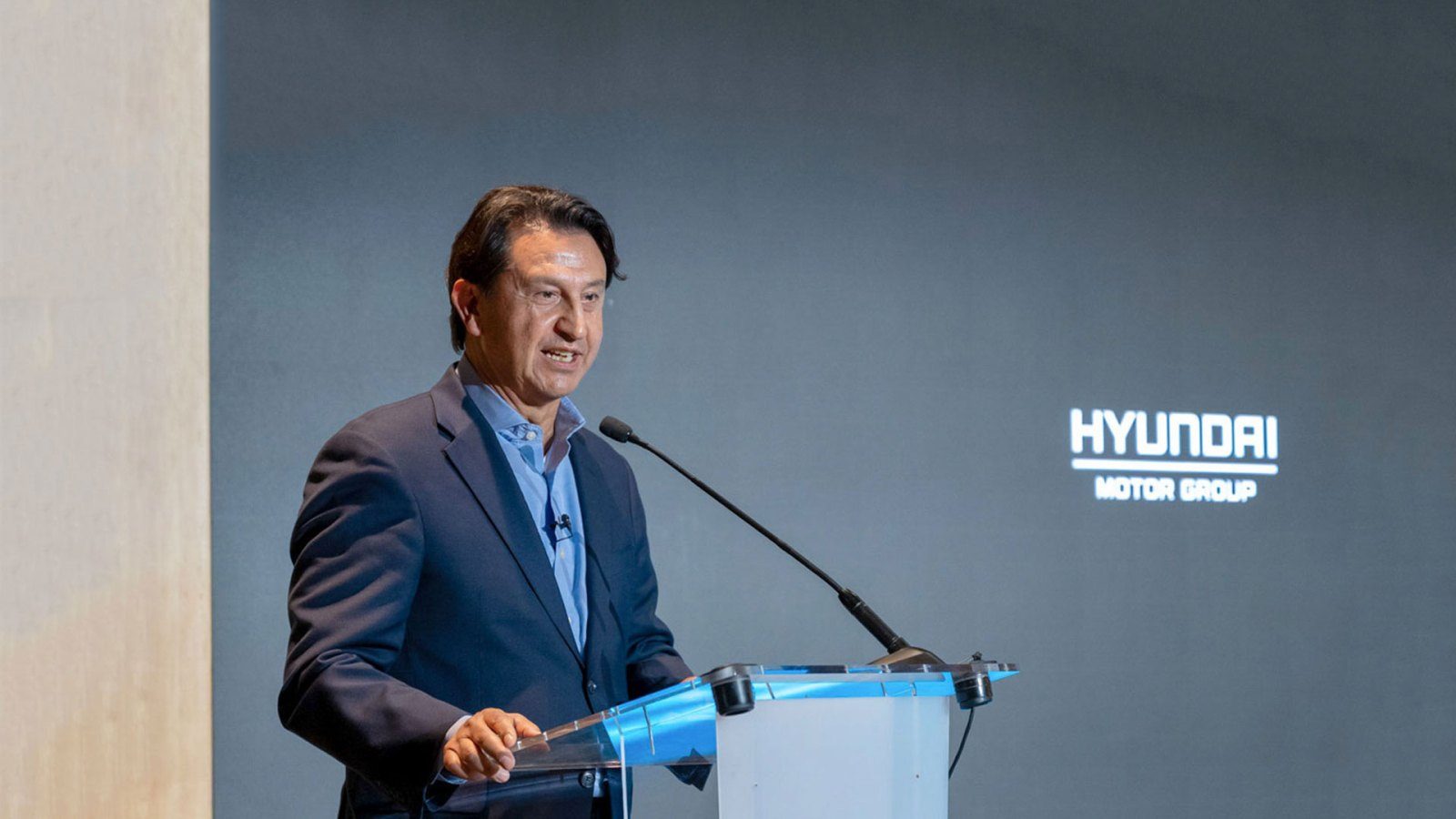

Hyundai CEO Jose Munoz warned that the United States could face a wave of Chinese auto imports similar to the one that has disrupted Europe’s car market unless Washington maintains tariffs and other market-access safeguards.
Chinese automakers have rapidly expanded across Europe, eroding market share and profitability at established manufacturers including Hyundai and Volkswagen by offering vehicles at significantly lower prices.
Munoz said Chinese cars are 30% to 40% cheaper than rival models in some European markets, including Italy, Spain and France — despite EU countervailing duties on Chinese-built electric vehicles that took effect in late 2024.
Those duties range from 7.8% for Tesla to 35.3% for SAIC on top of the standard 10%, giving totals of up to 45.3%. Hybrids were never covered.
“I think we could expect similar things to happen in the US, at different levels, unless there are certain conditions,” Munoz told Reuters in San Jose, California, referring to measures such as the EU’s tariffs and local-content requirements.
Britain as a Warning
Munoz singled out Britain as an example of what unprotected markets face.
Britain left the EU in 2020 and has not introduced similar tariffs on Chinese vehicles. Chinese-branded cars now account for 15% of new registrations there, according to the SMMT, the country’s auto trade body.
“The UK, which in the past was a very profitable, very strong market, has become like China,” Munoz said. “All the top sellers are Chinese because there are no barriers.”
Across the EU, Chinese-branded cars claimed more than 9% of registrations in the first half of 2026, according to ACEA, the European automakers’ association. That figure depends on where the line is drawn.
Wholly Chinese-owned brands, meaning BYD, SAIC, Chery and Leapmotor, took about 6.6% of EU registrations in the half, up from 3.4% a year earlier.
Adding Geely Group, which controls Volvo Cars, Polestar, Zeekr, Lynk & Co and Smart, the five largest Chinese-owned groups registered 791,958 vehicles across the EU, EFTA and the United Kingdom, about 11% of that market.
Fully electric vehicles reached 20.7% market share with 1,220,890 units registered, up from 15.6% a year earlier.
Plug-in hybrids added another 9.8%, on 577,735 registrations, up from 8.5%. Conventional hybrids remained the single largest powertrain at 37.3%, while petrol and diesel together fell to 29.7% from 37.8%.
Chinese manufacturers drove much of that growth. ACEA’s half-year data show BYD registrations up 168.2%, Chery up 268.7%, Leapmotor up 526.7% and SAIC, owner of the MG brand, up 19.1%.
BYD posted triple-digit registration increases during the first half, reaching about 2.2% to 2.4% share across various powertrain segments.
July data from Jato Dynamics showed Chinese brands hitting a record 11.2% overall market share across a broader Europe-28 perimeter, with volumes up 107% year on year. Leapmotor rose 294% to 9,306 units and XPeng grew 270% to 5,244.
A large share of recent Chinese volume in Europe comes from PHEVs. Brussels has separately asked Beijing to voluntarily cap Chinese hybrid exports to the EU at 15%, threatening its own restrictions if China refuses.
Chinese hybrid imports into the bloc rose from about 3,800 vehicles in October 2024, the month the battery-electric duties took effect, to 50,000 in July 2026.
US Tariffs and What Comes Next
Washington currently blocks Chinese electric vehicle imports with tariffs of about 100%.
US President Donald Trump told Fox News last week he would welcome Chinese automakers if they built vehicles in the country.
Munoz echoed warnings from Detroit.
Ford CEO Jim Farley told employees in July that his company was preparing for the possibility of Chinese automakers entering the US market within five to 10 years.
Munoz, who ran Nissan’s China operations about a decade ago, said conditions would need to be imposed on Chinese companies entering the US to minimize the impact. “But the impact is going to be there for sure,” he added.
“The level of innovation, the level of improvement, the technology is unbelievable,” he said of China’s automotive advances.
Brussels is also working on “Made in Europe” rules that will set minimum local-content limits for electric vehicles sold in the bloc, forcing Chinese automakers to search for factories in the region.
Munoz’s comments came days before a planned summit between Trump and Xi Jinping in Washington on September 24.
Beijing is considering including BYD founder Wang Chuanfu and Xiaomi CEO Lei Jun in the business delegation accompanying Xi, Bloomberg and the South China Morning Post reported.
Hyundai’s Own China Bet
Hyundai is expanding in the market it is asking Washington to guard against. “We are not leaving China. We are tripling down on it,” Munoz said at Auto China in April, unveiling the Ioniq V, a China-only electric sedan built on a platform co-developed with joint-venture partner BAIC, carrying CATL batteries, Momenta driver-assistance software and a Qualcomm Snapdragon chipset.
Hyundai and BAIC have committed 8 billion yuan ($1.19 billion) to Beijing Hyundai, with 20 new models planned over five years and a target of 500,000 annual sales by 2030, against about 210,000 in 2025.
At the same event, Munoz said Hyundai wants to export China-built cars to other markets, naming Britain, Europe and the Middle East. Five months later, he described Britain as having become like China.
Self-Driving Delays
Munoz also addressed a two-year delay to Hyundai’s in-house advanced driver-assistance system.
Hyundai Motor Group pushed back the planned launch of vehicles equipped with its proprietary Level 2++ software — comparable to Tesla’s Full Self-Driving system — to late 2029 from a previous target of late 2027.
Hyundai is working with Nvidia to launch Level 2+ and Level 2++ equipped vehicles in 2028 as a bridge while developing its own stack.
“I don’t like delaying anything,” Munoz said. “If you’re humble, you realize your technology is not good, maybe you need to try a partnership.”
Munoz said Hyundai ultimately plans to develop its own self-driving and battery technologies in-house, arguing that vertical integration remains central to the group’s long-term strategy.
Hyundai Motor Group also owns Motional, a US-based autonomous-vehicle firm.
“We want to internalize,” Munoz said. “We may buy things here or there, or have partnerships temporarily, but for relevant technologies like batteries, we want to have our own technology.”