
Tesla is requiring Canadian reservation holders of its new rear-wheel-drive Model 3 to formally accept downgraded performance specifications before taking delivery, formalizing changes made after many buyers placed their orders.
As previously reported by EV, lowered specifications include slower acceleration, reduced charging speeds and a shorter warranty.
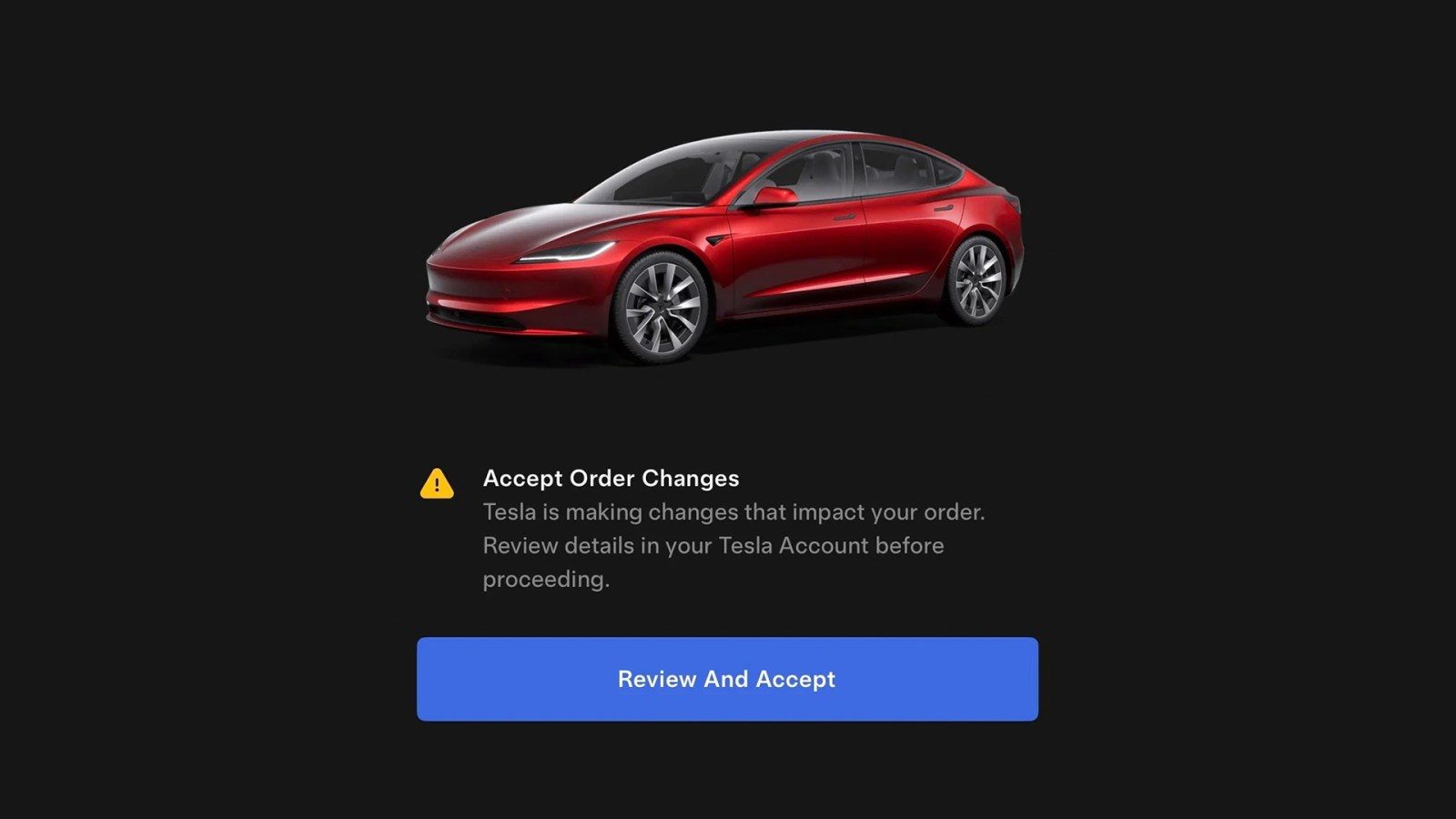
The notification, displayed on the “Order Updates” page of the Tesla account interface, lists the revised figures and presents customers with an “Accept and Proceed With Delivery” button, according to several users on the subreddit r/teslacanada.
Buyers must accept the changes to take delivery of the car.
The page confirms a 0-100 km/h acceleration time of 6.2 seconds, a peak supercharging rate of 175 kW, and a battery and drive unit warranty of 8 years or 160,000 km. Each figure is lower than what was displayed when many customers placed their orders.
First deliveries of the Shanghai-built Premium Rear-Wheel Drive Model 3 are expected as soon as next week.
What Changed
The acceleration figure has fallen by two seconds since the variant launched.
Tesla first listed the Shanghai-built Premium RWD at 4.2 seconds on May 1, then revised it to 5.2 seconds, before cutting it again to 6.2 seconds on May 20.
The 6.2-second figure makes the Canadian Premium RWD slower than the same variant in China, which lists a 6.1-second 0-100 km/h time, and slower than the US standard RWD Model 3, rated at 5.8 seconds. The Canadian car is now the slowest Model 3 Premium of any market.
The peak DC fast-charging rate dropped from 250 kW to 175 kW, a reduction of 75 kW. Tesla also lowered its charging estimate to 259 kilometres added in 15 minutes, down from 271 kilometres.
The battery and drive unit warranty was cut from 8 years or 192,000 km to 8 years or 160,000 km, a reduction of 32,000 km, while retaining the same minimum 70% capacity retention threshold.
The underlying hardware change saw the rear drive unit switch from the 3D6 motor, rated at 220 kW and 440 Nm, to the 3D7 motor, rated at 194 kW and 340 Nm, a reduction of 26 kW and 100 Nm of torque.
The charging speed and warranty cuts first appeared on the Canadian site on May 8. The acceleration figure was revised twice afterward.
The Acceptance Requirement
The new acceptance step is the first time Tesla has formally surfaced the revised figures to individual order holders rather than only updating its public configurator.
Until now, the changes had been documented in Tesla‘s owner’s manuals and regional ordering pages but were not communicated directly to reservation holders, who learned of them through the website or through other buyers on Reddit’s r/teslacanada community.
The acceptance page does not address the gap between the figures shown at the time of order and those listed at delivery.
Tesla‘s order agreement allows the company to apply revised warranty terms at delivery rather than at the time of order, stating that the applicable warranty version is the one in effect when the vehicle was first delivered or picked up from Tesla directly.
Requiring acceptance before delivery gives Tesla a documented record that buyers were presented with the final specifications.
It also leaves customers who object with the choice of accepting the lower figures or declining delivery and seeking a deposit refund.
However, several users have pointed out on Reddit that, upon accepting the terms, an error message showed up instead.
“Can’t click accept. Can’t see order details until you hit accept. Congrats Tesla on bricking the app for awhile,” one user wrote, with another replying, “Same here both on the app and online, can’t accept it due to error appearing.”
Customer Backlash
The repeated revisions had already drawn sharp criticism from buyers before the acceptance step appeared.
Many said they placed orders when the higher figures were displayed, and several said they had sold their existing vehicles in anticipation of a higher-performance car.
Several commenters said they were considering cancelling their reservations or contacting OMVIC, the Ontario Motor Vehicle Industry Council, with some characterizing the undisclosed changes as a “bait and switch.”
Multiple buyers reported cancelling their orders outright.
Several raised the question of whether Ontario’s consumer protection laws on misleading advertising might apply, though one commenter noted that because the changes were made before delivery rather than after, the practical recourse is a deposit refund rather than compensation.
Tesla representatives offered buyers inconsistent information during the period, according to multiple accounts on the Reddit thread.
One buyer said a representative suggested the first batch of orders could be delivered with the 5.2-second figure while later orders would carry the 6.2-second rating, though the buyer cautioned the information was unverified.
The China Supply Shift
The specification reductions stem from Tesla’s decision to import Canadian-market Model 3s from its Shanghai factory rather than its Fremont, California plant.
The supply shift was made possible by the trade agreement Prime Minister Mark Carney and Chinese President Xi Jinping reached in January, which replaced Canada’s previous 100% surtax on Chinese-built EVs with a 6.1% tariff under a 49,000-vehicle quota.
The 6.1% Chinese EV tariff is well below the 25% tariff applied to US-built vehicles entering Canada, an 18.9-percentage-point gap that gives Tesla a clear financial incentive to source from China.
The Premium RWD launched on May 1 at a base price of C$39,490, the cheapest Tesla vehicle ever sold in the North American market, or C$42,132 once delivery and other fees are included.
The variant uses lithium iron phosphate (LFP) battery chemistry sourced from Chinese suppliers, distinct from the nickel-manganese-cobalt chemistry used in the higher-spec Long Range and Performance trims previously sold in Canada.
LFP batteries typically deliver lower peak charging speeds than nickel-based chemistries, which may explain the 175 kW maximum power.