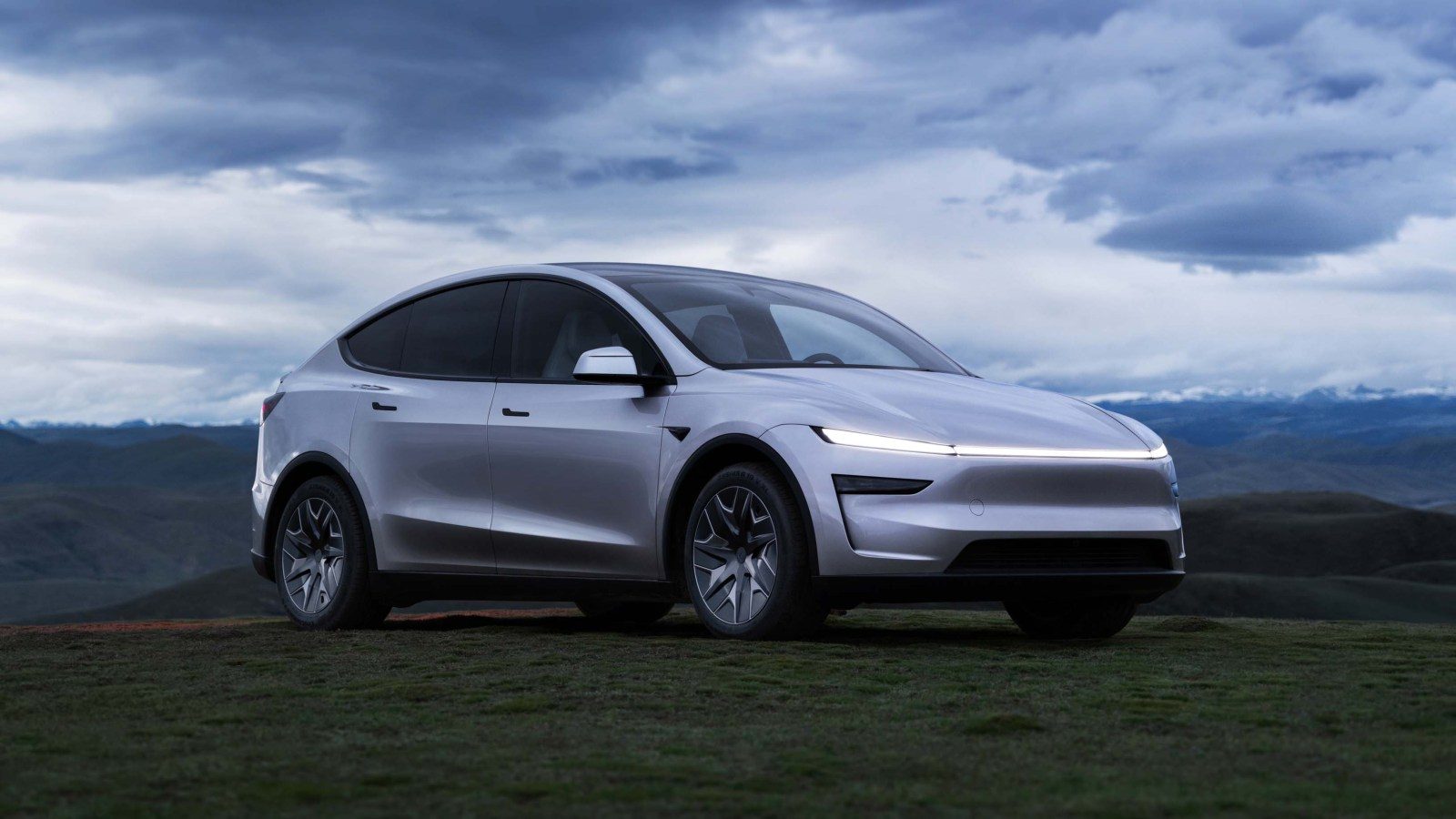

The 2027 Tesla Model Y L traveled 358 miles on a single charge in Edmunds‘ real-world range test — beating the company’s EPA-estimated range of 320 miles by 11.8% and claiming the longest range of any Model Y the publication has ever tested.
The automotive outlet ran the three-row SUV through its standardized EV Range Test, which follows a 60% city and 40% highway route at an average speed of 40 mph with climate control set to 72ºF on automatic.
No official EPA range rating exists for the Model Y L.
Tesla lists the variant at 320 miles with 20-inch wheels and 325 miles with 19-inch wheels, based on internal testing that has historically run more conservatively than the EPA’s own methodology.
According to Tesla shareholder and X user Sawyer Merritt, the company’s VP of Vehicle Engineering “Lars [Moravy] said to expect a little bit higher range rating for EPA than what is currently listed on the site.”
The model has not yet been submitted for official EPA testing.
Efficiency Despite Added Weight
Edmunds noted conditions should have worked against the Model Y L.
On the publication’s scales, the six-seat SUV weighed 300 pounds more than the Model Y Long Range Launch Series and borrows its rear motor from the Model Y Performance — a configuration that typically penalizes range.
However, there are three factors offsetting those disadvantages, with aerodynamics playing the largest role.
A coefficient of drag of just 0.216 — lower than the standard Model Y — stems from body revisions, a rear spoiler and wheels designed to sit more flush with the tires.
Improved thermal management also contributed, as Tesla says the glass roof on the Model Y L allows 30% less solar energy into the cabin than its predecessor, reducing the energy the climate system draws over sustained driving.
Edmunds flagged cabin cooling as an underrated factor whose savings compound over a long test.
A slightly larger battery pack rounded out the gains.
Tesla expanded the pack to approximately 83 kWh — a 4% increase over the standard Model Y — by lengthening the battery modules within the extended wheelbase.
Energy consumption came in at 25.1 kWh per 100 miles, better than both the Model Y Long Range AWD at 26.8 kWh and the Model Y Performance at 30.8 kWh.
The lighter, single-motor Model Y Standard remains the most efficient variant in the lineup at 22.8 kWh per 100 miles.
Model Y Lineup Results
Across the Model Y range, Edmunds‘ results show a clear pattern of Tesla‘s current-generation vehicles meeting or exceeding range expectations.
The Model Y Standard, a single-motor rear-wheel-drive variant, delivered 337 miles on a 321-mile EPA estimate — a 5.0% overperformance that previously stood as the best range result among Model Ys.
The Model Y Long Range AWD matched its 327-mile EPA rating exactly.
The Model Y Performance fell 4.2% short at 293 miles against a 306-mile estimate, the only current-generation variant to underperform.
Edmunds has not yet tested a current-generation Model Y Premium in its single-motor RWD configuration.
According to the publication, given its EPA-estimated range of 357 miles, the variant could surpass the Model Y L’s result.
Broader Tesla Range Pattern
A broader pattern extends beyond the Model Y.
In June, Edmunds had named the 2026 Model 3 Premium RWD the most efficient production EV it had ever tested, after the sedan traveled 393 miles on a 363-mile EPA estimate — an 8.3% surplus — while recording consumption of just 21.7 kWh per 100 miles.
Every Tesla the outlet tested from the 2018 through 2023 model years had failed to meet its EPA estimate.
Since the refreshed Model 3 generation arrived in late 2023, the updated Model 3, the Cybertruck and the redesigned Model Y have all met or exceeded federal figures.
Three-Row Competitive Landscape
Among three-row electric SUVs, the Model Y L’s 358-mile result does not lead the segment outright.
Edmunds noted that the Hyundai Ioniq 9 and the Rivian R1S both travel farther and offer more usable third rows for regular passenger use.
The Model Y L’s advantage lies in efficiency.
Rivals achieve their range figures by packing substantially larger battery packs.
The Rivian R1S carries nearly double the battery capacity of the Tesla, meaning higher energy consumption per mile and longer charging times to cover similar distances.
In a separate Edmunds test earlier this month, the Rivian R2 Performance fell 7.9% short of its 330-mile EPA estimate at 304 miles, consuming 33.6 kWh per 100 miles.
US Launch and Pricing
Tesla opened US orders for the Model Y L on July 2 and began building the variant at Gigafactory Texas days later.
Display units reached showrooms in late July, and the company began assigning delivery windows to US order holders earlier this month, with the earliest windows pointing to late August through September.
The Model Y L Launch Series — the only trim currently available — is priced at $61,990, or $63,380 including the mandatory $1,390 destination charge.
The variant is placed approximately $4,000 above the Model Y Performance and roughly $22,000 above the base Model Y Standard at $39,990.
Launch Series bundles one year each of Full Self-Driving (Supervised), Supercharging and Premium Connectivity, along with free choice of paint, interior and wheel options, Launch Series badging, floor mats, puddle lights, suede dash inserts and sill plates.
The model seats six in a 2+2+2 layout, with a wheelbase roughly seven inches longer than the standard Model Y.
At $61,990, the Model Y L does not qualify for California’s MyFirstEV point-of-sale rebate, which applies only to zero-emission vehicles priced under $50,000.
Tesla first developed the variant for China, where deliveries began in August 2025.
Sales have since expanded to Australia, New Zealand, India and several Southeast Asian markets.
Tesla initially signaled the Model Y L would not enter US production, but brought the timeline forward after prototypes were spotted at Giga Texas earlier this year.
A fresh US order now quotes an estimated delivery window of “December 2026.”