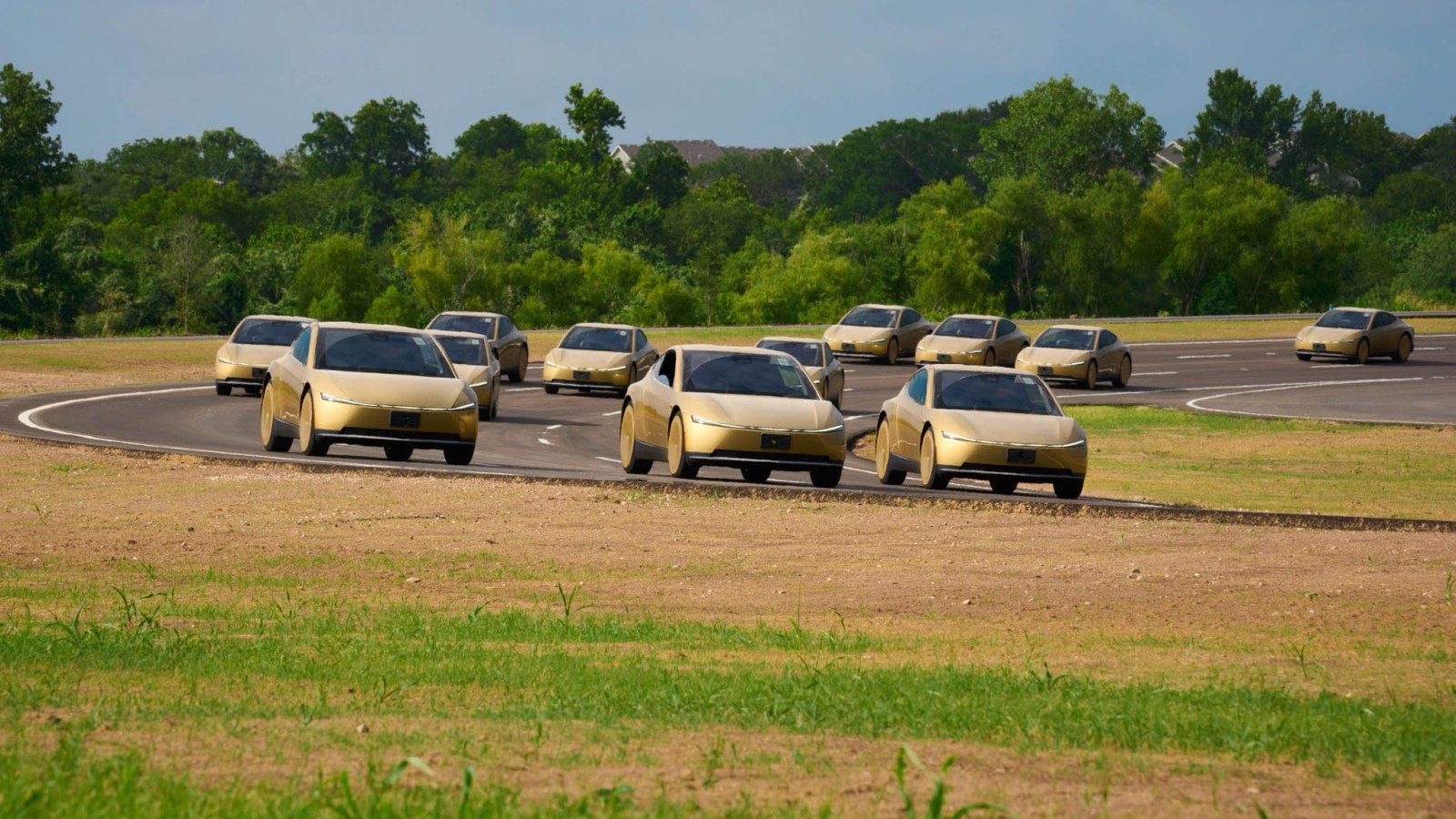

Tesla told JPMorgan it is deliberately holding back Model Y units from its Robotaxi fleet as it prepares to scale the purpose-built Cybercab.
The disclosure came in a new client note published on Wednesday by analyst Rajat Gupta, following a tour of the company’s Fremont factory and a meeting with the Investor Relations team.
Earlier this week, Tesla also confirmed a Cybercab launch event is approaching — the timing aligning closely with reports that the vehicle could enter robotaxi service before the end of August.
Tesla is giving robotaxi riders a chance to attend through a contest running until August 23, with winners announced by August 25 — suggesting the event will take place before the end of the month, though no specific date has been disclosed.
Cybercab Over Model Y
As Gupta wrote, “Tesla indicated it is intentionally holding back on adding Model Y units to the robotaxi fleet, expressing confidence in its ability to scale Cybercab in the near-term.”
Tesla has operated its robotaxi service exclusively with Model Y vehicles since launching the platform in Austin in June 2025 and expanding to the Bay Area in the following months — where a safety driver remains behind the wheel.
The fleet has since expanded to Dallas, Houston, and, most recently, Miami, Orlando, and Tampa.
The company also began offering employee rides in production Cybercabs on its Gigafactory Texas campus and started engineering test drives of production Cybercabs on public roads during the second quarter.
The decision to hold back Model Y additions signals that Tesla views the Cybercab — a two-seat, pedal-less and steering-wheel-less vehicle that entered production at Gigafactory Texas in February — as ready to assume a central role in the fleet.
CEO Elon Musk had previously described the early Cybercab production ramp as “agonizingly slow” given the volume of new parts and manufacturing steps involved.
FSD V15
On the software side, Tesla told JPMorgan that it views FSD V15 as a step-change in performance.
According to the note, “Tesla views this release as a step-change in performance, comparable to the leap from V13 to V14.”
The upgrade encompasses seven core technologies, with about 40% of those already under evaluation in the active robotaxi fleet.
“The V15 upgrade encompasses seven core technologies, with ~40% of those currently being tested in the robotaxi fleet, where initial feedback has been encouraging,” the analyst wrote.
Management described FSD V15 as “the primary gateway to scaling unsupervised FSD.”
Tesla said it “continues to focus on minimizing regression in core driving functions as it introduces new functionalities to the system,” a persistent engineering challenge in autonomous driving development where adding new features can degrade previously stable behaviors.
The current AI/HW4 compute stack is capable of running V15 and supporting unsupervised FSD, Tesla told JPMorgan.
The company’s next-generation compute system, however, is designed to address rising demands as the platform scales.
Tesla taped out its next-generation AI5 inference chip in April, with AI6 tapeout targeted for December, as part of the company’s broader push toward vertical integration of its silicon stack.
FSD adoption has been accelerating alongside the software improvements.
Active subscriptions reached approximately 1.28 million in the first quarter, up 51% year over year, and the cumulative FSD fleet crossed 10 billion miles in early May.
According to Elon Musk during the latest earnings call, “many customers’ primary reason for visiting our stores is FSD, the vehicle itself is merely a complementary platform.”
“Customers at U.S. stores have explicitly stated that they want FSD above all else and are indifferent to which vehicle model it comes with,” the Chief Executive Officer said, adding that “clearly, FSD has become the core engine driving demand” for Tesla.
Robovan Reaffirmed
According to JPMorgan, Tesla‘s management also “reiterated that the Cybercab is just the initial form factor, with additional vehicle types expected to follow as the platform evolves.”
Gupta noted that the company cited the “Robovan demo from the 10/10 event as an example.”
The Robovan was unveiled alongside the Cybercab at Tesla‘s October 10, 2024, ‘We, Robot’ event as an autonomous van capable of carrying up to 20 passengers or transporting goods.
No production timeline or pricing has been disclosed for the vehicle, and Tesla has offered limited public commentary on its development since the original unveiling.
The reference to the Robovan in the context of this factory visit suggests the vehicle remains an active part of Tesla‘s longer-term product planning rather than a shelved concept.
A multi-form-factor approach would allow Tesla to address higher-capacity urban transit and goods movement alongside the two-seat Cybercab, broadening the addressable market for its autonomous platform beyond individual ride-hailing.
JPMorgan Valuation
JPMorgan analyst Rajat Gupta maintained his $445 price target and Neutral rating on Tesla shares following the visit.
Based on Wednesday’s close of $351.12, the target implies an upside of approximately 26.8%.
The target was set on July 23, when Gupta trimmed his price objective from $475 to $445 ahead of Tesla‘s Q2 earnings report on July 30.
The $475 level had been established on June 5, when Gupta upgraded Tesla from Underweight to Neutral — a dramatic reversal for a franchise that had been one of Wall Street’s most prominent Tesla bears for the better part of a decade.
Gupta assumed coverage from longtime JPMorgan auto analyst Ryan Brinkman in early May.
Brinkman had carried an Underweight rating and a $145 price target on Tesla through the stock’s sharp recovery from its April lows, warning of 60% downside as recently as April 6.
Gupta’s June upgrade anchored Tesla‘s valuation not in traditional vehicle metrics but in the company’s non-automotive businesses — robotaxis, humanoid robots, and autonomous driving software.
The analyst framed the thesis around the company’s vertical integration across hardware and software, projecting revenue could more than double from approximately $95 billion in 2025 to $203 billion by 2030, with nearly half of the incremental growth coming from services and autonomy-linked businesses.