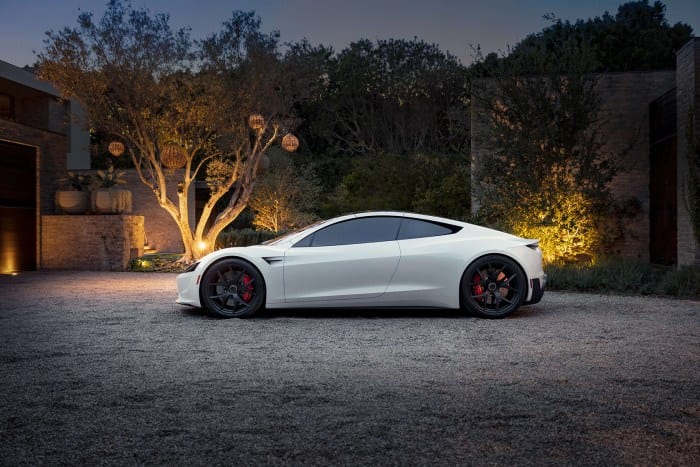
Tesla‘s Cybercab has secured a US Environmental Protection Agency Certificate of Conformity, and the underlying filing has revealed the purpose-built robotaxi’s specifications for the first time.
The certificate classifies the two-seat Tesla as a battery-electric Zero Emission Vehicle and confirms compliance with Clean Air Act emission standards.
A Certificate of Conformity is required before any vehicle can be introduced into US commerce, and the filing lists an “Introduction into Commerce Date” of May 29 — meaning the Cybercab has now officially entered the market.
What the Filing Reveals
The Cybercab weighs 3,113 pounds, with a gross vehicle weight rating of 3,730 pounds, and runs a single 326-volt front motor rated at 163 kW (219 horsepower).
The car draws 53.365 kWh of energy from the wall to recharge, implying a usable battery of roughly 48 kWh once charging losses are removed — a figure best treated as an estimate rather than a stated capacity.
The standout number is efficiency.
The Cybercab is certified at 165 Wh/mi, which Tesla vice president Lars Moravy has called the most efficient figure of any production EV.
For context, the next most efficient model, the Lucid Air Pure, consumes about 28% more energy per mile — though the comparison carries an asterisk, since the Cybercab achieves it as a tiny two-seater with a sub-50-kWh pack rather than a full passenger car.
Range demands the most care.
The filing lists a charge-depleting range of 418 miles and a highway figure of 375 miles, but those are unadjusted test-cycle values, not the window-sticker range a buyer would see.
The final EPA rating typically comes in well below the listed figure, and Tesla has previously put the Cybercab’s range at about 300 miles — so the 418-mile number should not be reported as the vehicle’s range.
The filing also settles the drivetrain question, and the answer is a mild surprise: the Cybercab is front-wheel drive.
A Car Without a Steering Wheel
The Cybercab debuted at Tesla’s “We, Robot” event in October 2024, where 20 prototypes gave short rides to attendees.
Designed by Franz von Holzhausen, the two-seater has no steering wheel and no pedals, relies on steer-by-wire controls, opens via butterfly doors, and charges wirelessly through inductive pads rather than a plug.
Musk priced it below $30,000 at the unveiling and positioned it as the vehicle that would make autonomous ride-hailing cheap enough to scale.
Production Has Started, Slowly
The first Cybercab rolled off the line at Gigafactory Texas in mid-February, and Musk confirmed the start of productionduring the company’s first-quarter earnings call on April 24.
He tempered expectations immediately, describing the ramp as a “stretched out S-curve” that would stay very slow before accelerating toward the end of the year.
The pace is now visibly building, with drone footage this month showing 85 Cybercabs staged at the Texas plant.
On the regulatory side, Moravy has said the Cybercab self-certifies to existing Federal Motor Vehicle Safety Standards, which would exempt it from the 2,500-vehicle annual cap that NHTSA applies to autonomous vehicles seeking safety waivers.
That claim is significant and contested, since a vehicle without manual controls would not obviously meet standards written around them — but it is a separate matter from the EPA certificate.
Deployment So Far
The Cybercab feeds a robotaxi service that Tesla launched in Austin on June 22, 2025, starting with roughly 10 modified Model Y vehicles and onboard safety monitors.
The service has advanced in steps since.
Tesla began driverless trips for employees in Austin in December, started removing safety monitors on some customer rides in January, and expanded to Dallas and Houston in April — its first markets beyond Austin and the San Francisco Bay Area.
This month, the company stretched the unsupervised Austin service to the entire metro area, where riders can now hail a driverless Cybercab or Model Y.
The map outran the fleet, however, with independent observers estimating only around 20 vehicles actually running across that expanded zone — a reminder that coverage announcements and deployed cars are not the same thing.
Fleet counts remain contested throughout, with Tesla’s figures running well ahead of crowdsourced trackers.
The Targets on the Table
The company has guided to volume production of the Cybercab this year and aims to run robotaxi operations in roughly a dozen US states by the end of 2026, having earlier named Phoenix, Miami, Orlando, Tampa and Las Vegas among the markets slated for the first half.
Musk’s broader targets, tied to his pay package, run further still — a million robotaxis in commercial use and ten million Full Self-Driving subscriptions.
The Cybercab is meant to be the engine of that scale, eventually replacing the Model Y as the highest-volume vehicle in the fleet, since it is purpose-built to minimise cost per autonomous mile.
The Real Gate
For all the regulatory progress the EPA certificate represents, the document does not touch the constraint that has defined the program for a decade.
The Cybercab cannot fulfil its purpose until Tesla secures broad approval for unsupervised driving and proves the safety case city by city.
The car has rolled off the line, cleared its emissions certification, and technically entered commerce — but whether it carries paying passengers at scale still rests on autonomy, not on the Clean Air Act.
Given that Bank of America has estimated the robotaxi effort accounts for roughly 45% of Tesla’s valuation, the gap between a certified vehicle and an approved driverless service is the one investors are watching most closely.