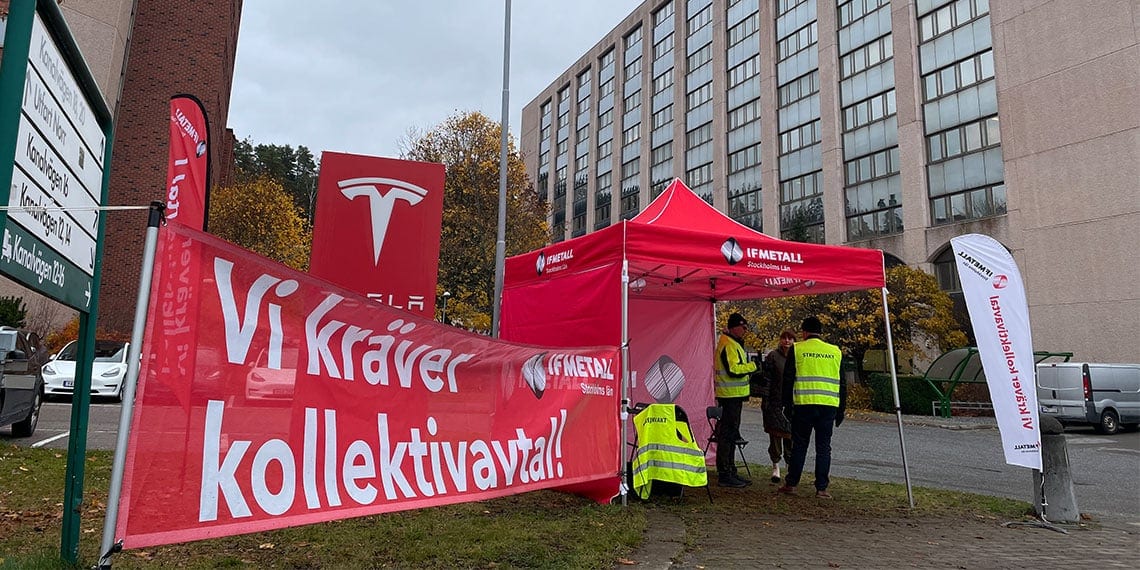

IF Metall has ended all industrial action against Tesla‘s Swedish operations on Thursday, closing the longest strike in modern Swedish history after the EV and AI giant bought out every remaining union member at the company.
The Swedish metalworkers’ union announced the decision on Thursday, stating that with no members left at Tesla, continued action could no longer have any effect.
The union praised its members’ endurance, noting that being on strike for nearly three years came with enormous personal sacrifices.
IF Metall stressed that the end of industrial action does not represent a shift in its position.
According to the union, the collective agreements should apply throughout the Swedish labor market and it remains prepared to fight for them wherever employers resist.
“Today, we end our industrial action against Tesla,” the union stated. “We do so because it can no longer have an effect, not because our principles have changed.”
Just last week, IF Metall had called a new strike at Tesla workshops in Malmö, Umeå, Uppsala, Upplands Väsby, Segeltorp and Huddinge, with blockades set to take effect on August 13: the same day the union ultimately announced the dispute’s end.
The dispute, which began in late October 2023 when roughly 130 mechanics walked off the job, ran for nearly three years after Tesla refused to sign a collective bargaining agreement — a cornerstone of Sweden’s labor market model.
Tesla ‘Paid Their Way Out’
IndustriAll Global Union General Secretary Atle Høie condemned Tesla‘s approach in a statement accompanying the announcement.
“There seems to be no limits to the length Tesla would go to keep unions out of their operations,” Høie said. “Unfortunately they have managed to pay their way out in Sweden.”
Høie acknowledged the buyouts left former members with more money, however noting that the arrangement still deprives them of the protections a collective agreement provides.
IF Metall described Tesla as “an entirely exceptional employer,” not as a compliment.
The union said the company systematically used strikebreakers and devoted enormous financial resources to undermining the strike over its duration, ultimately choosing to buy out union members rather than offer them the security of a collective agreement.
IF Metall said it fully understood why workers accepted the buyouts.
Commercial Impact
Tesla‘s ability to register new vehicles, receive deliveries at Swedish ports, and operate support services has been disrupted as a consequence of the three-year strike.
However, the company adapted to the conditions.
It secured a port storage deal at Trelleborg that remained intact despite union blockade efforts, routing vehicle imports through Germany to circumvent license plate and postal restrictions.
A planned showroom and service center in Kalmar proceeded after a planned blockade by the Vision union was ruled illegal.
The dispute had a measurable commercial impact on Tesla in Sweden.
Full-year 2025 registrations collapsed to 7,252 vehicles, down 66.8% from 21,894 in 2024.
First-half 2026 registrations recovered to 5,661 units, a 56.8% increase year-over-year, though still well below pre-strike levels.
Last month, sales fell to just 65 vehicles as the company prioritized other European markets such as France and Denmark.
Germany Went the Same Way
The Swedish outcome lands five months after Tesla saw off the same challenge at its only European plant.
IG Metall’s vote share in the Grünheide works council election held March 2-4 fell to 31.1% from 39.4% in 2024, giving the union 13 of the council’s 37 seats — well short of the majority it had targeted.
The management-aligned Giga United list, led by works council chair Michaela Schmitz, took around 41%.
The vote followed months of escalation.
Tesla filed a criminal complaint in February after plant manager André Thierig said an external IG Metall representative had been recording a works council meeting on a laptop.
The union responded by suing Thierig for defamation and seeking an injunction at the Frankfurt (Oder) labour court. Prosecutors dropped the case in March, finding no evidence the microphone had been active.
Elon Musk intervened directly, telling Thierig in a video interview that the German plant’s expansion could depend on the election result and referring to “external organisations pushing Tesla in the wrong direction.”
IG Metall has since challenged the result in court, filing at Frankfurt (Oder) on 26 March under Section 19 of the Works Constitution Act and alleging intimidation and unequal treatment of candidates and lists.
A successful challenge would dissolve the council and force a fresh election, but only once the ruling is final — a process lawyers expect to run one to three years through appeals, with challenges of this kind succeeding roughly 15 to 20% of the time.
Grünheide remains the only automotive plant in Germany without a collective bargaining agreement.
IG Metall wants the standards common in the German industry — a 35-hour week, shift allowances and binding pay scales — where Tesla negotiates wages with each of its roughly 11,000 employees individually.