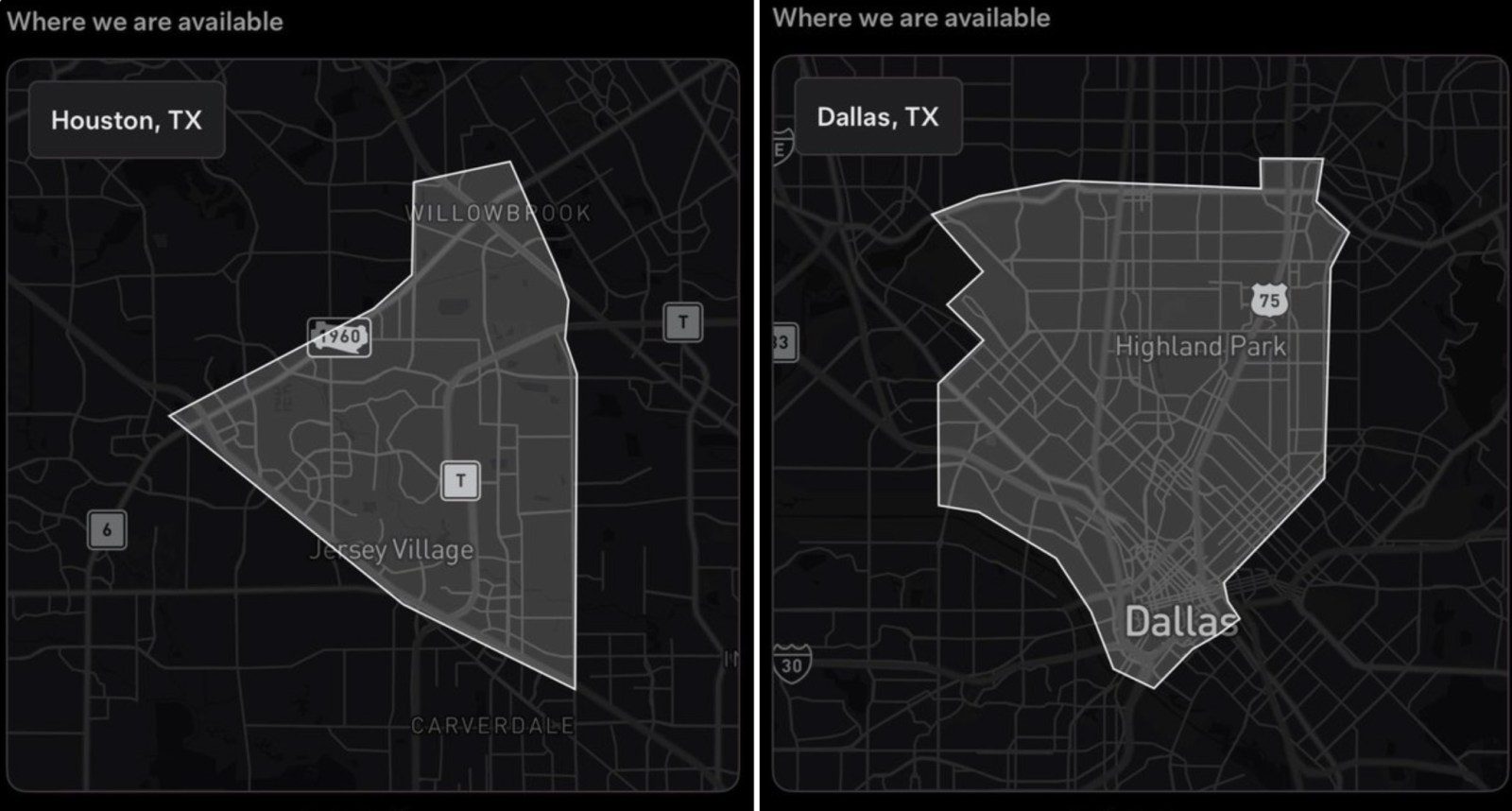

Tesla started on Saturday offering unsupervised rides on its Robotaxi service in Dallas and Houston, marking the first expansion of the autonomous ride-hailing programme beyond Austin and the San Francisco Bay Area.
The launch comes four days before the company is scheduled to report first-quarter 2026 earnings on April 22.
“Robotaxi now rolling out in Dallas & Houston,” Tesla‘s official ‘robotaxi’ account posted on Saturday, alongside two map images showing the service areas.
The company did not disclose fleet size, pricing, or whether the vehicles would carry human safety monitors.
However, minutes after the announcement, the account wrote in a new post, “All by myself.”
CEO Elon Musk commented on the announcement, writing: “Try Tesla Robotaxi in Dallas & Houston!”
Delivering on a January Commitment
The two launches fulfil part of a seven-city expansion plan Tesla outlined in its Q4 2025 shareholder update deck, published on January 28, 2026 alongside the company’s fourth-quarter earnings.
That document committed Tesla to launching Robotaxi in Dallas, Houston, Phoenix, Miami, Orlando, Tampa and Las Vegas within the first half of 2026 — a timeline CEO Elon Musk called aggressive on the earnings call that followed.
Dallas, Houston, Phoenix and Las Vegas had been named as expansion targets as early as late 2025, with Tampa, Orlando and Miami added in the Q4 2025 deck.
The same document classified the Bay Area operation as “Safety Driver” and Austin as “Ramping Unsupervised.”
The launch of Dallas and Houston four days before Q1 2026 earnings gives Musk a concrete expansion datapoint to cite during Wednesday’s earnings call and Q&A, when Wall Street is expected to press for specifics on fleet size, supervision status, and the timeline for the remaining five promised cities.
Geofenced areas
The Houston geofence covers approximately 25 square miles and is centered on the Jersey Village and Willowbrook areas in the northwest of the metropolitan area, bounded roughly by Highway 6 to the west, the Sam Houston Tollway to the south, and Highway 249 and FM 1960 to the north.
The Dallas geofence covers the Highland Park area, bounded roughly by the Dallas North Tollway to the west, Central Expressway (US 75) to the east, and extending south to downtown Dallas, according to Tesla‘s official map.
The service area includes portions of the Park Cities, Uptown, and downtown Dallas.
Both geofences are a fraction of the size of Tesla‘s Austin service area, which has expanded to approximately 245 square miles after nearly a year of operation, up from an initial 20-square-mile footprint at the June 2025 launch.
Across Austin and the Bay Area combined, Tesla reported achieving nearly 700,000 paid Robotaxi rides as of late January 2026, according to the Q4 2025 earnings call.
Waymo in Both Texas Markets
Tesla‘s entry into Dallas and Houston comes two months after Alphabet’s Waymo launched fully driverless commercial service in both Texas cities in February, operating through a fleet-management partnership with Avis Budget Group.
Waymo‘s Texas vehicles carry no safety monitor and no chase car, and rely on no remote supervision.
Waymo delivers over 500,000 paid robotaxi rides per week across eleven US cities, and has set a target of 1 million weekly rides by the year end. The service operates approximately 2,500 active robotaxis nationwide.
Production and Capacity
Tesla has said it plans to begin volume production of the Cybercab, its purpose-built two-seat autonomous vehicle, later in 2026 at the Texas factory.
The Cybercab is positioned as the scaling platform for the Robotaxi network beyond the current Model Y-based fleet.
Volume production of the Tesla Semi is also targeted for the first half of 2026, alongside the ramp of Megapack 3 production at the Houston Megafactory with a planned annual capacity of up to 50 GWh.
Tesla reported earlier this month that it produced more than 408,000 vehicles and delivered over 358,000 vehicles in the first quarter of the year.
Analyst consensus for Q1 2026 revenue is between $21.4 billion and $21.9 billion, according to data compiled ahead of Wednesday’s release.