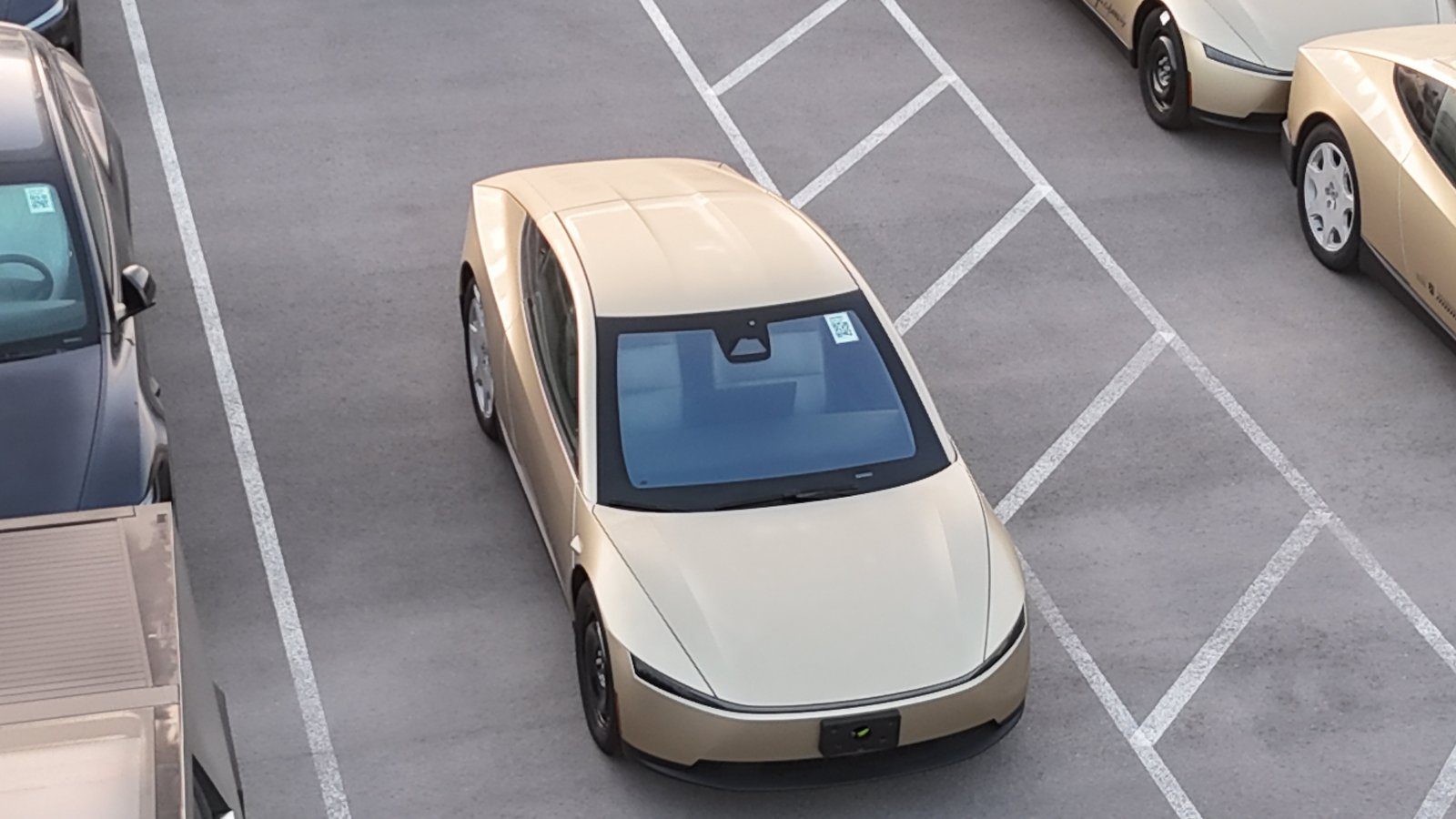

New drone images show Tesla has begun ramping up production of the Cybercab model with no steering wheel at its Giga Texas facility — marking a significant milestone for the purpose-built autonomous model.
X user Joe Tegtmeyer, who regularly shares drone footage of the factory, posted photos on Friday showing roughly 14 Cybercab builds in the outbound lot — none equipped with a steering wheel.
“Something big has changed at Giga Texas with Cybercab production,” Tegtmeyer wrote, adding that he expects “many more starting on Monday, 4/20.”
He called the shift “a big step forward.”
Tesla had previously said it would build Cybercab units with a steering wheel and pedals for testing purposes, but confirmed it would not offer the model to customers in that configuration.
Test vehicles also included side mirrors, which are to be removed from the production version of the fully autonomous vehicle.
Last month, Tegtmeyer had already shared images appearing to show steering-wheel-free builds, as highlighted by Tesla shareholder Sawyer Merritt.
Steering Wheel Removal
The question of whether the Cybercab would include a steering wheel has been a recurring topic since the model was unveiled at the ‘We, Robot’ event in October 2024 as a fully autonomous two-seater with no pedals or steering wheel.
In August 2025, VP of Vehicle Engineering Lars Moravy acknowledged that there was a “Cybercab RC [remote controlled] fleet running around with a steering wheel,” but clarified it was “not for sale” and was a “test feature only.”
A few months later, when the Cybercab was first spotted testing on California roads, Tesla Chair Robyn Denholm told Bloomberg that “if we have to have a steering wheel, it can have a steering wheel and pedals” — a comment that diverged from CEO Elon Musk’s position that the model was “a vehicle that’s optimized for full autonomy.”
In January, when the company expanded road testing to five US states, all test vehicles still included a steering wheel and pedals.
That same month, the House Energy and Commerce Subcommittee reviewed the Self Drive Act of 2026, which would establish a federal framework permitting vehicles without traditional steering wheels — legislation that later advanced in a narrow 12–11 committee vote in February.
Production and Deliveries
Tesla has been ramping Cybercab production at Giga Texas since the first unit rolled off the line in mid-February.
Chief Executive Officer Elon Musk reaffirmed last month on X that the first customer delivery — priced below $30,000 — would still take place this year, recalling a bet made by tech reviewer MKBHD in late 2024.
Volume production is set to begin in April, as Musk reiterated during Tesla’s latest earnings call in January.
The company remains confident it can achieve a rate of one Cybercab every 10 seconds — what it says would be the fastest production rate ever achieved in the automotive industry — with plans to eventually halve that to five seconds.
Tesla is debuting its ‘Unboxing’ manufacturing process, patented last September, on the Cybercab production lines.
Musk cautioned in January, however, that “for Cybercab and Optimus, almost everything is new, so the early production rate will be agonizingly slow.”
Testing and Regulatory Developments
Earlier this year, Tesla expanded public road testing of the Cybercab to five US states: California, Texas, New York, Illinois, and Massachusetts.
The company recently began winter testing at its Alaska proving grounds.
The first Cybercab units were spotted on California roads in late October near the company’s engineering headquarters, followed by sightings on public roads in Austin — where Tesla‘s Robotaxi service launched months earlier using modified Model Y vehicles.
In February, Tesla filed two new trademark applications with the US Patent and Trademark Office for the words ‘Cybercar’ and ‘Cybervehicle.’
The filings followed Musk’s disclosure during the fourth quarter earnings call that some states do not permit Tesla to use the words ‘Cab’ or ‘Taxi’ when referring to the model or its ride-hailing service.
Executive Departures
The production milestone comes amid a wave of senior departures from the Cybercab program.
Three leaders directly involved in bringing the model to manufacturing left the company in roughly five weeks, including manufacturing operations leader Mark Lupkey — who oversaw Cybercab assembly and end-of-line validation at Giga Texas — and software director Thomas Dmytryk, who built Tesla‘s over-the-air update system and robotaxi ride-hailing infrastructure.
Lupkey announced his departure on X the day after the first production Cybercab rolled off the line in mid-February.
“After nearly 8 collective years across two stints at Tesla, last week was the end of an unforgettable chapter for me,” he wrote.
Wall Street Expectations
The Cybercab and Tesla‘s broader autonomy push have become central to how Wall Street values the company, with some firms attributing nearly half of Tesla‘s market capitalization to its robotaxi ambitions.
BofA estimated last October that the Robotaxi accounts for roughly 45% of Tesla’s valuation.
Wedbush’s Daniel Ives, one of the most bullish voices on the stock, has called Cybercab production “the golden goose in unlocking TSLA’s AI valuation.”
The firm maintains a $600 price target — the highest on Wall Street — and sees a path to a $2 trillion market cap over the coming year, with a bull-case scenario of $3 trillion by the end of 2026.
Wolfe Research analyst Emmanuel Rosner wrote in February that the firm’s top-down model suggests Robotaxi revenue could reach $250 billion by 2035, which could support approximately $2.75 trillion in equity value.
Still, the firm flagged that “it’s difficult to have high confidence in the success of all of Tesla‘s initiatives, especially as timing can shift around.”
Morgan Stanley analyst Andrew Percoco projected in December that Tesla would have 1,000 Robotaxis on the road by the end of 2026 and 1 million by 2035.
Following the Q1 delivery miss earlier this month, the firm said it expects the stock to trade in close correlation to progress in scaling the unsupervised robotaxi fleet and the seven additional city launches expected by the end of June.
Not all analysts share the optimism, however.
JP Morgan’s Ryan Brinkman recently reiterated its Underweight rating on the stock, with a $145 price target — implying roughly 60% downside — and advised investors to approach Tesla shares “with a high degree of caution.”
UBS analyst Joseph Spak dropped the firm’s Sell rating to Neutral this week, maintaining a $352 price target.
Spak wrote that recent stock weakness was driven by concerns over EV demand, higher capital spending, and slow progress on the Robotaxi and Optimus, but added that the risk-reward is now more balanced given the decline.
The analyst cautioned that Tesla‘s stock “trades more on sentiment, narrative and momentum than fundamentals.”
Barclays’ Dan Levy reaffirmed an Equalweight rating and $360 target on Wednesday, flagging that the stock’s recent weakness reflects “seemingly little progress disclosed on Robotaxi/FSD and Optimus.”
The firm warned that any indication of capital spending rising beyond the over $20 billion already announced could weigh further on investor sentiment.
Tesla is scheduled to report its first-quarter 2026 financial results on April 22.
Competitive Landscape
The company is not alone in pursuing purpose-built autonomous vehicles.
Waymo, backed by Google, remains the furthest ahead in commercial deployment, operating driverless rides in multiple US cities. Uber, meanwhile, has been assembling a diversified robotaxi supply chain through partnerships with several automakers and autonomy providers.
Last month, the ride-hailing company agreed to invest up to $1.25 billion in Rivian to deploy up to 50,000 R2-based robotaxis across 25 cities in the US, Canada, and Europe by 2031.
That deal followed a structurally similar agreement signed with Lucid Motors in mid-2025, under which Uber invested $300 million tied to a minimum purchase of 20,000 Gravity SUVs for its autonomous fleet.
The ride-hailing company expanded its commitment to the EV maker with another $200 million investment and an increase in the order by 15,000 vehicles — now including Lucid’s upcoming mid-size EV. Lucid has also unveiled its own vision for the segment.
At its inaugural Investor Day in March, the company revealed a two-seat dedicated robotaxi concept called Lunar, claiming 40% lower operating costs than current robotaxi fleets.
Interim CEO Marc Winterhoff dismissed comparisons to the Cybercab, citing Uber’s own data showing that over 80% of rides involve only one or two passengers — a figure that, he argued, justifies a smaller, lighter, more efficient purpose-built vehicle.
While Tesla is developing its camera-only Full Self-Driving system in-house, Lucid’s robotaxi vehicles will integrate Nuro’s autonomous driving software.
Rivian is also building its Level 4 system internally, using a sensor suite that includes LiDAR — a technology Tesla has rejected.