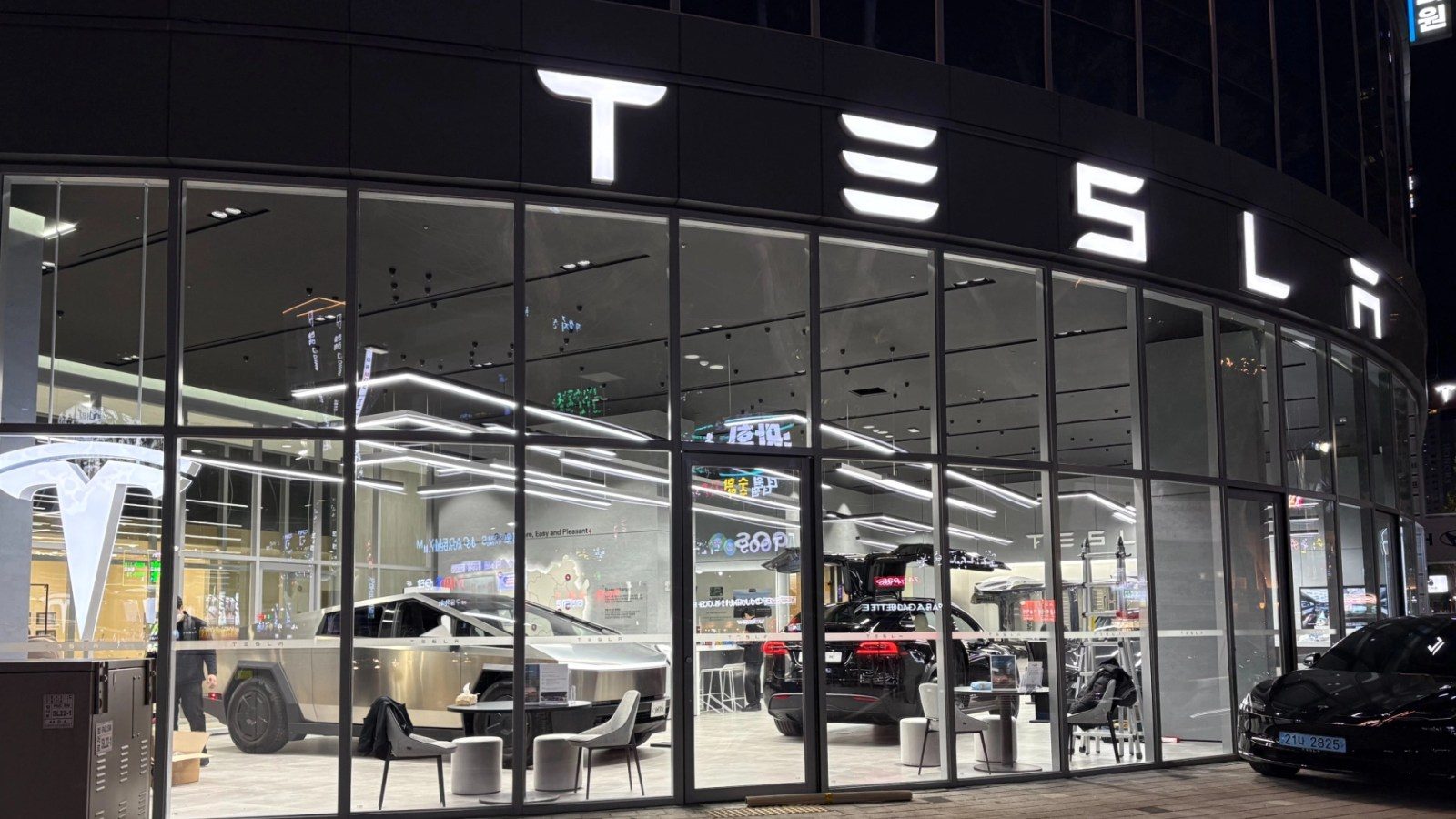

Tesla extended its record run in South Korea in April, registering 13,190 vehicles in the country.
The figure marks a new monthly high, exceeding the previous record of approximately 11,190 units set in March by roughly 2,000 vehicles.
Sales surged 811.5% from the same month a year earlier.
The April result also marked Tesla’s third consecutive month as South Korea’s best-selling imported brand, with a 38.8% share of the imported market.
Monthly sales have risen sequentially since January.
Tesla sold more vehicles last month than both German automakers BMW (6,658) and Mercedes-Benz (4,796) combined.
Both brands sell internal combustion engine (ICE) and hybrid models alongside EVs — unlike Tesla, which only produces fully electric models.
When considering domestic brands, Tesla places third — just behind Hyundai and Kia, which sold over 54,000 and 55,000 vehicles, respectively.
First-quarter deliveries reached 20,964 units — the company’s second-best quarter in the country, trailing only the third quarter of 2025.
Tesla’s vehicle registrations in South Korea since the beginning of the year total 34,154 units — a number that is more than half of last year’s 59,916 units already.
The company finished 2025 with a 19.5% share of the imported-vehicle market.
In the first four months of 2026, the company registered more vehicles than in the whole year of 2024.
Lineup
Tesla currently offers the Model 3 sedan and Model Y SUV in South Korea, with prices starting at 41,990,000 won ($28,900) and 49,990,000 won ($34,400), respectively.
The Standard versions of both models, available in the US and Europe, are not sold in the country.
The company has since introduced the six-seat Model Y L to the lineup, first launched in China in August 2025.
The six-seat SUV, only produced in Shanghai, is already available in 11 markets, including India, where Tesla only sells the best-selling SUV.
The variant adds 20,000,000 won to the price.
The company also debuted the Cybertruck pick-up in South Korea last year, priced from 145,000,000 won ($100,000).
Introduction of FSD
Tesla rolled out its Full Self-Driving (Supervised) software in South Korea late last year — making it the seventh global market to receive it.
It was initially supported on Model S and Model X vehicles only, as they were produced in the United States and, therefore, are not subject to South Korean regulations.
As the Model 3 and Model Y sold in Korea are imported from Giga Shanghai, additional regulatory requirements are likely delaying their approval.
It’s still uncertain when FSD will become available for these vehicles.
Tesla has since rolled out the software on its Cybertruck model.
EV Subsidies
South Korea aims to have 70% of vehicles on the road be zero-emission by 2035.
In August, the government was already mulling raising incentives on electric vehicle purchases.
The country raised its maximum EV purchase subsidy to 6.8 million won ($4,700) for 2026, up from 5.8 million won ($4,000) the previous year.
The national subsidy budget increased 20% to 936 billion won ($658 million), according to the Ministry of Climate, Energy, and Environment.
The price cap for subsidy eligibility remains at 53 million won ($36,700) this year but will drop to 50 million won ($34,600) in 2027.
The government has also eliminated consumption and acquisition taxes on battery-electric, hybrid, and hydrogen vehicles.
Buyers who scrap or sell an internal combustion engine vehicle when purchasing a new EV can claim an additional 1 million won ($700).
According to the government, the incentives are designed to help the country’s auto industry cope with risks from US tariffs, despite the agreement reached between the two countries.
Local governments are adding their own incentives on top of the national program.
In Seoul, EV subsidies can reach up to 7.54 million won ($5,200) per vehicle.
Import Quota
Last July, the two countries reached a trade agreement under which the US agreed to lower tariffs on South Korean product imports to 15%, in exchange for the Asian country altering its rules on vehicle imports.
South Korea lifted a 50,000-unit annual cap on US vehicle imports, a move that benefits Tesla and General Motors while drawing criticism from domestic automakers.
As of late last year, vehicles produced in the United States can enter South Korea as long as they meet US safety standards, without having to comply with the country’s domestic regulations.
The decision has drawn criticism from domestic automakers, which struggle to compete with foreign rivals such as Tesla and General Motors.
The competition cited by automakers in South Korea is not (only) focused on sales, but rather on technology and safety.
Traffic safety rules in the US are less strict than those in South Korea — hence why US President Donald Trump has denounced these regulations as “non-trade barriers.”
Additionally, the two countries have very different types of roads, making US vehicles less suitable for South Korea’s narrow and densely packed streets.
The Korean government has said the impact would be “negligible.”
However, as Tesla expands its presence — introducing the large Cybertruck and its Full-Self Driving (FSD) system — local automakers are increasingly concerned.