
Tesla’s GigaShanghai — the company’s largest and most productive manufacturing base, which accounts for more than half of its global vehicle output — can produce its Optimus humanoid robots in the future, an executive said on Tuesday.
Allan Wang Ho, Tesla China’s President, said the plant’s manufacturing efficiency and innovation capacity are potential drivers of CEO Elon Musk’s push to commercialize the technology at scale.
Speaking during a media briefing, the executive said on Tuesday that GigaShanghai could serve as a “golden key” to the mass production of robots.
“Like other Tesla factories, Giga Shanghai can shoulder important responsibilities in manufacturing all new products, including robots, to make our contributions to the company,” Wang said.
The country chief is “highly confident in welcoming the arrival of a new era of robots.”
It marks the first time a Tesla executive has publicly floated the Shanghai facility as a potential site for humanoid robot production, a strategic priority Musk has set for the company.
Wang did not specify whether Tesla would assemble robots at its existing Shanghai facilities or build a new plant for the business.
AI-focused Shift
On December 24, Musk said on X that he was changing the “Tesla mission wording” from “Sustainable Abundance” to “Amazing Abundance.”
Musk had been using the “sustainable abundance” phrasing for several months prior.
“It’s beyond abundance in any— beyond what people possibly could think of as abundance. Like the AI, actually. AI and robots. The limit will saturate all human desire,” Musk said on the Moonshots podcast earlier this year.
Speaking at the World Economic Forum in Davos in January, the Tesla CEO reiterated that AI and robotics are the only route to this abundance.
“People often talk about solving global poverty, or essentially, how do we give everyone a very high standard of living. I think the only way to do this is AI and robotics,” he said.
He also warned that the technology “doesn’t mean that it is without its issues. I mean, we need to be very careful with AI, we need to be very careful with robotics.”
Musk has outlined a benign scenario in which large numbers of humanoid robots generate an economic output that triggers an explosion in the global economy and “saturate all human needs.”
For that to happen, he said AI and robotics would need to be ubiquitous and “essentially free or close to it.”
Optimus Humanoid
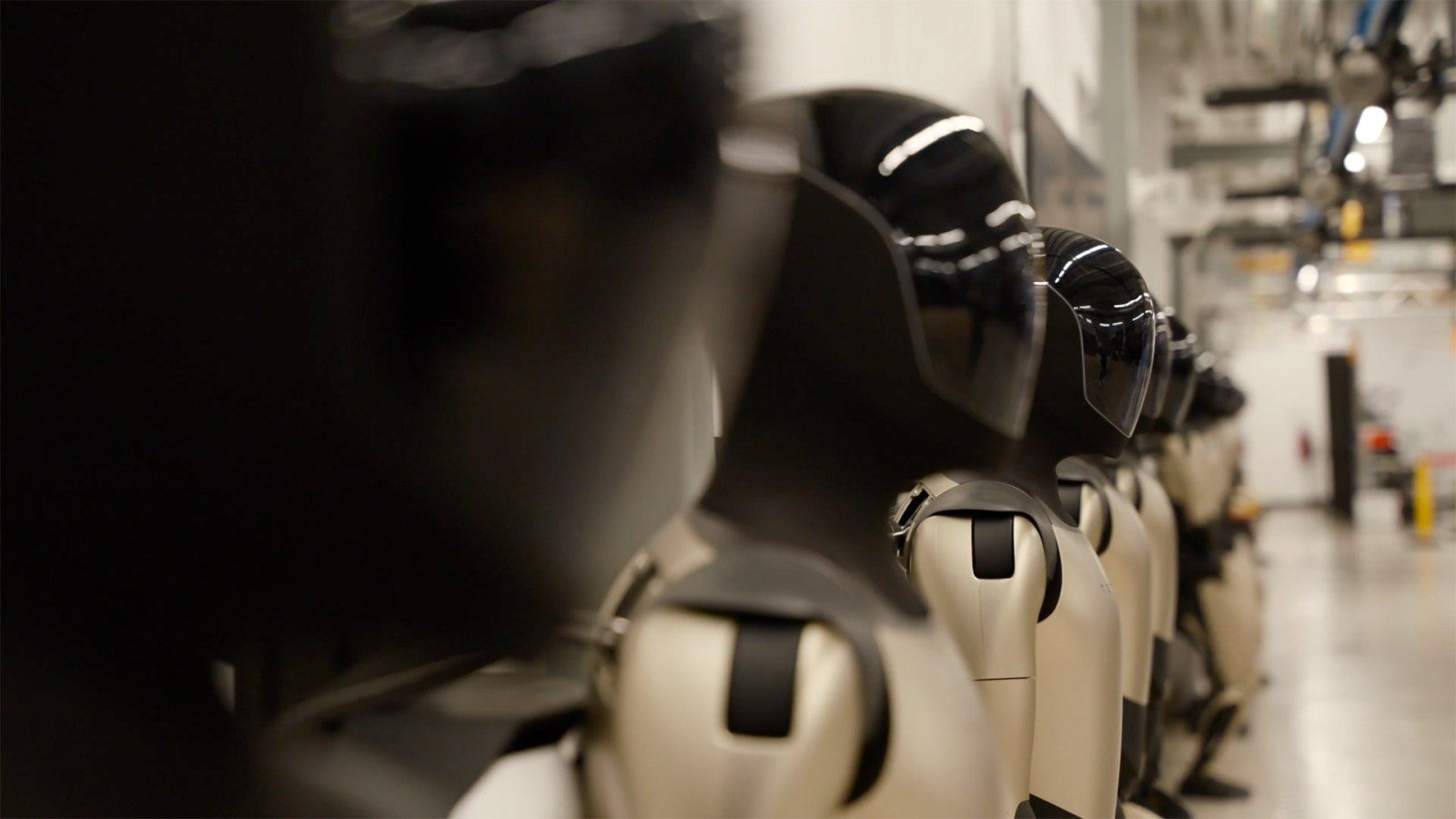
At the same conference, Musk said the Optimus humanoid would be available for public purchase “by the end of next year.”
According to Musk, it is “probably true” that people will forget Tesla ever built cars once the company launches its Optimus V3.
In its fourth-quarter earnings call in late January, Tesla announced it would end production of its Model S and Model X flagship models as the company transitions toward autonomy.
Tesla is converting the Fremont plant — where the two models were built — into a humanoid robot production site.
To unlock his most recently approved pay package — potentially worth up to $1 trillion and tied to ambitious valuation and product-rollout milestones — Musk must deliver 1 million humanoid robots by 2035.
GigaShanghai Plant
In 2025, the Shanghai Gigafactory produced about 851,000 vehicles for domestic sales and exports, accounting for 52% of Tesla‘s global total, which fell 8.6% to 1.63 million units.
Deliveries from the plant — which produces the Model 3 and Model Y — rose 23.5% year over year to 213,398 vehicles in the first quarter.
These vehicles — which are both intended for the domestic Chinese market and overseas exports as well — accounted for 59.6% of Tesla‘s global total for the period.
Besides automotive production, Tesla began manufacturing Megapack large-scale batteries for energy storage in China a year ago, with an annual target of 10,000 units.
Each Megapack can store enough energy to power 3,600 homes for one hour, giving the facility a total annual energy storage capacity of 40 gigawatt-hours.
Musk on China robots
Last December, Tesla‘s CEO Elon Musk reacted to several videos of Chinese-developed humanoid robots on X.
He called a video of Unitree robots performing Webster flips and appearing at Chinese-American singer Wang Leehom’s concert in Chengdu “impressive.”
Around the same time, Chinese media outlet Sohu Tech reported that Musk had commented on XPeng’s IRON humanoid robot in a private chat, saying it was “not bad.”
“Tesla and China companies will dominate the market,” Musk allegedly said, adding that “other companies in the West are weak.”
“I have great respect for China competition. So many smart, hardworking people in China,” he said.
During Tesla‘s latest earnings call in January, Canaccord analyst George Gianarikas asked Musk about competition in the humanoid robot segment, to which he also replied by acknowledging China’s progress.
“Well, I do think that by far, the biggest competition for humanoid robots will be from China,” Musk said, adding that “China is incredibly good at scaling manufacturing” and “very good at AI.”
“People outside of China kind of underestimate China. China’s next level,” he added.
According to Musk, no companies outside China are capable of competing with Tesla.
“To the best of our knowledge, we don’t see any significant competitors outside of China,” he said.
Musk still framed Optimus as “much more capable than any robot that we are aware of under development in China.”
Chinese Automakers on Robots
XPeng announced at its AI Day late last year that it plans to launch robotaxis later this year while preparing to begin mass production of its IRON humanoid robot.
The company is targeting monthly production capacity for IRON of more than 1,000 units.
Founder and CEO He Xiaopeng said annual robot sales could reach one million units by 2030.
State-owned Changan Automobile and Chery Automobile Group are also developing their own humanoid robots.
Shanghai-based EV maker Nio, by contrast, has reiterated that it is not rushing into robotics — as founder and CEO William Li said the company is pursuing a “late-comer strategy” despite growing interest from rivals.
Li said Nio will enter the robotics field only after achieving sustained profitability, and estimated the company would begin preparations one to two years before any market entry.