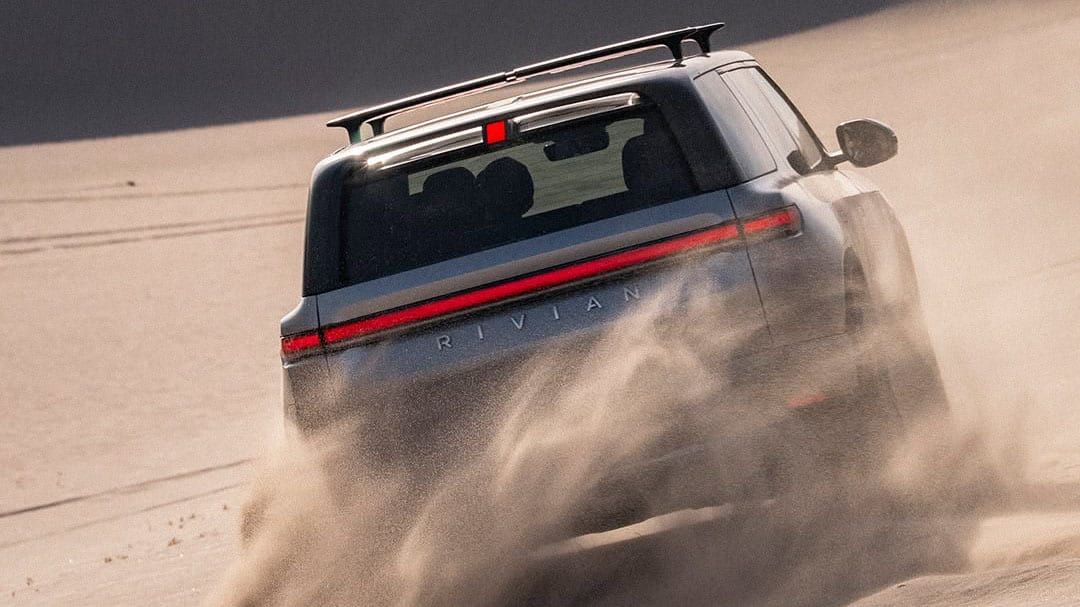

Rivian shares fell as much as 7.70% in early trading on Friday, touching $15.97 within the first half hour, as the months-long delay of the R2’s cheaper Premium variant outweighed a second-quarter beat and a wave of price-target increases across Wall Street.
After beginning deliveries to external customers of the Performance variant in early June, the company founded and led by RJ Scaringe had previously announced “late 2026” for the Premium trim.
The stock’s reversal was sharp.
Rivian shares had climbed as high as $17.72 in Thursday’s extended session after Rivian narrowed its adjusted EBITDA loss to $379 million, its smallest since early 2025, and improved full-year loss and spending guidance.
The stock opened Friday at $17.01, up from Thursday’s $16.83 close — then surrendered the gain and more, sliding roughly 6.1% from the open by 10 a.m. ET on volume of 9.4 million shares, already above a quarter of its full-day three-month average.
Since the $17.32 high reached during the conference call, the stock has declined 12.36% to the $15.53 level seen at 10:17 Eastern time.
At the morning low, the move erased about $1.9 billion in market value from Thursday’s close.
Rivian shares are down about 20.9% year to date and up 26.0% over the last twelve months.
What Moved the Stock
The selling gathered as investors worked through the call’s implications, chief among them the timeline chief executive RJ Scaringe walked back on Thursday.
The Dual-Motor R2 Premium, promised at $53,990 for late 2026 since the model’s March launch, now arrives with the Standard trims “as we look at early 2027.”
The consequence is concentration.
This year’s targeted 20,000 to 25,000 R2 deliveries will consist almost entirely of the $57,990 Performance Launch Edition — and the year’s delivery math was already back-loaded before the trim slipped.
CFO Claire McDonough told analysts the guidance implies approximately 42,400 to 47,400 second-half deliveries, “weighted towards the fourth quarter as we ramp R2.”
At the same time, Chief Operations Officer Javier Varela said the second production shift, due by the end of September, will contribute no material volume until the fourth quarter.
The delay also lands on a launch already generating friction.
Five separate quality issues surfaced in the R2’s first 47 days of customer deliveries — spanning paint, exterior lighting software, the high-voltage battery, charging hardware and cabin components.
EV exclusively reported this week that the lapses trace to the October 2025 layoffs: the restructuring, which cut more than 600 jobs, dismantled the vehicle operations organization responsible for pre-delivery inspections, a person familiar with the matter said.
Nine days after R2 deliveries began, Rivian cut more than 300 further jobs from the service organization those duties had been folded into.
Rivian has since disputed the delay, telling EV the Premium trim remains on track to become available in late 2026 — with “available” covering the start of customer orders and initial deliveries.
The company’s full statements, and how they sit against the chief executive’s four references to 2027 on the call, are detailed here.
Why a Trim Moves a $23B Stock
The R2 is not one model among several — it is the volume thesis the company is valued on.
Rivian has guided R1 and commercial van volumes to stay roughly flat with 2025’s 42,247 units, making the R2 the sole source of growth, and the Normal plant’s 215,000-unit capacity reserves up to 155,000 slots for it, with Georgia adding 300,000 more from 2028.
The profitability case runs through the same vehicle: McDonough reaffirmed that the R2 will reach positive gross profit as part of the 2026 exit rate — the fixed-cost leverage the company has pointed to since withdrawing its 2027 profitability target without offering a replacement date.
The delayed trims are where the mass market lives.
The Premium at $53,990 and the Standard versions at $48,490 and $44,990 are the configurations that carry the R2 from a $58,000 halo car toward the $45,000 promise made at the model’s unveil — and Rivian itself says waiting for a different build is by far the top reason reservation holders have not yet converted.
The delay defers exactly the demand the company says is queued.
Scaringe has put the stakes in his own words: “If R2 doesn’t go well, the whole company is not designed properly,” he said at the Aspen Ideas Festival in early July.
Cantor calls R2 deliveries the most material catalyst for the company, and Needham this month called the R2 the first legitimate competition to Tesla’s Model Y.
Targets Up, Stock Down
The decline came against a uniformly friendlier sell side.
TD Cowen’s Itay Michaeli — whose question on the call drew the trim-timing answer — raised his target to $21 from $20 with a Buy rating.
Wells Fargo’s Colin Langan lifted his to $16 from $15 at Equal Weight, RBC Capital’s Tom Narayan to $16 from $14 at Sector Perform, and Morgan Stanley’s Andrew Percoco to $14 from $13 while staying at Underweight.
Cantor Fitzgerald’s Andres Sheppard held his Neutral rating and $19 target in a Friday note, modeling roughly 18,228 third-quarter deliveries — arithmetic that leaves about 26,700 vehicles for the final quarter, roughly 70% above Rivian‘s best quarter on record.
What the Beat Bought
Thursday’s results gave the bulls their case: revenue of $1.658 billion came in just above the company’s own pre-announced range, gross profit reached $179 million.
Rivian trimmed its full-year adjusted EBITDA loss guidance to $1.8 billion to $2.0 billion while cutting capital expenditure guidance by $250 million at the midpoint, holding the delivery range raised on 2 July.
The market’s Friday answer is that the second half now has to deliver it.
The shares remain above their 52-week low of $11.57, and well below the $22.69 high — with the next scheduled catalyst the third-quarter delivery pre-announcement expected in the second day of October.